Predictive Solar Farm Energy Production
The client needed a predictive engine that could process multiple interacting variables (weather, seasonality, equipment conditions) without succumbing to high variance or overfitting.
- Client
- Vok
- Timeline
- 1 Week
- Services
- AI/ML Automation
01 · Challenge
Predicting solar output is not a straightforward calculation. The client faced several analytical challenges:
Complex Interactions: Environmental factors interact in non-linear ways (e.g., the impact of cloud cover varies heavily depending on base solar irradiance).
Extreme Weather Outliers: Sudden storms or extreme heat waves skewed traditional linear models.
Overfitting Risks: Previous attempts using single Decision Trees memorized the training data but failed to generalize to unseen weather patterns.
02 · Goal
I engineered an Advanced Predictive Forecasting System using a Random Forest Regressor. By leveraging an ensemble of decision trees, the model effectively captured non-linear relationships and mitigated the risk of overfitting caused by extreme weather days.
Workflow Overview:
Data Processing & Aggregation:
Ingested 365 days of operational data encompassing 10 distinct features, including Solar Irradiance, Panel Temperature, Cloud Cover, Humidity, and Dust Accumulation.
Exploratory Data Analysis (EDA):
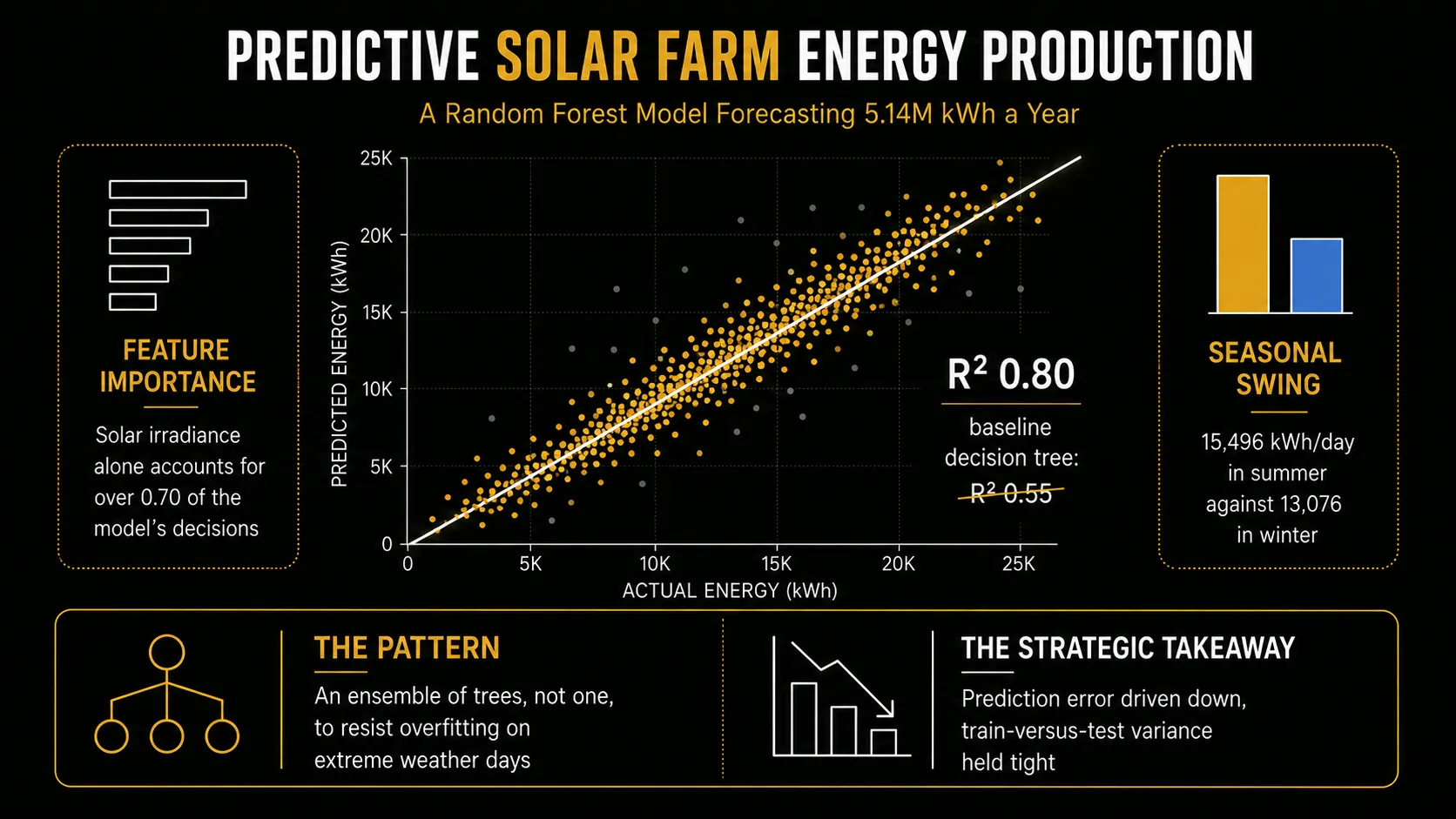
Conducted seasonal analysis and correlation mapping. Identified that Summer yielded the highest average production (15,496 kWh/day) while Winter yielded the lowest (13,076 kWh/day).
Model Training & Optimization:
Trained a baseline Decision Tree alongside default and optimized Random Forest models.
Utilized Scikit-Learn to tune hyperparameters, ensuring the model focused on generalized patterns rather than noise.
Feature Importance Extraction:
Analyzed the internal nodes of the Random Forest to extract a hierarchy of production drivers, providing the client with actionable operational insights.
03 · Result
The Random Forest model successfully learned the complex environmental dynamics of the 5.14M kWh annual production cycle:
Superior Predictive Power: The optimized Random Forest achieved a test $R^2$ score of ~0.80, drastically outperforming the baseline Decision Tree ($R^2$ ~0.55).
Reduced Prediction Error: The Root Mean Squared Error (RMSE) was significantly lowered, meaning the daily kWh forecasts were reliably closer to the actual output.
Eliminated Overfitting: The train-vs-test variance was strictly controlled. The model proved robust against weather outliers.
Key Drivers Identified: The feature importance analysis mathematically proved that Solar Irradiance is the overwhelming primary driver of production (>0.70 importance score), validating that factors like wind speed and humidity are largely negligible by comparison.
Gallery
Related insights
The thinking behind the system.
-
Claude Code in Production: Build Apps Without Vibe Coding
Use Claude Code in production with a one-page PRD, vertical task slices, test gates, and release checks. A practical app-build workflow.
Read article → -
Marketing System Build: Keeping Strategy Alive Through Delivery
A case study of the 19-document marketing system I built to carry strategy, research, and brand rules from intake to published content.
Read article → -
Claude Code for Small Business: What the Enterprise Case Studies Don't Show You
Enterprise Claude Code case studies come from Datadog and Rakuten. Here's what actually changes when a small team runs it instead.
Read article →