Claude Code for Small Business: What the Enterprise Case Studies Don't Show You
Enterprise Claude Code case studies come from Datadog and Rakuten. Here's what actually changes when a small team runs it instead.
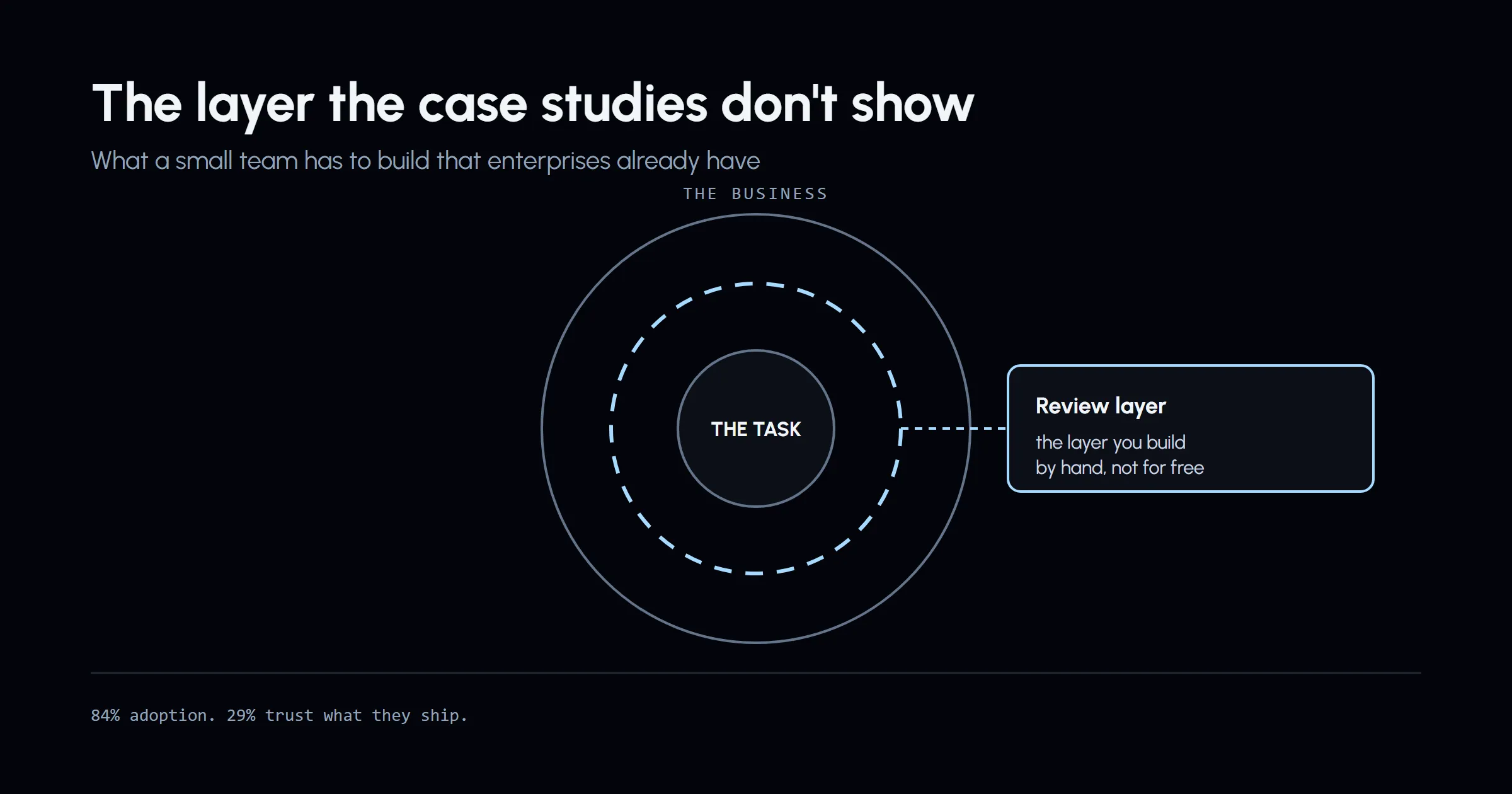
Every Claude Code case study I can find has a household enterprise name attached to it. A 1,100-person legal team. A company shipping AI features to millions of customers. I run automation for a business a fraction of the size of any single department at those companies, and not one of those write-ups tells me what changes when there’s no dedicated platform team behind the agent.
Here’s the honest read after digging through the actual case studies instead of the headlines: enterprise adoption of agentic AI is real and accelerating fast, but almost every public example is published by, or in direct partnership with, the vendor whose tool it showcases, and small-scale, non-enterprise use is barely documented at all. That gap matters more than the case studies themselves, because it’s where most businesses actually operate.
What the enterprise case studies actually say
ABC Legal rolled Claude out to all 1,100 of its employees, not just its engineers, turning legal-services staff into people who build their own automations for document delivery and eFiling. Datadog now attributes at least two-thirds of its AI-generated code to Claude Code, using it for bug fixes, custom internal tooling, and large-scale refactors inside a codebase that has to stay production-stable. Rakuten has been building agents with Claude since early 2025 and now uses them across business functions serving millions of customers. Indicium AI, an AI services firm, reports efficiency gains as high as 70 to 75 percent for enterprise clients across financial services, healthcare, and manufacturing, though that number comes from the vendor doing the implementation, not an independent audit, so it belongs in the room as a claim, not a fact.
Zoom out and the pattern holds: over 80 percent of enterprises are projected to run agentic AI in some production capacity by the end of 2026, and 84 percent of developers already use an AI coding tool day to day. The same survey behind that 84 percent found only 29 percent of developers fully trust the code they ship from it. That trust gap is the part every enterprise write-up glosses over, and it’s the part that actually determines whether any of this works at your size.
Enterprise pattern vs. small-team reality
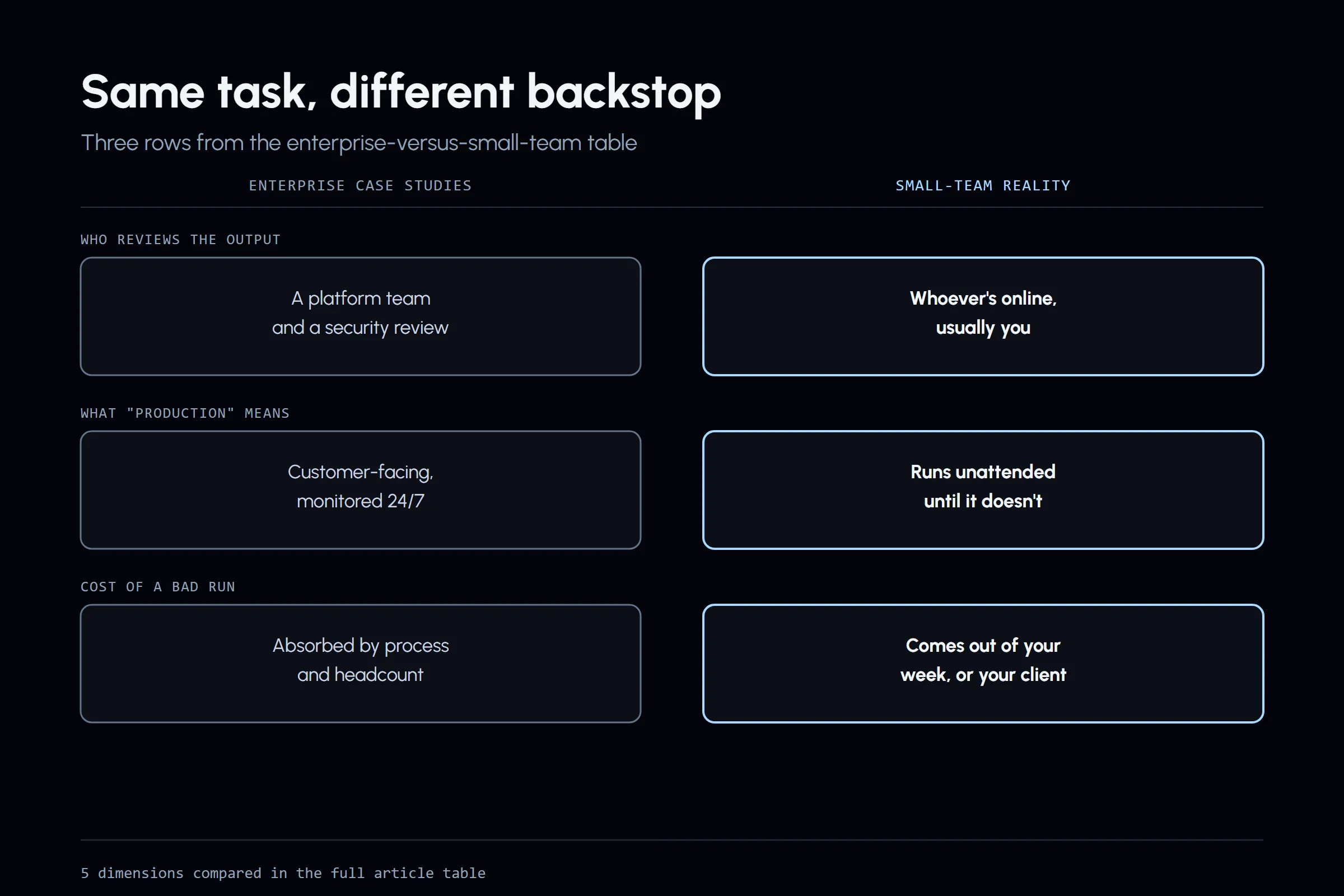 Same task, a very different backstop.
| Enterprise case studies | Small-team reality | |
|---|---|---|
| Who reviews the output | A platform team, a security review, sometimes a whole AI governance function | Whoever’s online, usually you |
| What “production” means | Customer-facing systems at scale, monitored 24/7 | A workflow that runs unattended until it doesn’t |
| Cost of a bad run | Absorbed by process and headcount built for exactly this | Comes straight out of your week, or your client relationship |
| What gets automated first | Narrow, well-scoped internal tooling with a team already reviewing it | Whatever’s eating the most hours, often the least scoped task in the business |
| How trust gets built | Formal evaluation pipelines, staged rollouts | You watching it closely for the first ten runs, then loosening the leash |
Why the small-scale version never gets written
Case studies are marketing artifacts before they’re evidence. Anthropic publishes Datadog and Rakuten because those names carry credibility and both companies have comms teams whose job includes agreeing to the interview. A five-person team running the same pattern internally has no comms team, no incentive to publish, and often no idea their setup would even count as a case study. The absence of small-business examples isn’t proof agentic AI doesn’t work at that scale. It’s proof that the people running it at that scale are busy running it, not writing about it. Anthropic’s own analysis of roughly 400,000 real Claude Code sessions found effective human-AI collaboration across ordinary coding work, which is closer to independent signal than a named customer story, and it still doesn’t break small operators out separately.
The trust gap nobody enterprise-side has to close the same way
Twenty-nine percent trust is a strange number to build a business function on, and Datadog and Rakuten can absorb that uncertainty because a bad output gets caught by a review layer that exists whether or not AI wrote the code. At small scale, that review layer is you, on your own time, and it doesn’t scale the way a platform team does. The fix isn’t more trust in the model. It’s scoping the task down until a wrong output is cheap to catch: narrow the agent to one job, keep a human on anything client-facing or financial, and treat the output like a fast, slightly overconfident junior rather than a decision-maker. That’s the actual shape of my own setup, and I’ve written the full walkthrough of the guardrails that make it safe to leave running unattended in the case study that follows this one.
What actually transfers down, and what doesn’t
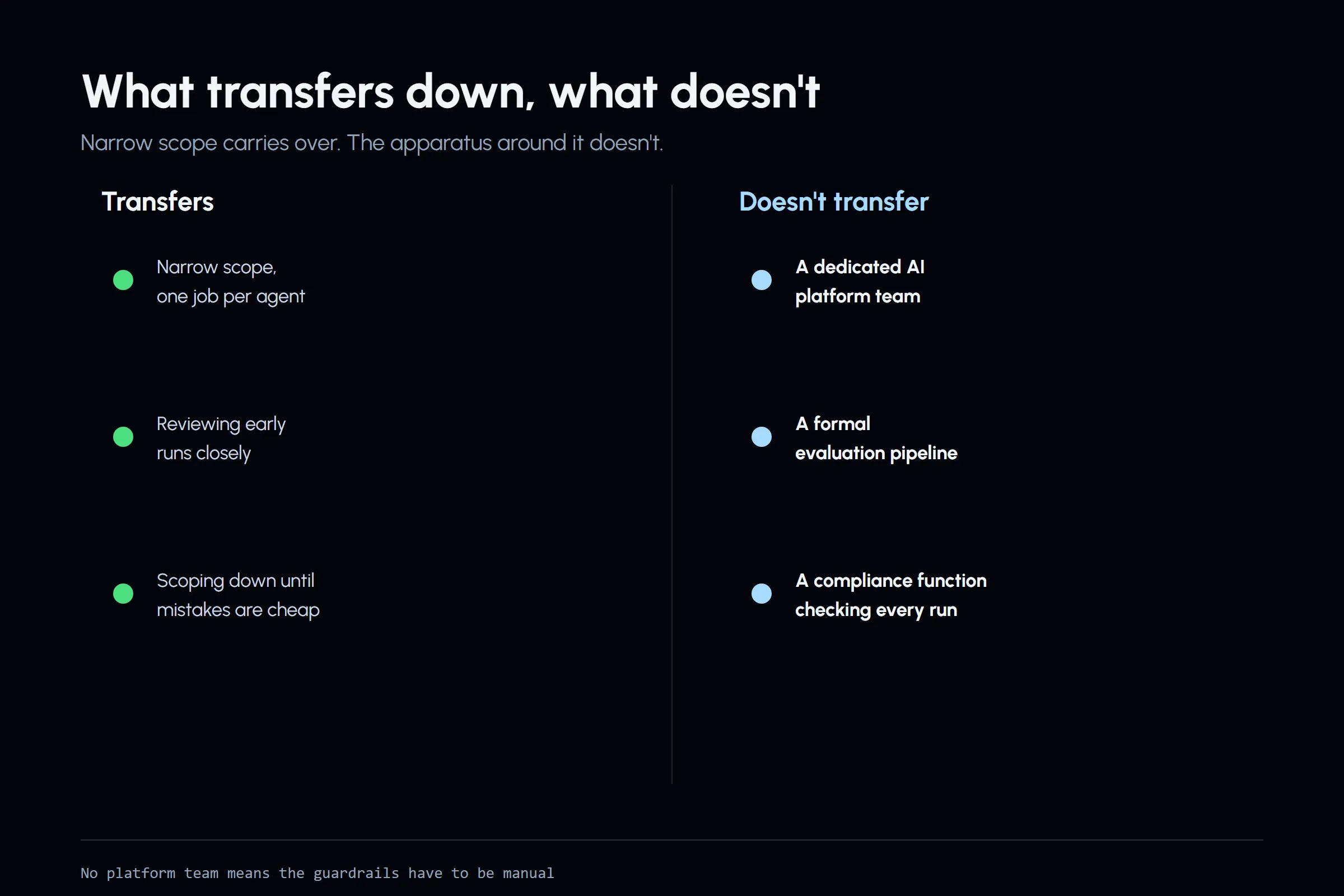 Narrow scope carries over. The apparatus around it doesn’t.
The pattern that transfers is narrow scope: one agent, one job, reviewed until you trust it, exactly what ABC Legal did rolling out task-specific automations rather than one general-purpose agent for everything. What doesn’t transfer is the apparatus around it. You will not have a dedicated AI platform team, a formal evaluation pipeline, or a compliance function checking every run, so whatever guardrails a review team would normally provide, you have to build into the workflow itself: hard limits on what it can touch, a ceiling on what it’s allowed to cost, and a log of what it actually did. Skip that step because you’re small and the enterprise case studies never had to write about it, and the first expensive mistake teaches it to you the hard way instead.
Frequently asked questions
Is Claude Code only useful for large engineering teams?
No, but almost all of the public documentation is written from that vantage point. The pattern that works, one agent scoped to one job with a human reviewing early runs, applies at any size. What’s missing at small scale is the review infrastructure enterprises already have, which you have to build yourself instead of skip.
What percentage of businesses are actually using agentic AI in production?
Industry projections put enterprise adoption above 80 percent by the end of 2026, and 84 percent of developers already use an AI coding tool. Neither figure breaks out small businesses or non-engineering functions separately, which is exactly the reporting gap this piece is about.
Can a solo founder or small team run Claude Code the way Datadog does?
Not the same way, no. Datadog has two-thirds of its AI-generated code reviewed inside an existing engineering process built for exactly that. A small team has to substitute deliberate scoping and manual guardrails for the review layer it doesn’t have.
What’s the biggest risk of using Claude Code for real business operations, not just coding?
An agent doing something expensive or irreversible while nobody’s watching, because a small operation doesn’t have the review layer that catches it before it ships. Hard limits on cost, scope, and what it’s allowed to touch matter more than how capable the model is.
Do I need a dedicated AI team to adopt this?
No, but a dedicated AI team’s job doesn’t disappear when you’re a team of one. It just becomes your job, done manually: reviewing early runs, setting hard limits, and logging what actually happened.
The gap worth building into
The enterprise case studies prove agentic AI works at scale. They were never built to show what it costs, or looks like, at a hundredth of that scale, because the companies writing them don’t operate there. That gap is exactly where small operators need to build their own evidence, one scoped task and one guardrail at a time, instead of waiting for a case study that matches their size to show up.
Newsletter
New notes, in your inbox.
Get each new article from the workbench by email. No spam, unsubscribe anytime.
Related reading
Continue through the system.
-
Claude Code in Production: Build Apps Without Vibe Coding
Use Claude Code in production with a one-page PRD, vertical task slices, test gates, and release checks. A practical app-build workflow.
Read article → -
Sprinting the Frontier: Reviewing and Comparing Opus 5.5, Sonnet 5.5, GPT-6.1 Sol, and GPT-6 Astra
Compare Opus 5.5, Sonnet 5.5, GPT-6.1 Sol, and GPT-6 Astra on real work, pricing, benchmark limits, and cost per accepted result.
Read article → -
Codex vs Claude Code: pick by task type, not the benchmark
Codex and Claude Code now score within a point of each other on SWE-bench. Three real-task tests show what actually decides it instead.
Read article →