Sprinting the Frontier: Reviewing and Comparing Opus 5.5, Sonnet 5.5, GPT-6.1 Sol, and GPT-6 Astra
Compare Opus 5.5, Sonnet 5.5, GPT-6.1 Sol, and GPT-6 Astra on real work, pricing, benchmark limits, and cost per accepted result.
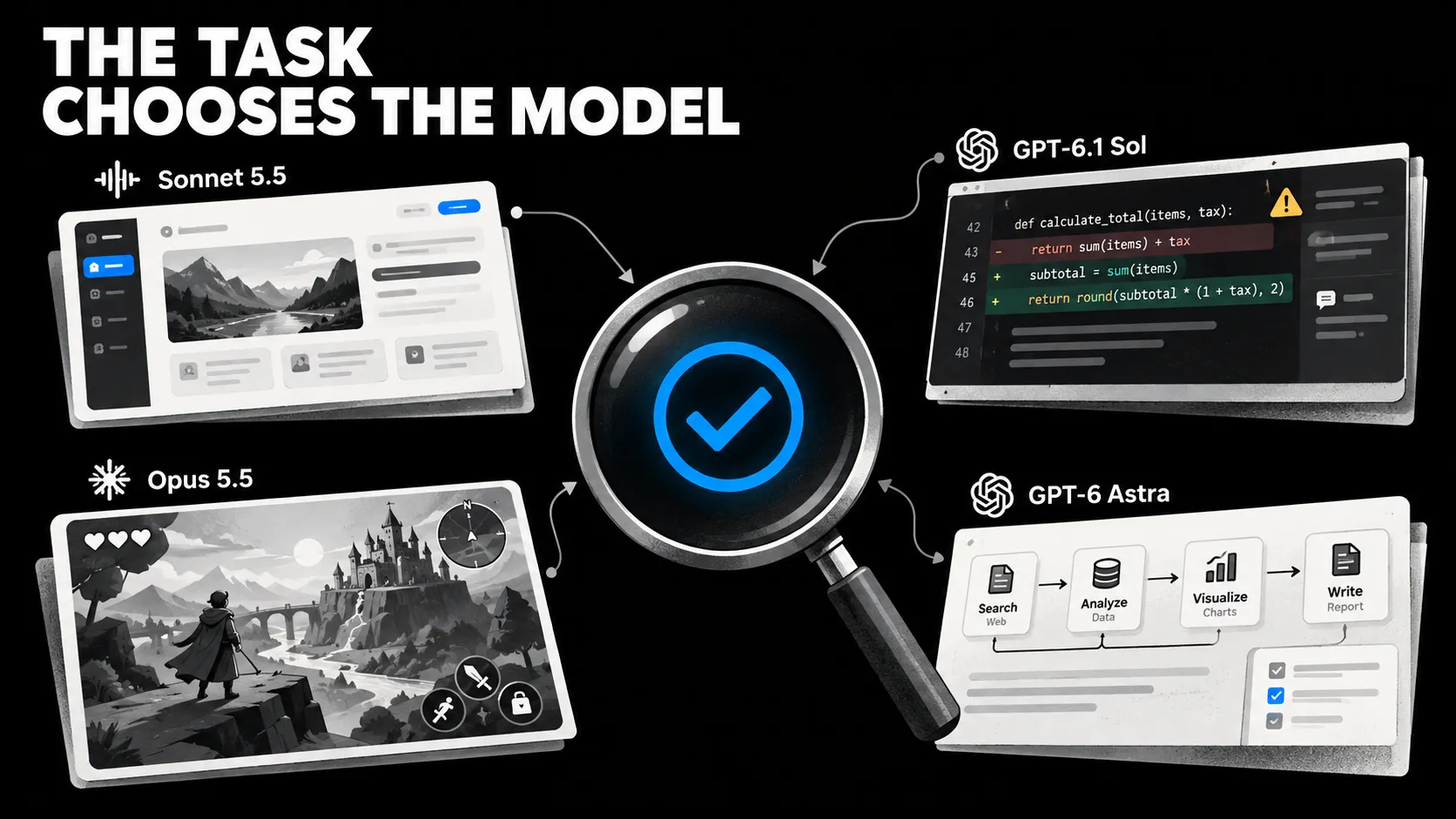
I can swap the model behind a workflow in minutes. I cannot recover the same minutes when that swap quietly changes a customer-facing result, a codebase, or a published article. Four major releases arriving within weeks make model selection feel like a race. I think the winning move is to slow one part down: the test that decides what ships.
My starting choices are Claude Sonnet 5.5 for well-scoped, repeatable work; GPT-6.1 Sol as a direct challenger at the same standard input and output token rates; and Claude Opus 5.5 or GPT-6 Astra for the ambiguous jobs where a wrong decision costs more than the model call. These are test priorities, not claims that I have run a controlled four-model benchmark. A leaderboard cannot tell me which model preserves my constraints, fixes its own mistake, and leaves a result I can actually use.
What changed in this four-model wave?
The change is the shape of the tradeoff. Anthropic describes Sonnet 5.5 as its faster complement for bounded tasks, and Opus 5.5 as the stronger option for sprawling work. OpenAI positions GPT-6.1 Sol near Astra on several complex tasks at one-fifth of Astra’s standard input and output token prices, while Astra remains its flagship for demanding end-to-end work. Those are vendor positions, not my measured outcomes.
The rates below are standard API prices per one million input and output tokens, checked against the providers’ release pages on October 5, 2026. They exclude caching, tools, special speed tiers, retries, and human review.
| Model | Standard input / output | First workload I would test | Main reason to escalate or reject |
|---|---|---|---|
| Claude Sonnet 5.5 | $2 / $10 | Scoped bug fixes, document production, repeatable agent steps | Escalate when the task crosses too many uncertain decisions. |
| GPT-6.1 Sol | $2 / $10 | Coding, computer use, and multi-step work with measurable acceptance checks | Reject if a low token bill hides repeated retries or manual repair. |
| Claude Opus 5.5 | $4 / $20 | Architecture, large migrations, difficult review | Reject if its added judgment does not improve the accepted result. |
| GPT-6 Astra | $10 / $50 | High-stakes, ambiguous, cross-tool execution | Reject when a cheaper model passes the same gate reliably. |
Sonnet and Sol have the same headline input and output rates, but not the same total cost. Anthropic lists a $0.20 cache-read rate for Sonnet 5.5; OpenAI lists $0.10 cached input for Sol 6.1. A workflow that repeatedly reuses a large brief can magnify that difference. A workflow that needs retries can erase it. Price the completed job, not the token line.
Which model would I start with for real work?
I would start with the cheapest model that can meet the job’s acceptance test, then escalate by failure type. Sonnet 5.5 and Sol 6.1 are the serious first-round candidates for most bounded production work. Opus 5.5 and Astra 6 enter when the cheaper candidates cannot handle ambiguity, long context, or a consequential handoff without help. This is a routing rule, not a universal ranking.
For a small website feature, I would give Sonnet and Sol the same brief, repository state, time budget, and browser test. For a codebase-wide change, Opus deserves a run because Anthropic specifically reports gains on long, sprawling migrations. Astra deserves one when the job combines code, browser actions, research, and decisions that cannot be reduced to a neat checklist. Both top-tier models still need boundaries and human review. More autonomy increases the cost of a misunderstood instruction.
Creative work needs an artifact test
The exception is a creative task whose quality cannot be captured by a unit test. I built a Reel Engine that connects a scene plan, voiceover, word-level captions, animation, and final render. If a model revises the script but the spoken words and captions drift apart, the text answer may look excellent while the video fails. I would test the final render, not reward the model for describing a good one. I made the same point in my Opus 5.5 creator-workflow review. I have not run all four models through that pipeline, so I will not pretend to know the winner.
Why do the public leaderboards disagree?
They often measure different systems, not just different models. Effort level, fallback behavior, tool access, prompt, harness, and scoring rule can change the result. A vendor’s best reported number from one setup is not automatically comparable with another vendor’s best number from another setup. Even a neutral index is a useful shortlist, not a substitute for your own workload.
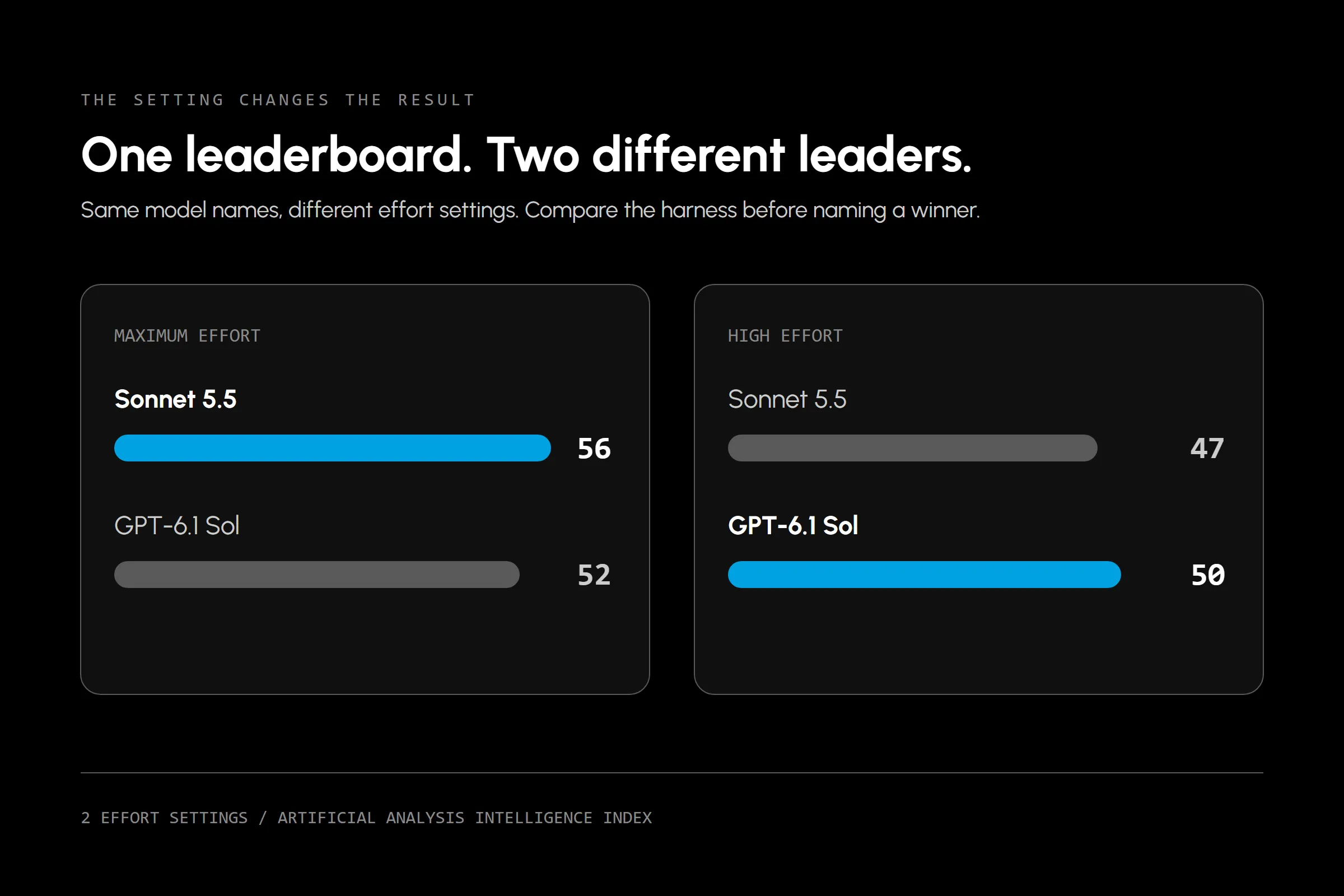
One concrete example: Artificial Analysis’s release comparison shows Sonnet 5.5 ahead of GPT-6.1 Sol at the highest listed effort variants, 56 to 52 on its Intelligence Index. At high-effort variants, its direct comparison shows Sol ahead, 50 to 47. That is not a contradiction. It is evidence that a model name without a setting is an incomplete specification. Artificial Analysis also defines cost per task using the tokens consumed across its benchmark mix, not just posted token rates. Its workload mix may not match yours.
The score hides its harness
Anthropic makes the same caution visible in its Opus 5.5 benchmark notes: some cross-vendor scores use different reported efforts, and some runs involve production safeguards or fallback models. OpenAI also notes that its evaluations may differ from production products because prompts and tools differ. I would use these pages to decide what to test, not to publish a four-column victory chart.
How would I run a fair comparison in one week?
I would run a small, locked task set that reflects the work I actually ship. Give each model the same input files, tools, permissions, time limit, and definition of done. Record its exact version and effort setting. Run each task more than once when failure is expensive or results vary. Then score the artifact after an independent check, not the model’s own completion message.
My first task set would include:
- A scoped bug fix: reproduce the failure, edit the smallest relevant code, run tests, and show the diff.
- A cross-tool publishing job: add a prepared article, build the site, inspect the live index and article, and verify the image URLs before marking it published.
- A fragile creative edit: change one Reel Engine scene, regenerate captions and audio alignment, render, and inspect the playback.
What could I build with each model?
The projects below are assignments I would test, not a claim that I have built and compared all four. The right model still depends on the brief, the tools it can use, and how much review the result needs.
Claude Sonnet 5.5: polished work with a clear finish line
I would use Sonnet to build a small dashboard feature, fix a reproducible UI bug, or turn a weekly KPI export into a client-ready deck. Anthropic positions it for scoped everyday work, bug fixes, and polished documents. Tip: provide the existing design system or slide template, name the files it may change, and give it a visual acceptance check. Start at a moderate effort setting, then raise it only if the task actually needs deeper reasoning.
To see how far someone pushed it, one creator gave six Sonnet 5.5 agents a single brief to make a browser kart racer. They reported a 67-minute run that produced four tracks, eight racers, bots, items, and drift boosts, with a playable build. The useful lesson is not “one prompt makes a finished game.” It is that parallel agents can cover distinct subsystems, while the human still has to judge playability, originality, and polish.
GPT-6.1 Sol: repeatable code and tool-driven workflows
I would test Sol on a website QA assistant that opens key pages, checks forms and links, files reproducible bugs, and proposes small fixes. That combines the coding and computer-use work OpenAI highlights for Sol. Tip: give it a fixed checklist and structured output: URL, expected behavior, observed behavior, evidence, and severity. Keep write access narrow. A browser run that reports “done” without showing the page state has not passed.
A more ambitious build is Crowd Rush, a playable 3D browser runner credited to GPT-6.1 Sol. Its creator shows the brief and a later revision prompt; the current game has a 30-course campaign, regional hazards, upgrades, saved progress, and a leaderboard. That is a better reference than a static screenshot because a reader can try the controls and progression. The model credit and build history are creator-reported, not an independent audit.
Claude Opus 5.5: architecture and messy migrations
I would give Opus a legacy app migration, a tangled integration redesign, or a security-sensitive architecture review before assigning implementation slices to a faster model. Anthropic describes Opus as stronger on complex, open-ended work that needs sustained judgment. Tip: ask first for a dependency map, failure modes, and a staged plan. Approve the plan before code changes, then require tests and a reviewable diff at each stage.
The creator of Chainmate used Opus 5.5 in Claude Code to build a Godot chess roguelite. The original build account says the model wrote the game, generated its 3D pieces and audio in code, and handled tests and builds after four art-direction images and brief lighting feedback. Its browser demo is playable. This is a striking example of coordinating mechanics, assets, and release work, but it is a creator account, not proof that Opus will complete any game unattended.
GPT-6 Astra: supervised end-to-end projects
I would test Astra on a cross-tool launch workflow: research an offer, draft the page, update the site, run browser checks, and prepare a publish report. OpenAI presents Astra as its flagship for demanding, multi-step work across tools. Tip: separate reversible work from external actions. Let it draft and test autonomously, but require approval before publishing, emailing, or changing live data. Have it return links and screenshots of the final artifacts, not just a completion summary.
For a different kind of stress test, a creator reported letting Astra Max work in Blender for about seven hours. The result shown in their renders was an articulated tractor with more than 3,000 parts and 100 callable animations. The creator says it used research images, command-line Blender work, and several modeling and texture passes. I would take the process lesson, not the part count as a benchmark: long creative jobs need references, checkpoints, and inspection of the actual artifact.
These examples show what motivated builders attempted, not a controlled ranking. None fixes the test harness, budget, human input, or definition of done across all four models.
Should a team use one frontier model or route between them?
Route only after the task categories are stable enough to measure. A single model keeps prompts, monitoring, and debugging simple. Add a second model when a recurring class of work demonstrably benefits from it. Otherwise the routing layer becomes another system to maintain, and nobody can explain why a particular output came from a particular model.
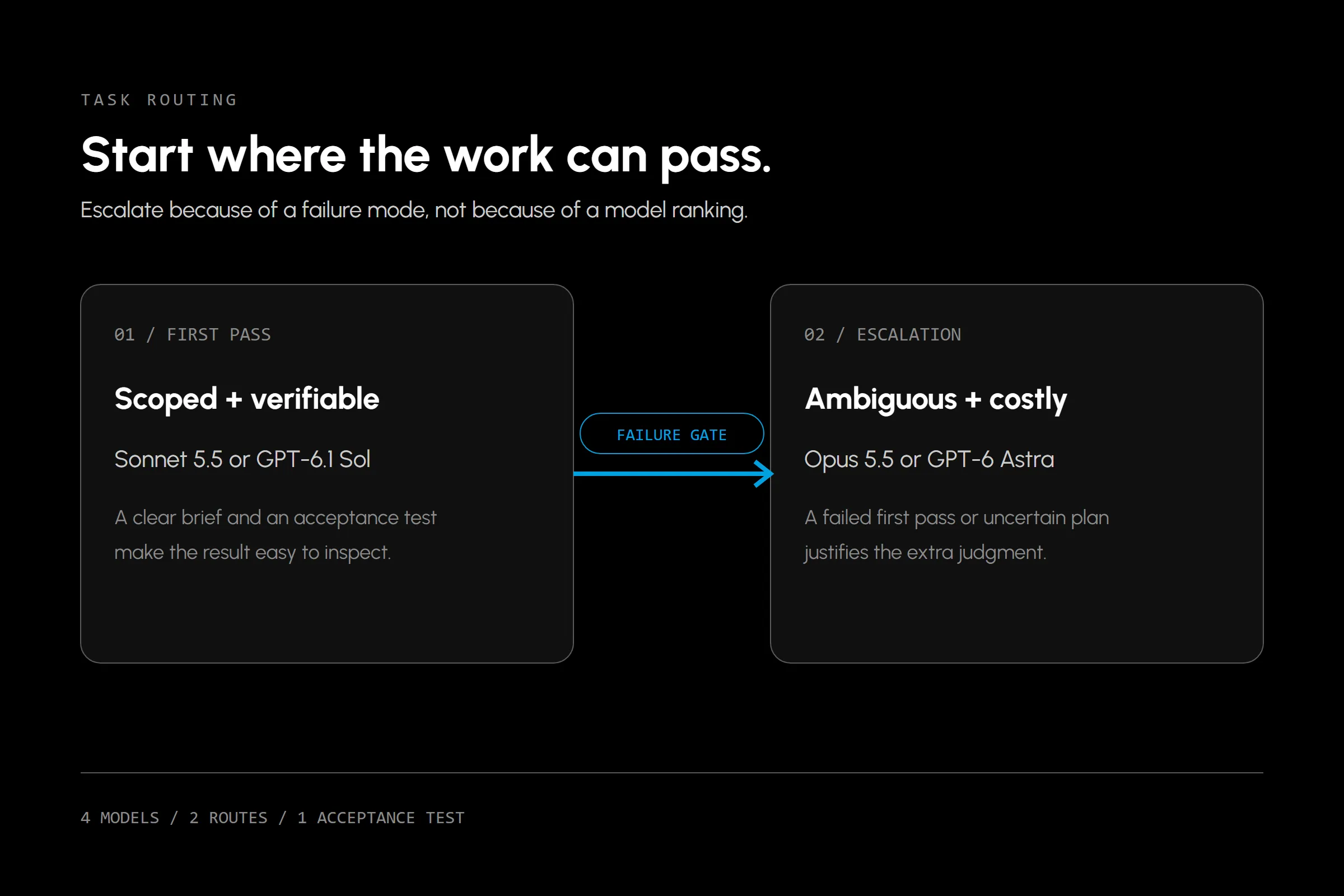
My provisional policy is simple: Sonnet 5.5 or Sol 6.1 for routine, verifiable execution; Opus 5.5 or Astra 6 for a failed first pass, an uncertain plan, or a costly handoff. Keep the input contract and acceptance test fixed. If the top-tier model still misses the same requirement, rewrite the task or the system boundary before buying more intelligence.
For a closer two-model example, my Sol versus Astra shootout framework focuses on accepted results rather than token price alone.
FAQ
Is GPT-6.1 Sol better than Claude Sonnet 5.5?
There is no task-independent winner. They share $2 input and $10 output rates per million tokens, but differ in caching and measured performance by effort setting. Test the exact workflow and settings you plan to run.
Is Opus 5.5 worth twice Sonnet 5.5’s token price?
Only when it raises the accepted-result rate enough to offset its higher standard input and output rates. Large migrations and ambiguous review are plausible candidates. Scoped, repeatable steps are not an automatic Opus job.
When should I pay for GPT-6 Astra?
When a consequential, multi-step task needs its additional judgment and a cheaper model fails the same acceptance gate. OpenAI calls it its strongest model, but that claim does not make it the economical default for every workflow.
Can one benchmark rank all four models fairly?
Not without fixing effort, prompts, tools, permissions, retries, and scoring. Independent indexes help shortlist candidates, but their workload weights and harnesses may differ from yours. Publish your test conditions with any ranking.
The actual frontier
The release cadence will keep accelerating. My evaluation method should not. The model is a replaceable component; the brief, boundaries, and acceptance test are the part I want to keep. Pick one real workflow this week, freeze its definition of done, and make all four models earn the right to run it.
Newsletter
New notes, in your inbox.
Get each new article from the workbench by email. No spam, unsubscribe anytime.
Related reading
Continue through the system.
-
GPT-6 Sol vs Astra: The Model Shootout That Matters
GPT-6 Sol vs Astra is a workload decision, not a leaderboard contest. Compare capability, speed, and cost, then run a fair shootout on your own tasks.
Read article → -
Claude Opus 5.5: What Creators Are Making
Claude Opus 5.5 is helping creators build games, videos, and interactive projects. Here is what changed, what examples show, and where review matters.
Read article → -
GPT-6 Astra Is a Capability Leap. The Workflow Is Still the Product.
GPT-6 Astra can carry more work across browsing, computer use, and creation. The advantage now comes from supervised creator and agent workflows.
Read article →