The 12-Question Marketing Brief That Ends Random Acts of Marketing
I stopped posting on mood and built a 12-question brief that turns one idea into a week of content in 2 to 4 hours.
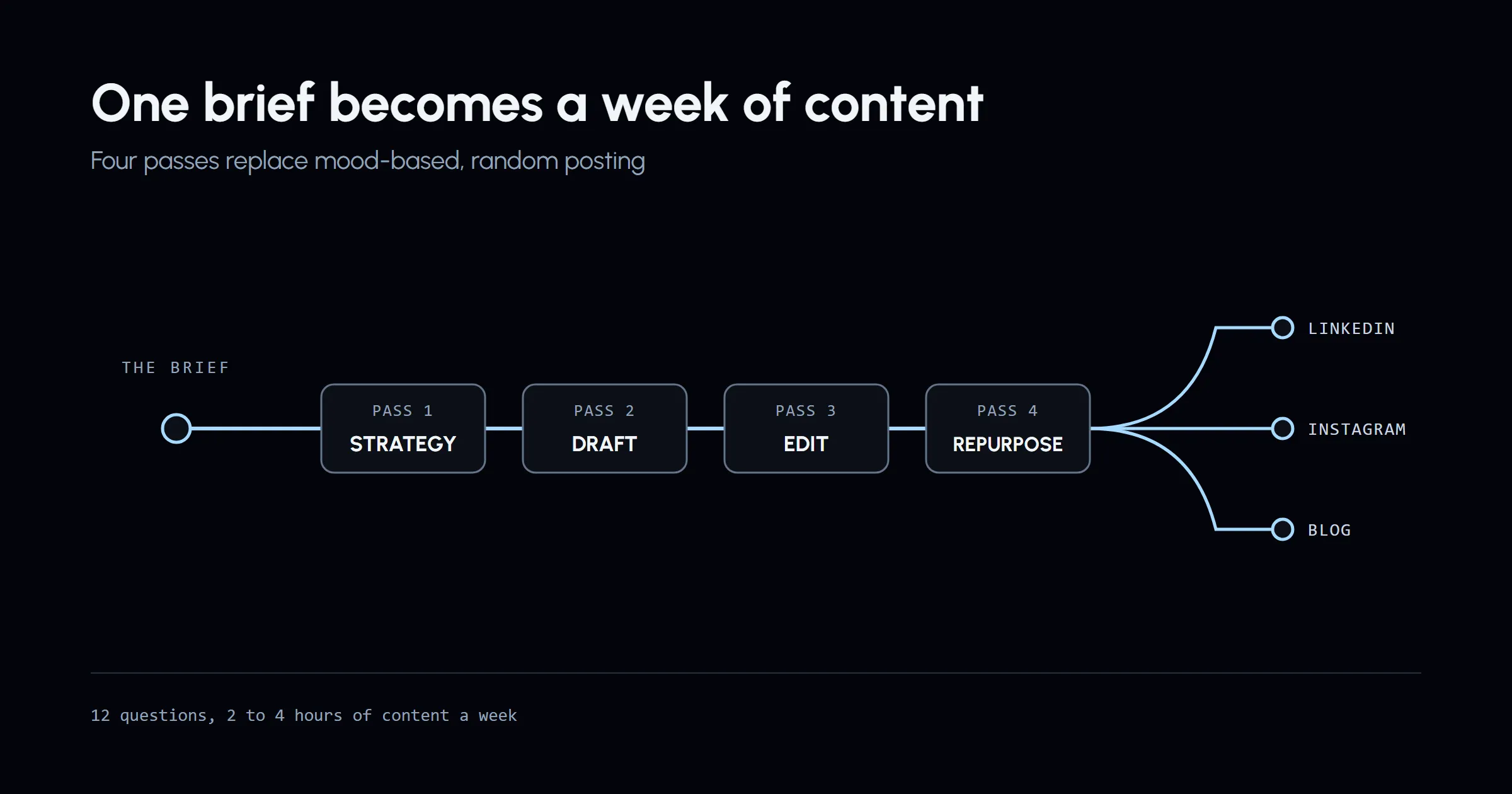
Eleven weeks ago I posted three times in one day because I finally had what felt like “content energy.” Then nothing went out for twelve days. That is not a content strategy. That is a mood, and moods do not compound.
Here’s what actually fixed it: one fixed brief, twelve questions, filled out once per idea, that then runs through four chained passes until it comes out the other side as a week of content across every channel I use. The brief itself takes 15 to 20 minutes. The four passes after it take another 2 to 4 hours a week, more if you’re repurposing into three or four channels instead of one.
Why “just post more consistently” doesn’t fix this
The standard advice for inconsistent posting is discipline: set a schedule, block the time, show up whether you feel like it or not. I tried that for about six weeks and it produced exactly as much random content as no schedule at all, just on a timer. The actual problem was never willpower. It was that every piece of content started from a blank page and a fresh decision about what it even was. A blank page with a deadline attached is still a blank page. What I needed was a fixed unit of work I could run the same way every time, so the only variable left was the idea itself.
The 12 questions, in the order I actually answer them
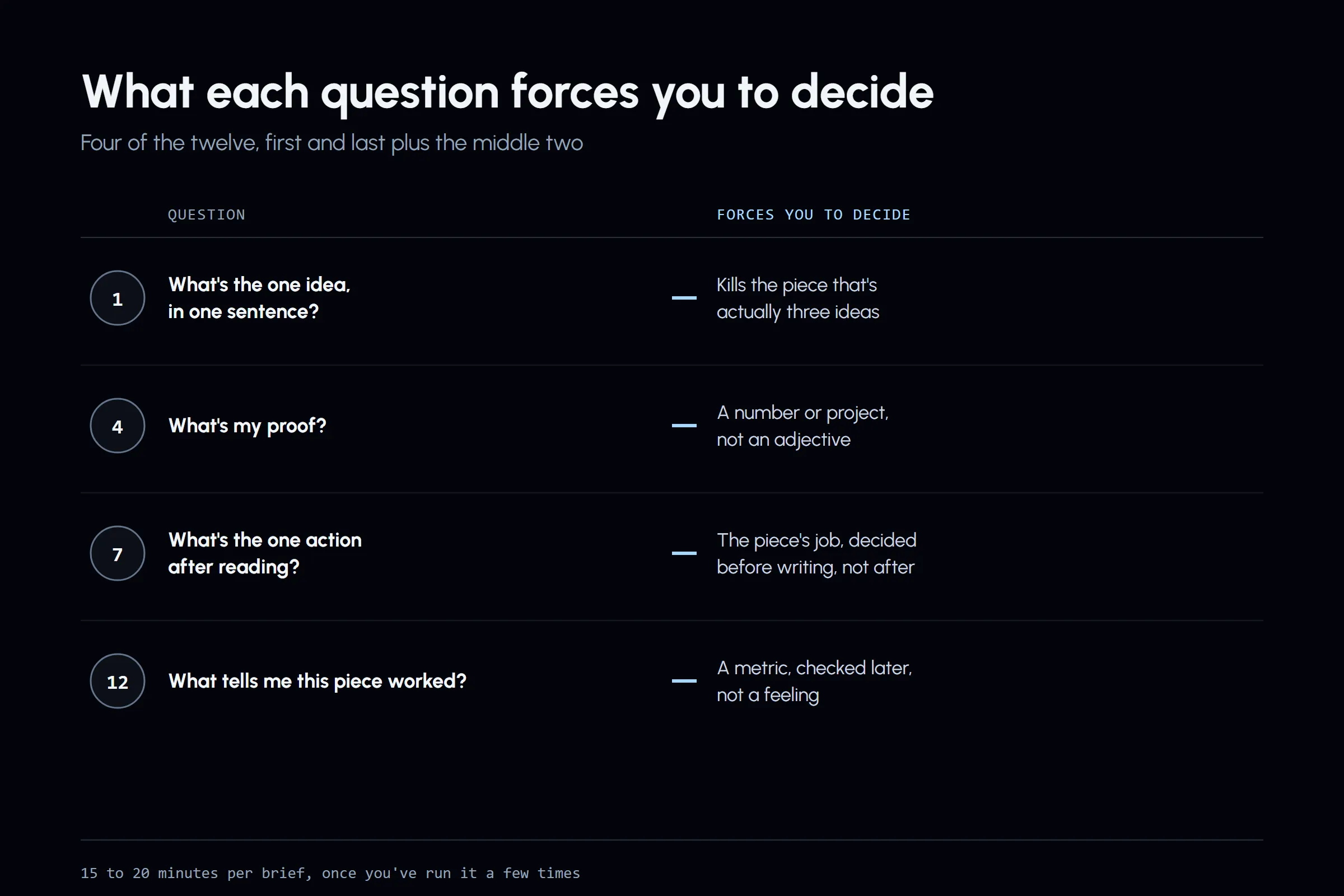 Four of the twelve, the ones that bookend the brief.
Each question forces one decision that would otherwise get made sloppily, halfway through drafting, when it’s most expensive to fix.
| # | Question | What it forces you to decide |
|---|---|---|
| 1 | What’s the one idea, in one sentence? | Kills the piece that’s actually three ideas wearing a trenchcoat |
| 2 | Who is this actually for, by name if you can? | Rules out “everyone,” which writes like no one |
| 3 | What do they currently believe that’s wrong? | The belief you’re pushing against, not a strawman |
| 4 | What’s my proof? | A number, a project, or a result you can point to, not an adjective |
| 5 | What do most people do instead, and why does it fail? | The contrast that makes your take worth reading |
| 6 | What breaks if the reader ignores this? | The stakes, so ignoring it has a real cost |
| 7 | What’s the one action they should take after reading? | The piece’s actual job, decided before you write it |
| 8 | Which platform gets the deep version, which gets the fast cut? | Format decided before drafting, not after |
| 9 | What’s the search intent or keyword this should own? | Whether anyone looking for this will find it |
| 10 | What existing piece does this extend or repurpose from? | Whether you’re building a cluster or a pile |
| 11 | What’s the strongest objection, and how do I answer it in the piece itself? | Pre-empts the comment that would’ve killed it anyway |
| 12 | What tells me this piece worked? | A specific metric, checked later, not a feeling |
Fifteen minutes on these twelve questions removes almost every editorial decision I used to make mid-draft, tired, at question six of “does this even matter.”
What happens after the brief: four passes, not one
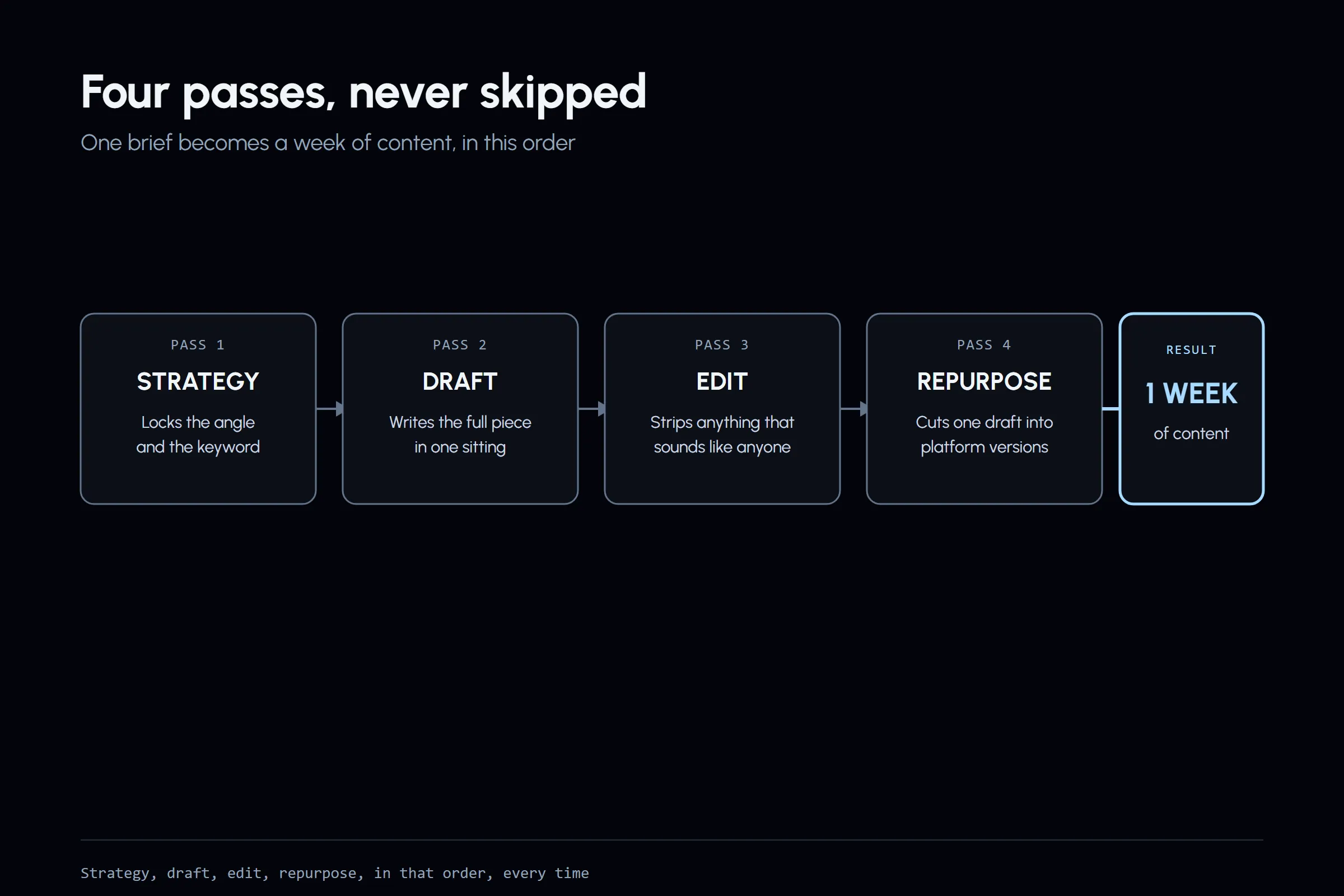 One brief, four passes, one week of content.
One finished brief doesn’t become one post. It becomes a week’s worth, because it moves through four separate passes and I don’t let myself skip the order.
A strategy pass takes the brief and locks the angle, the pillar it belongs to, and the keyword it’s trying to own, before a single sentence gets written. A draft pass writes the full piece in one sitting, in one voice, against that locked brief, so it isn’t re-deciding what the piece is about halfway through. An edit pass checks the structure and strips anything that reads like it could’ve been written by any agency about any topic, the sentence that sounds fine but says nothing specific. A repurposing pass takes the one finished draft and cuts it into the platform-native versions instead of copy-pasting the same paragraph everywhere with a shorter headline.
Four passes sounds like more overhead than one person dashing off a caption, and it is, by about twenty minutes. What it buys back is the eleven weeks I used to lose between usable ideas.
The mistake this brief is built to catch
Before I ran this, I wrote a post about a result I was proud of and left the actual number out because I didn’t want to stop and dig it up. It read like every other post claiming a win, and it got the engagement to match: none. Question four exists because of that one post. If I can’t answer it with a real number or a real project, the piece doesn’t get written yet. It gets parked until I have the proof, instead of shipped soft.
Frequently asked questions
Do I need software to run a system like this, or can I do it on paper?
The brief itself is twelve questions in a doc or a notebook, nothing more. The four passes are where automation helps, because a strategy pass, a draft pass, an edit pass, and a repurposing pass are four distinct types of thinking, and switching between them manually inside one sitting is where most people burn out and quit by week three.
How long does the brief actually take to fill out?
15 to 20 minutes once you’ve run it a few times. The first two or three take longer, closer to 30 minutes, because you’re still learning to answer question three, the wrong belief, without reaching for a strawman.
What if it’s just me, no tools to chain, just a document?
Run the four passes as four separate sessions instead of four automated steps: one sitting to lock the angle, one to draft, one to edit against the brief, one to cut it into platform versions. The order matters more than the tooling. Skipping straight from brief to finished draft is where the old bad habit creeps back in.
Does this work for repurposing old content, not just new ideas?
Yes, and question ten exists specifically for that. Run an old post back through the twelve questions and you’ll usually find the angle has aged, the proof is stronger now, or the objection you didn’t answer the first time is answerable now. That’s a new brief, not a rewrite.
What’s the biggest reason people abandon a system like this?
They skip the brief on the days they feel inspired, because it feels like it’s slowing down momentum. Those are exactly the days the finished piece turns out thinnest, because inspiration answered question one and nothing else.
The part that actually matters
The twelve questions I use aren’t the point. The point is having any fixed set you answer the same way every single time, so the only thing left to vary is the idea, not the process around it. If a different set of questions fits how you think, use those instead, write them down once, and stop rebuilding the brief from scratch every time you sit down. That’s the whole fix. Not more discipline. Fewer decisions per piece.
Newsletter
New notes, in your inbox.
Get each new article from the workbench by email. No spam, unsubscribe anytime.
Related reading
Continue through the system.
-
Marketing System Build: Keeping Strategy Alive Through Delivery
A case study of the 19-document marketing system I built to carry strategy, research, and brand rules from intake to published content.
Read article → -
88 Skills, 194 Decisions Logged, One AI System That Actually Runs My Business
I stopped chatting with AI and built it an operating system: 88 skills, a second brain, and 194 logged decisions.
Read article → -
How I Turn SMART Marketing Goals Into Weekly Targets With Claude Code
Use Claude Code to turn vague marketing goals into a measurable weekly system. Set one outcome, choose the right metric, and review it every Monday.
Read article →