Marketing System Build: Keeping Strategy Alive Through Delivery
A case study of the 19-document marketing system I built to carry strategy, research, and brand rules from intake to published content.
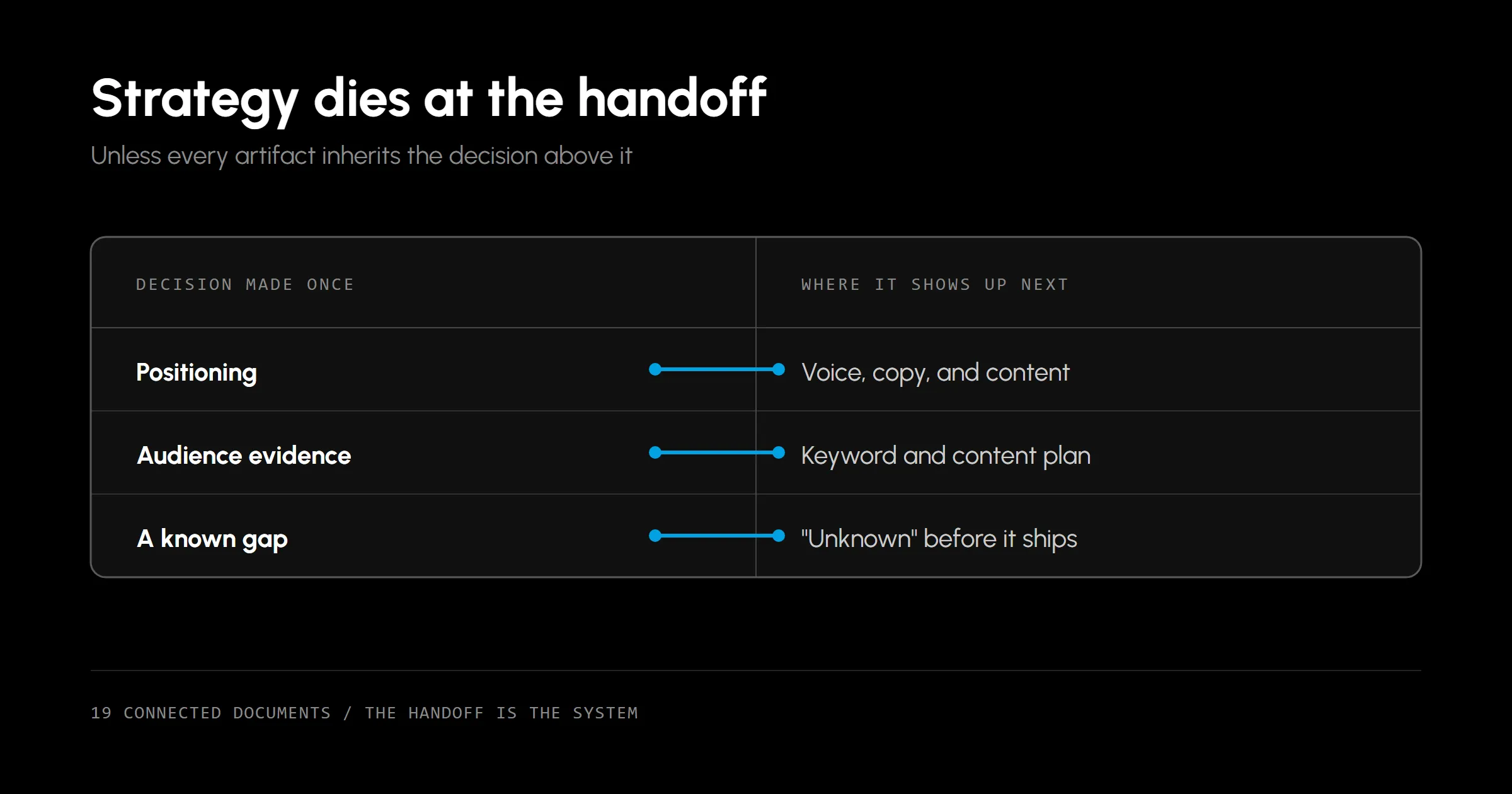
A marketing system works when every output has a known input, owner, and destination in the next step. I built mine as 19 connected documents, from intake through published content, so positioning, research, and constraints are inherited instead of repeatedly rediscovered.
Marketing work rarely falls apart because one deliverable is terrible. It falls apart because each deliverable is created in isolation, then nobody carries its decisions into the next one.
I used to see the same quiet failure pattern in client work: a brand document says the voice is direct and restrained, an SEO report recommends keywords that do not belong to that brand, and a content calendar is handed to someone who never saw either. Every artifact can look competent. Together, they do not compose.
That is the problem this build was designed to solve. Not by adding another dashboard, but by making the work itself carry context forward.
Why do marketing engagements lose the original strategy?
Most marketing engagements lose strategy because the next person has to reconstruct it from files, meetings, and memory. The handoff is informal, so the same discovery is repeated, assumptions harden into facts, and the client becomes the only person holding the whole picture.
The cost is bigger than a few inconsistent posts. When the writer has not seen the positioning work, the content becomes generic. When the SEO work has not read the audience research, the keyword plan chases traffic without a buyer. When a decision made in month one lives in a PDF or an email thread, month three starts from zero.
Shared templates cannot preserve client decisions
The standard fix is a shared folder full of templates. I do not think that is enough. A template gives every client the same container. It does not give the next stage the exact decisions it needs to make a better move.
The 19-document chain carries decisions forward
The system is a numbered chain, not a pile of deliverables. Each document reads the relevant documents above it before it can produce the next artifact, which turns a marketing engagement into an operating system rather than a sequence of disconnected tasks.
| Stage | Documents | What moves forward |
|---|---|---|
| Workspace | 01 to 06 | Scope, goals, task board, internal bottlenecks, and improvement opportunities |
| Shared foundation | 07 to 08 | Evidence-backed strategy and a standalone audience persona |
| Search | 09 to 12 | Keyword, on-page, technical, and AI-search findings |
| Brand | 13 to 16 | Positioning, voice, visual identity, and assembled guidelines |
| Copy and content | 17 to 18 | Shippable conversion copy, pillars, cadence, funnel, and repurposing plan |
| Production | 19 | The subject-specific content engine that turns the strategy into publishable work |
The important detail is the format. These are markdown documents in one workspace, so the next producer can read, quote, and validate the upstream decision. A strategy deck that gets filed is a deliverable. A strategy document the content engine can open before it writes is infrastructure.
Refusal rules stop missing inputs becoming fake answers
Dependency alone is not enough. The system needs permission to stop, label uncertainty, and refuse to produce a confident-looking artifact when the evidence is not there. Otherwise, automation only makes bad assumptions travel faster.
I built refusal rules into the chain. The brand manual will not assemble if the strategy, voice, or visual identity inputs are missing. Content work flags a missing voice source instead of inventing one. Research-dependent reports can return “not measured,” “not connected,” or “unknown” when the data cannot be verified.
That sounds less impressive than an agent that always produces an answer. It is more useful in client work. A made-up search volume, customer quote, or performance claim can quietly contaminate every file downstream. A visible gap gives a human a decision to make.
Parallel tracks prevent strategic drift
The system does not force every marketing task into one long queue. After the strategic foundation and persona are complete, search, brand, and copy can move in parallel, but each track still has its own order of operations.
Brand strategy feeds brand voice. Brand voice feeds conversion copy. Search research informs content strategy. The content engine reads both before it defines formats, hooks, or a publishing rhythm. The order is not ceremony. It prevents a content plan from being built on imagined demand, and prevents a writer from filling a missing voice with generic language.
This is a systems problem more than a marketing problem. In software, a function with an undeclared input eventually produces strange output. In marketing, the equivalent is a polished post that does not sound like the business, target the right customer, or support the offer. It looks finished until you ask what it was derived from.
Evidence from the completed live build
The live build shows that a connected document chain can carry detailed context from research into content production without re-deriving it at every handoff. I ran this exact system end to end on my own brand, providing a real operating test rather than a theoretical diagram.
Sixteen numbered documents were completed in eight days. The work started with a 37.5KB strategic foundation, an evidence-tagged persona, and a measurable baseline rather than a success story invented after the fact. The blog system then turned 2,553 autocomplete candidates from 10 informational seeds into 92 keyword clusters. Six articles shipped across six distinct clusters, each 1,058 to 1,352 words, with citations checked against their source pages.
On a separate client search engagement, the first 12 documents produced 152KB of work in 11 days, including a 38-page crawl and 30 AI Overview samples. That is a delivery measurement, not a claim about a business outcome.
The scope and limits of the live run
The live run does not prove a particular revenue lift, eliminate the need for human judgment, or cover every marketing channel. It proves the build can preserve and reuse decision context. Business impact still needs to be measured client by client, against the goals established at intake.
The system’s limitation is scope. It does not own channel mix, offer pricing, paid ads, email lifecycle, or cross-channel attribution. A human also drives the runbook. That is deliberate, because deciding which track matters, whether a gap is acceptable, or when to skip a stage is judgment work.
The lesson is not that every agency needs 19 documents. It is that the upstream decisions need a route into the work that ships. Google frames its own content guidance around original, helpful, people-first work with clear experience and sourcing. A traceable chain makes that standard practical instead of aspirational. Read Google’s guidance on people-first content.
The single rule that makes this system useful
The valuable part of this build is simple: make a decision once, then let every downstream artifact inherit it. Do not ask the content writer to rediscover the persona. Do not ask the SEO audit to guess the positioning. Do not let a missing data point become a polished lie.
Most agencies already perform the pieces of this work. The gap is that their pieces cannot read each other.
If your strategy repeatedly dies between the kickoff call and Tuesday’s post, the next move is not more content. Map the decisions that should travel through delivery, then make the handoffs explicit.
Frequently asked questions about the marketing system
Is a marketing system just a collection of templates?
No. Templates standardize the shape of a document. A marketing system defines the inputs, evidence, constraints, and handoffs that make each client’s version different from the last.
Why use documents instead of one marketing dashboard?
Dashboards are useful for status and metrics. They are poor at carrying positioning, evidence, voice rules, and the reasoning behind a decision. The system uses documents for context and connected operational surfaces for tasks and delivery.
Can the whole system run without a human?
No, and it should not. Parts of the work can be automated, but a human needs to decide the sequence, validate uncertain inputs, and judge whether a client-specific exception is justified.
Newsletter
New notes, in your inbox.
Get each new article from the workbench by email. No spam, unsubscribe anytime.
Related reading
Continue through the system.
-
Claude Code in Production: Build Apps Without Vibe Coding
Use Claude Code in production with a one-page PRD, vertical task slices, test gates, and release checks. A practical app-build workflow.
Read article → -
The 12-Question Marketing Brief That Ends Random Acts of Marketing
I stopped posting on mood and built a 12-question brief that turns one idea into a week of content in 2 to 4 hours.
Read article → -
GPT-6 Astra Is a Capability Leap. The Workflow Is Still the Product.
GPT-6 Astra can carry more work across browsing, computer use, and creation. The advantage now comes from supervised creator and agent workflows.
Read article →