How I Turn SMART Marketing Goals Into Weekly Targets With Claude Code
Use Claude Code to turn vague marketing goals into a measurable weekly system. Set one outcome, choose the right metric, and review it every Monday.
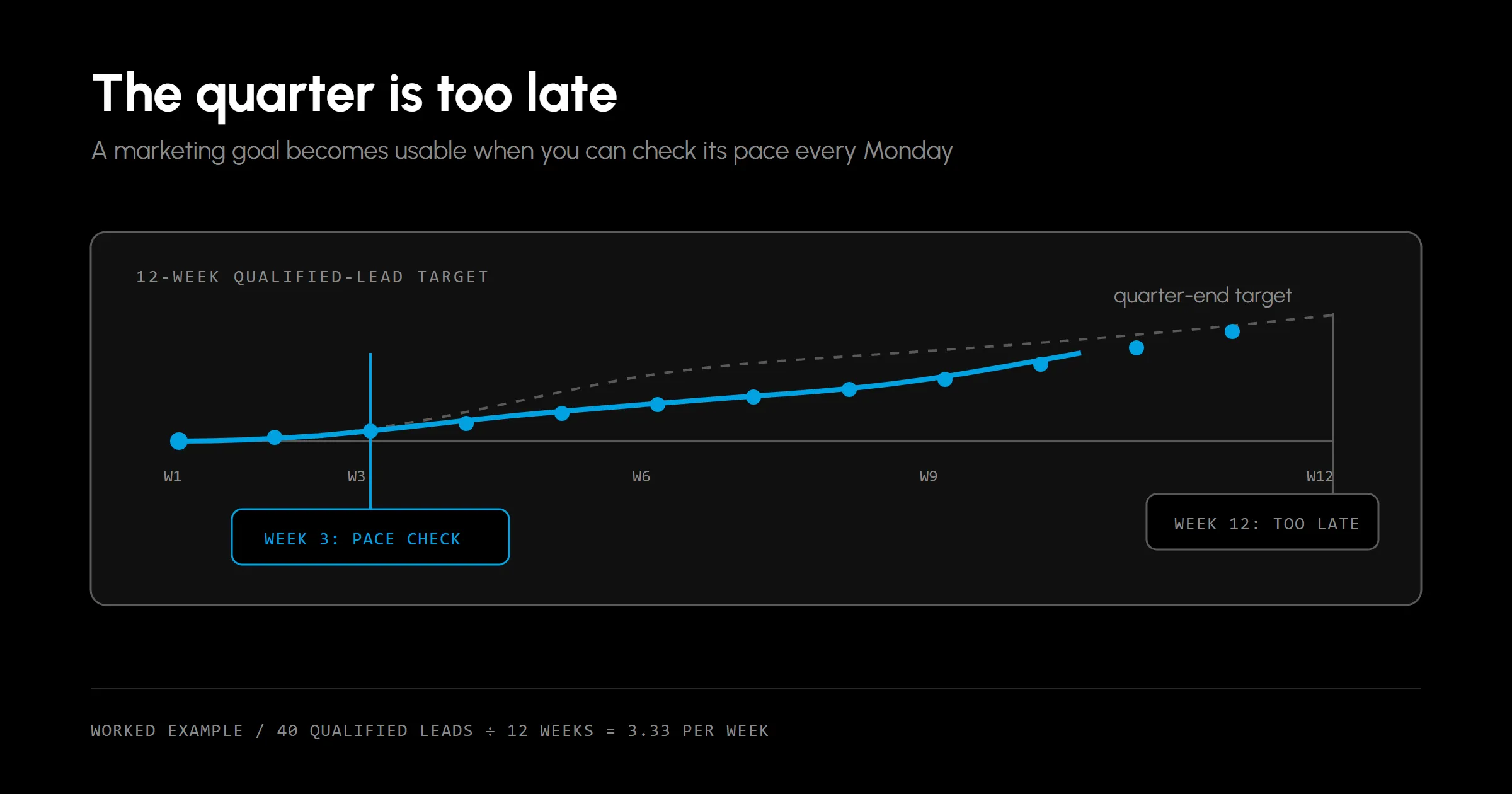
“We need more customers” is the sentence that makes me distrust a marketing plan.
It sounds ambitious, but nobody can check it on Monday. It has no number, no deadline, no owner, and no way to tell whether this week’s work moved anything. The usual result is familiar: posts get published, campaigns get tweaked, and the team stays busy while the owner is still guessing.
The short version: SMART marketing goals only become useful when one business outcome is converted into a weekly target and paired with the metric that shows whether it is moving. I use Claude Code to do the unglamorous translation and keep the review structure consistent. It can calculate, document, and challenge missing inputs. It cannot decide what your business should want.
That distinction matters. A goal-setting agent should make fuzzy thinking harder, not make vague plans sound more polished.
Why a quarterly marketing goal is not enough
A quarterly goal is useful for direction, but it is too slow to manage on its own. If you discover in week 11 that you are behind, the goal did not guide the work. It only recorded the miss.
The standard SMART checklist gets the first half right. A good goal should be specific, measurable, achievable, relevant, and time-bound. OWOX’s guide is clear on that foundation. The operational mistake comes after the checklist: teams write the goal once, put it in a planning document, then go back to measuring whatever is easiest to screenshot.
I reject that workflow. Marketing does not become accountable because a target exists in a deck. It becomes accountable when the target has a weekly cadence, an owner, and a decision attached to a miss. A long enterprise sales cycle may need a different outcome horizon, but it still needs a weekly leading indicator.
What does a useful SMART marketing goal look like?
A useful marketing goal names the business outcome, the qualifying event, the deadline, and the observation rhythm. It does not stop at a channel activity or a vanity number.
Here is the difference:
| Weak goal | Operational goal |
|---|---|
| Get more customers | Generate 40 qualified leads by the end of Q1, reviewed every Monday |
| Grow Instagram | Create 12 sales-qualified conversations from Instagram in 12 weeks |
| Improve email | Produce 24 demo requests from the email list by the end of the campaign |
| Post consistently | Publish the planned weekly content only if each piece supports a tracked conversion path |
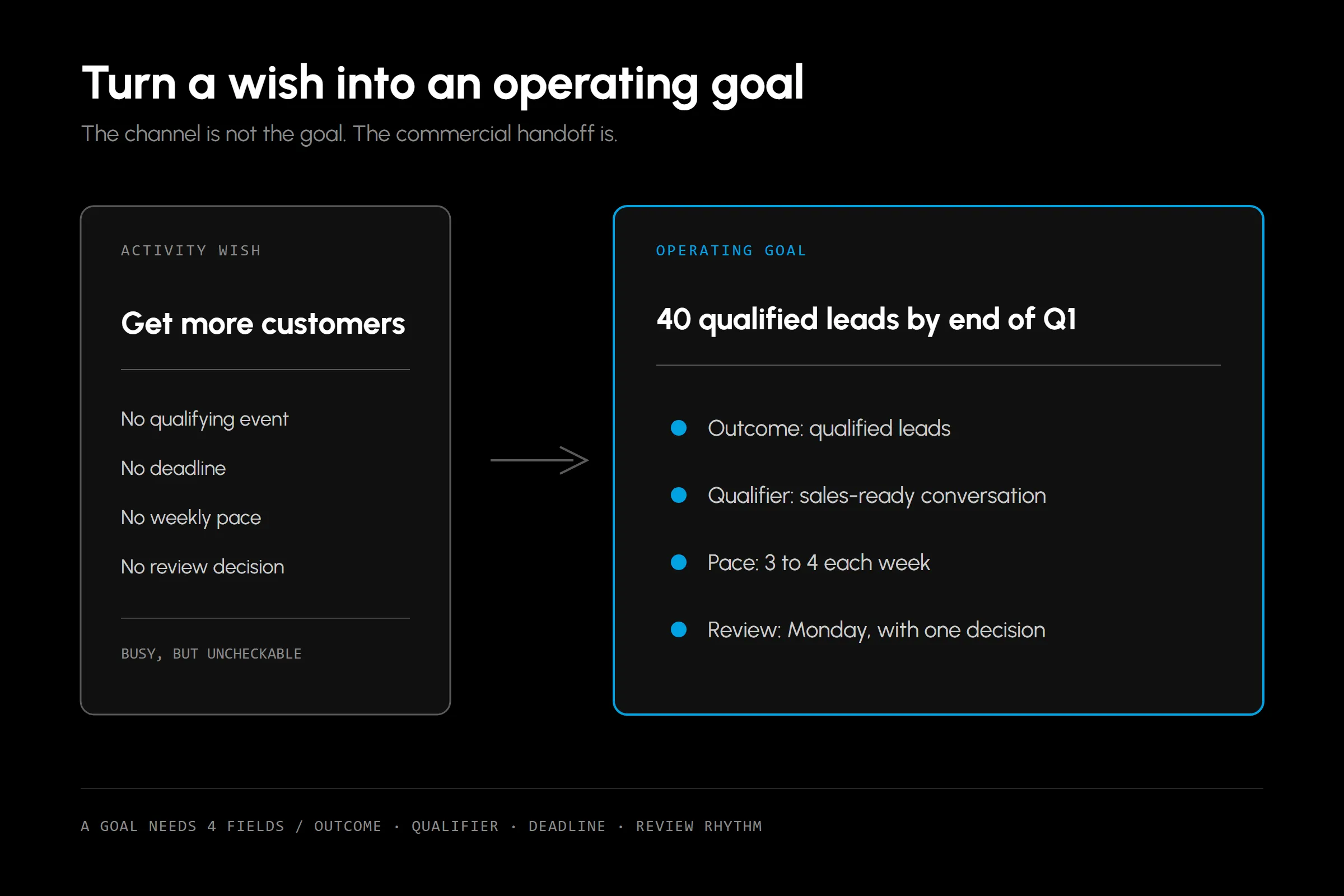 A goal needs four fields: outcome, qualifier, deadline, and review rhythm.
For a service business, that may be qualified leads, booked calls, proposals accepted, or retained customers. For a product business, it might be trials started, activated users, or completed purchases. The right metric depends on how the business actually makes money. Follower count usually fails this test because it can rise while sales conversations stay flat.
How I use Claude Code to turn one outcome into a weekly target
Claude Code is useful here because it can work across the files where the plan already lives, pull baseline data from a sheet or report, calculate the pace, and write the result into a repeatable goal document. Anthropic describes it as an agentic coding tool that can read files, edit them, and run commands across a codebase and connected tools. That capability is the point, not the novelty of having AI write a SMART sentence. The distinction between an agent and a fixed automation matters here because this workflow needs to identify missing context, not just move a number between tools. See AI Agent vs Automation for the decision rule.
I give the workflow four jobs.
1. Name the commercial outcome before naming the channel
Start with the business result required by a real date. Do not start with LinkedIn, ads, SEO, or email. Those are routes, not outcomes.
The input can be plain language: “We need enough qualified pipeline to support the next quarter.” The next questions should be uncomfortable and specific:
- What event counts as qualified?
- How many of those events are required by what date?
- What is the baseline for the last four to twelve weeks?
- What capacity limits the target, such as sales calls, fulfilment, budget, or team time?
If those answers are missing, the agent should return an incomplete brief, not manufacture a target. A clean-looking goal with invented assumptions is worse than no goal because it creates false confidence.
2. Divide the outcome into a weekly pace
Next, turn the deadline into a pace the team can observe. The calculation is simple, which is exactly why it gets skipped.
Example: 40 qualified leads in 12 weeks equals 3.33 qualified leads per week. In practice, I would track a weekly target of 3 to 4 and the running cumulative pace.
This is an example, not a performance claim or a universal benchmark. The target should be checked against baseline conversion data and sales capacity before it is approved.
Once the weekly target exists, the conversation changes. “How is marketing going?” becomes “We needed 12 qualified leads by the end of week three. We have eight. Which stage is failing?“
3. Pair the lagging result with one leading metric
Qualified leads and booked calls are outcomes. They can arrive too late to diagnose the week. The goal system needs one leading metric that predicts the outcome and is close enough to the work to change quickly.
For example, a founder-led content system might track qualified conversations started. An email campaign might track replies from a defined segment. A search campaign might track landing-page conversions by source. The agent’s job is to ask how the business gets from activity to revenue, then identify the narrowest observable handoff.
I would not let it create a dashboard of 20 numbers. If a number would not change this week’s decision, it is reporting noise. Keep one outcome metric, one leading metric, and a place to record the decision.
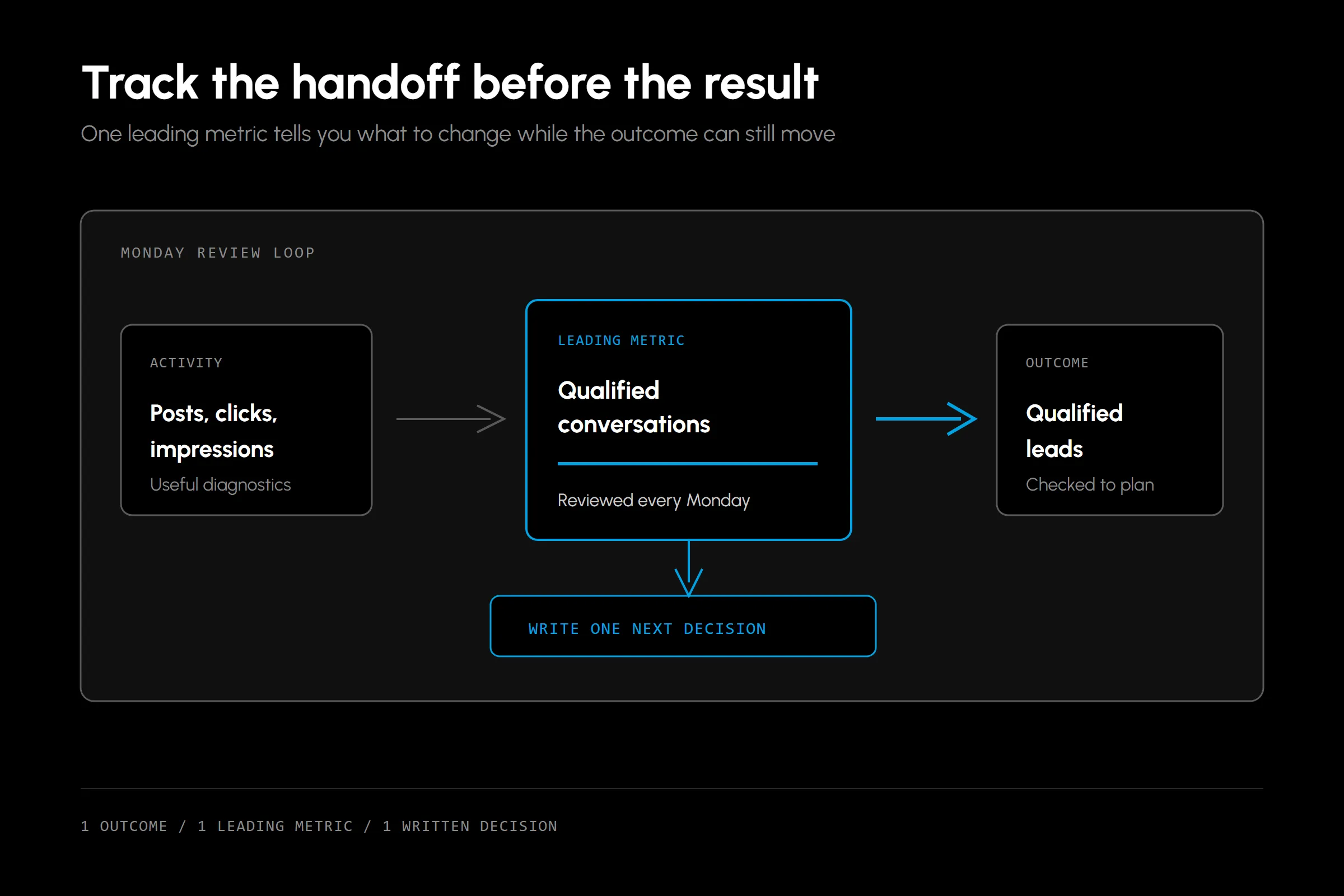 One outcome, one leading metric, one written decision each Monday.
4. Run the Monday review as a decision, not a ritual
The Monday review should take minutes, not become another meeting. The workflow compares actual pace to planned pace, explains the gap using the leading metric, and writes one next move.
Use this three-question review:
- Are we ahead of, on, or behind the cumulative target?
- What did the leading metric do last week?
- What will we change before the next review?
“Post more” is not a decision. “The last two posts produced attention but no qualified conversations, so this week we will test an offer-specific call to action for the same audience” is a decision. It can be judged next Monday.
The prompt structure I would use for a SMART marketing-goals agent
A goal-setting agent needs an explicit refusal rule: if it lacks baseline, capacity, or a defined qualifying event, it should ask for evidence instead of producing a confident-looking target. Give Claude Code this compact brief:
You are a marketing-goal operator. Do not invent targets, baselines, or conversion rates.

1. Ask for the commercial outcome, deadline, baseline, and capacity constraint.
2. Define the qualifying event in one sentence.
3. Convert the approved outcome into a weekly and cumulative target.
4. Recommend one leading metric only, and explain why it predicts the outcome.
5. Produce a Monday review table with planned pace, actual pace, variance, evidence, and one next decision.
6. If an input is missing, mark the goal "Not ready to set" and ask the exact follow-up question.
The prompt is not the system. The system is the weekly evidence and the decision record. A founder still decides whether the goal is commercially relevant and the pace is realistic.
What breaks when you measure activity instead of progress?
Activity metrics let teams look productive without confronting the funnel. More posts, impressions, and clicks can be diagnostics, but they are weak substitutes for a defined commercial handoff. The work is not done when content is published. It is done when the business can connect an action to the next meaningful event on its path to revenue.
Write the next decision down. Otherwise, the same dashboard gets opened next week and the same explanation gets repeated. A good agent preserves the thread: what was expected, what happened, what changed, and what must be tested next.
A target checked every Monday becomes a system
SMART goals are not interesting because they make plans sound more precise. They matter because they force a business to decide what success looks like before it starts spending attention and budget.
My rule is simple: a goal you only check at the end of the quarter is a wish with a deadline. A goal you check every Monday, against a real weekly pace and a named next decision, is a marketing system.
Pick one commercial outcome for the next 12 weeks. Define what counts. Do the pace math. Then make the next Monday review unavoidable.
Frequently asked questions about SMART marketing goals
What are SMART marketing goals?
SMART marketing goals are objectives that are specific, measurable, achievable, relevant, and time-bound. Add a weekly pace and review cadence so they can guide decisions before the deadline arrives.
What is a good marketing goal for a small business?
A good goal names a business-relevant event the team can define and track, such as qualified leads, booked calls, email signups, trials, or purchases. Choose it from the actual path from marketing to revenue, not the easiest platform metric to display.
Can Claude Code set my marketing targets?
Claude Code can turn approved inputs into a documented target, calculate the weekly pace, and produce a review template. It should not invent the target, baseline, or conversion rate. Those need real business data and human judgment.
How often should marketing goals be reviewed?
Keep the main outcome on its natural planning horizon, often a quarter, but review progress every week while there is still time to correct the route.
Newsletter
New notes, in your inbox.
Get each new article from the workbench by email. No spam, unsubscribe anytime.
Related reading
Continue through the system.
-
Marketing System Build: Keeping Strategy Alive Through Delivery
A case study of the 19-document marketing system I built to carry strategy, research, and brand rules from intake to published content.
Read article → -
The 12-Question Marketing Brief That Ends Random Acts of Marketing
I stopped posting on mood and built a 12-question brief that turns one idea into a week of content in 2 to 4 hours.
Read article → -
Always-on AI agents: what OpenAI Dots actually changes
Always-on AI agents can carry work between conversations. Learn what OpenAI Dots changes, where agent computers help, and how to run a useful pilot.
Read article →