GPT-6 Astra Is a Capability Leap. The Workflow Is Still the Product.
GPT-6 Astra can carry more work across browsing, computer use, and creation. The advantage now comes from supervised creator and agent workflows.
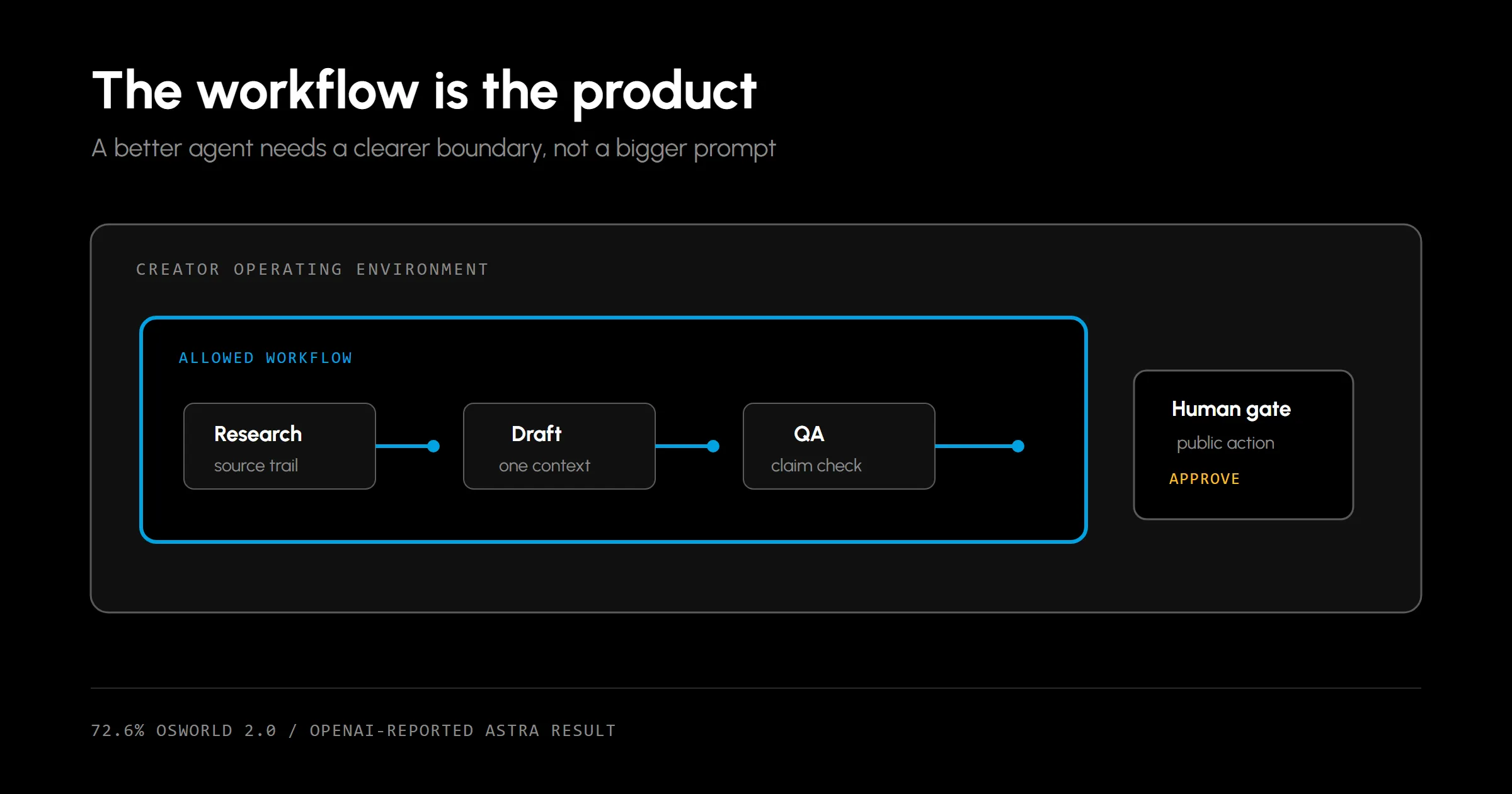
The content systems I build rarely fail because a model cannot produce a decent paragraph. They fail at the handoff: research loses the original angle, the draft loses the source trail, the visual loses the brief, and the post gets scheduled with claims nobody checked.
That is why GPT-6 Astra interests me more as a workflow model than as a writing model.
GPT-6 Astra is a capability leap because OpenAI says it can work across computer use, browsing, software engineering, and professional artifacts in one multistep run. The practical implication is blunt: creators and operators should stop designing isolated prompts and start designing supervised workflows with clear inputs, stop conditions, and evidence. OpenAI’s launch announcement makes a large set of capability claims. The useful question is what those claims change in the work you hand to an agent.
The distinction matters because an AI agent and an automation should not be governed the same way. Automation follows a fixed path. An agent needs an explicit boundary for judgment, tools, and escalation.
What is the real capability leap in GPT-6 Astra?
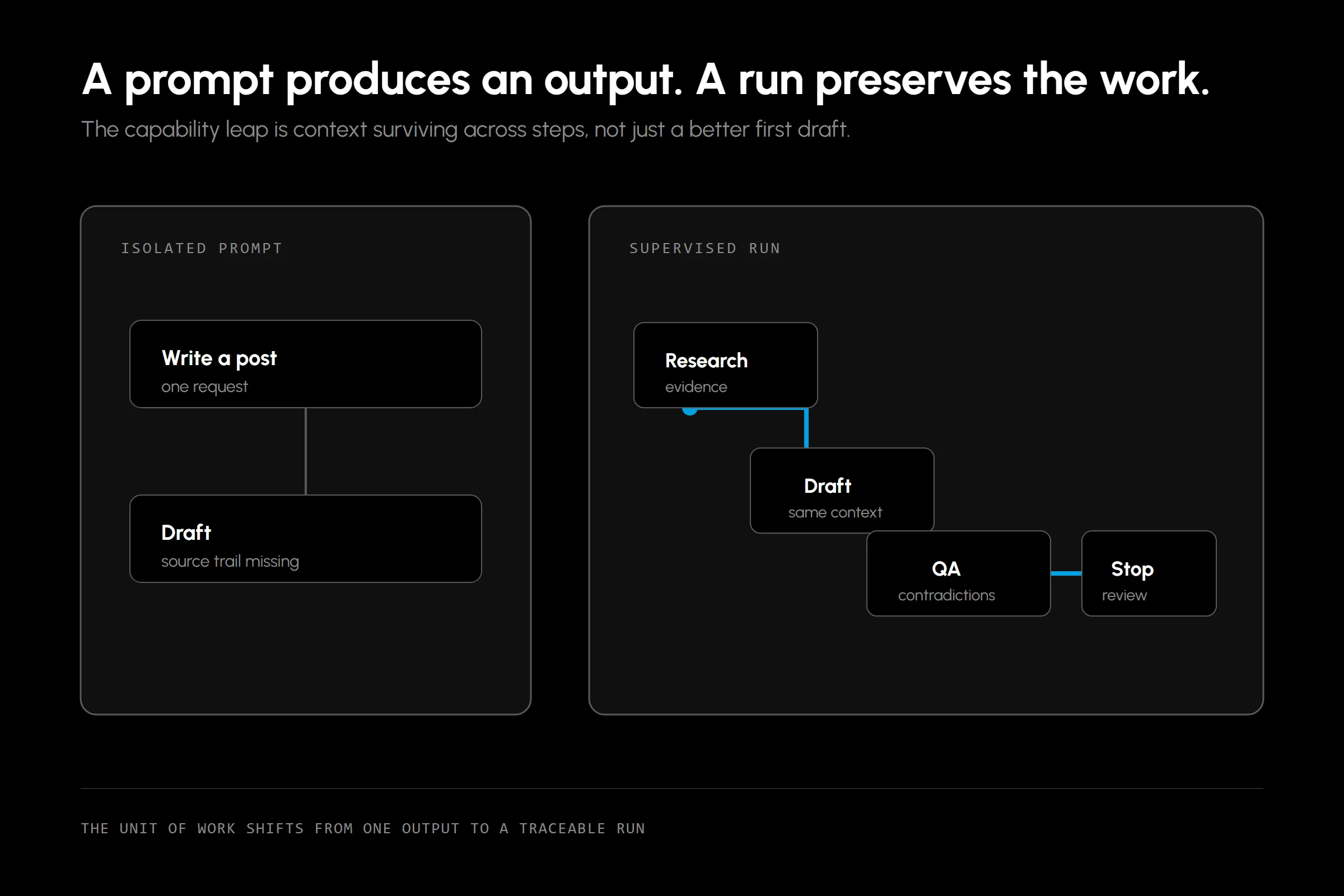
The important leap is that an agent can now carry more of the chain between intent and a usable artifact. OpenAI says Astra can browse, use a computer, write code, create documents and spreadsheets, and continue a multistep task while asking focused questions when an unresolved choice matters. That moves the unit of work from a single output to a supervised run.
That distinction sounds semantic until you compare the two jobs.
| The old request | The workflow request |
|---|---|
| ”Write a LinkedIn post about agent workflows." | "Research the claim, save the source trail, draft the post, flag claims that lack evidence, prepare the visual brief, and stop before publishing." |
| "Build a landing page." | "Review the offer and existing site, implement the page, run frontend QA, record unresolved conversion decisions, and stop before the production deploy." |
| "Update the CRM." | "Classify new leads against these rules, update only high-confidence fields, prepare exceptions for review, and leave customer-facing actions pending approval.” |
OpenAI reports large benchmark gains for Astra in computer use and agentic coding, including 72.6% on its listed OSWorld 2.0 evaluation versus 65.7% for GPT-5.6 Sol. That is an OpenAI-reported result, not a guarantee that your CRM or content system will work unattended. The operational change is still real: more of the workflow can stay in context before a human needs to intervene.
How should creators redesign their workflows for Astra?
Creators should make the brief and proof trail first-class artifacts. Astra can reportedly research online, draft in documents, produce structured artifacts, and create sites or frontend QA outputs. A creator workflow should use that range to preserve the path from source to claim to final asset, rather than ask the model for more volume.
For content, I would build the run like this:
- Set the editorial decision. A human chooses the audience, commercial point of view, and claim worth defending. The agent should not invent the angle because it can browse.
- Collect evidence. The agent researches the query, records source URLs, separates confirmed facts from interpretation, and identifies the questions the article must answer.
- Build the content package. It creates the article outline, draft, metadata, visual brief, and social adaptations from the same evidence set.
- Run the contradiction check. It compares the headline, body claims, image copy, and calls to action. This is where a connected workflow beats a folder of individually competent files.
- Stop at the public action. A human approves a publish, scheduled post, paid spend, or customer-facing claim.
The creator advantage is not that Astra can produce a blog and a graphic in one session. Plenty of tools can produce assets. The advantage is that a capable agent can keep the decision context alive across those assets, then show you exactly where that context is missing.
What should an Astra agent workflow contain?
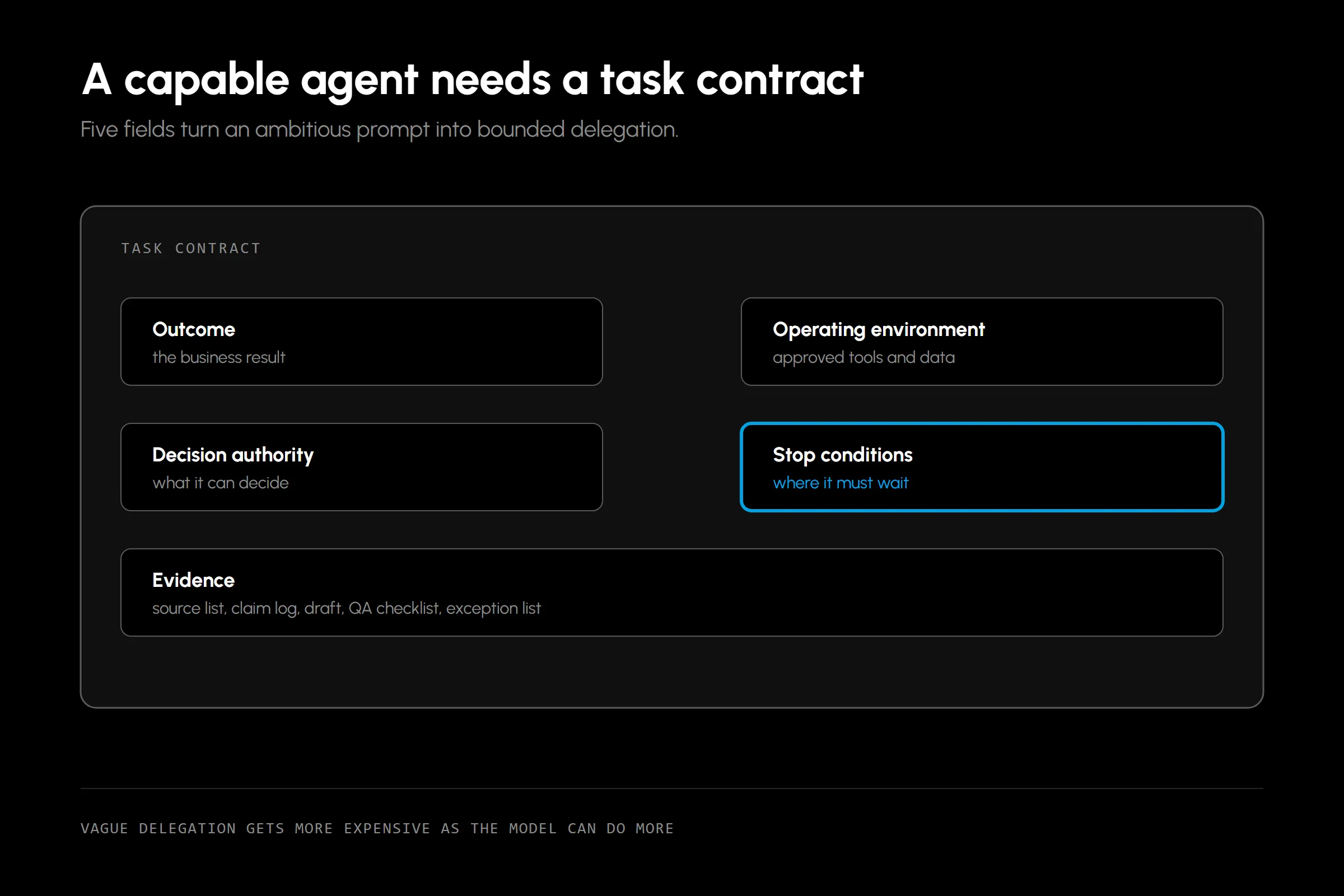
An Astra workflow needs a task contract, not an ambitious prompt. The stronger the model becomes, the more expensive vague delegation gets because it can take more actions before the error is visible.
I would give every workflow five fields:
| Field | What it means | Example |
|---|---|---|
| Outcome | The business result, not the tool activity | Produce a source-backed article package for one buyer question |
| Operating environment | The files, apps, and data it may use | Content folder, approved research sources, draft calendar |
| Decision authority | What it can decide on its own | Select source excerpts and propose an outline |
| Stop conditions | Where it must wait | Publishing, sending messages, changing money or permissions |
| Evidence | What proves the run is complete | Source list, claim log, draft, QA checklist, exception list |
This is the part most people skip. They give an agent access to five tools and call the result a workflow. It is closer to hiring someone, handing them browser tabs, and refusing to say what they are allowed to decide.
OpenAI’s launch material says Astra is better at resolving routine ambiguity and asking focused questions when a missing answer would change the outcome. That should improve handoffs. It does not remove the need to define the consequential boundary in the first place.
Why a stronger model can make a weak process worse
Astra can make a weak process fail faster because it can reach farther into the environment before someone notices the original instruction was underspecified. The same capability that lets an agent research, edit a document, update a CRM, and run QA also raises the cost of an unclear stop condition.
OpenAI’s safety overview is unusually direct about this. It says Astra reaches the Critical threshold for cybersecurity capability under its Preparedness Framework, and that the company has added monitoring and stronger safeguards for tool-using deployments. It also states that monitoring cannot replace alignment. The safety overview is a useful reminder that capability and control have to rise together.
For founders, the translation is simple:
- Do not measure an agent by whether it completed the task.
- Measure whether it stayed inside the task boundary.
- Do not reward an agent for filling missing inputs with confidence.
- Reward it for identifying the missing input, preserving the evidence, and stopping at the right moment.
That is the creator version of safety. It is less dramatic than cybersecurity, but it prevents the ordinary damage: a public claim nobody sourced, a wrong CRM change, a page that deploys with the wrong offer, or a week of content that was built on a bad premise.
Do you need a multi-agent system to use GPT-6 Astra well?
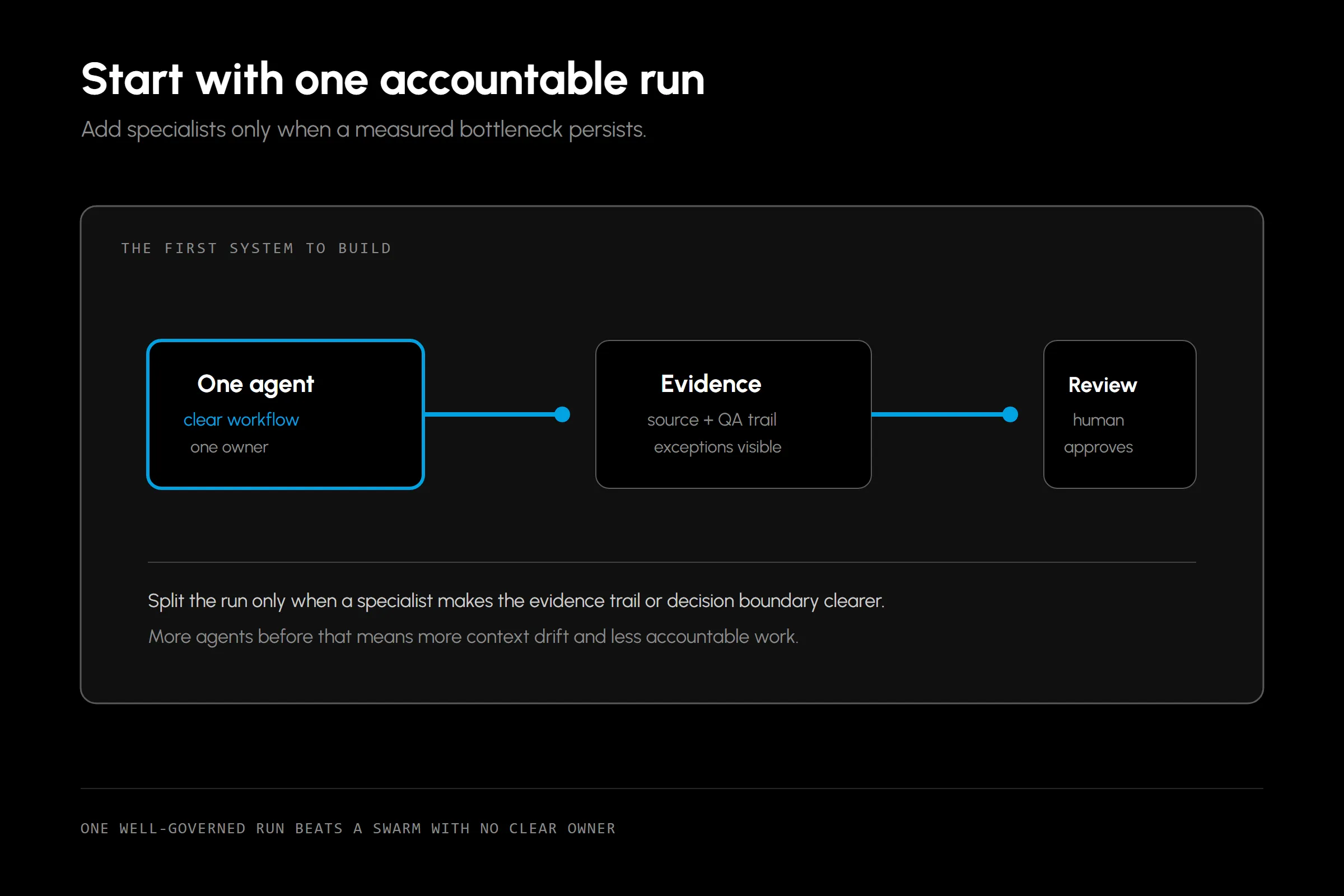
No. Most creators and small teams should begin with one capable agent operating inside one well-defined workflow. Adding multiple agents before the first workflow has clear inputs and review gates usually creates more context drift, more logs, and more places for responsibility to disappear.
The first system I would build is an editorial operator, not a swarm:
- It reads the approved topic and business context.
- It researches only from the source policy you set.
- It produces a traceable article and social package.
- It flags unsupported claims and missing choices.
- It waits for approval before any public action.
Once that run is reliable, split off a specialist only where a real bottleneck persists. Research is a reasonable candidate. Visual QA might be another. But the test is not whether you can name another agent. The test is whether a separate role makes the evidence trail or decision boundary clearer.
Where does human judgment still matter?
Human judgment still owns the decisions whose error changes the business, the customer relationship, or the public record. Astra can narrow the work around those decisions. It should not quietly take them over.
For a creator, that means a person still decides:
- Which audience problem is worth addressing
- Which claim the brand can honestly make
- What a source actually proves
- When a draft sounds true to the business instead of merely polished
- Whether a public post, email, launch, or deployment should go live
I do not see that as a limitation of the model. It is the point of a serious workflow. The agent handles the work that benefits from speed, breadth, and context retention. The human owns taste, commercial judgment, and irreversible decisions.
The workflow is now the differentiator
GPT-6 Astra raises the ceiling on what one agent can do in a run. OpenAI’s own examples include research, document work, coding, computer use, and visual QA. That deserves attention.
But the model will not create a durable advantage by itself. The advantage comes from deciding what the agent may touch, what proof it must return, what it should do when context is missing, and where it must stop.
My rule for the Astra era is simple: do not hand a better model a bigger mess. Give it a workflow that preserves context, exposes uncertainty, and keeps the final business decision with the person accountable for it.
Frequently asked questions about GPT-6 Astra workflows
What is GPT-6 Astra best used for?
OpenAI positions GPT-6 Astra for complex work across computer use, browsing, software engineering, science, and professional artifacts. For a creator or operator, the best starting point is a workflow that combines research, structured drafting, QA, and evidence collection while retaining a human approval step for public or irreversible actions.
Can GPT-6 Astra run a creator workflow end to end?
It can reportedly handle more of an end-to-end run than prior models, including online research, document creation, and frontend QA. The safer design is for it to prepare the complete package, identify exceptions, and stop before publication, spending, customer outreach, or other consequential actions.
Will GPT-6 Astra replace multi-agent workflows?
It may reduce the need to split a workflow into many narrow agents because one model can retain more context across tools and steps. It does not eliminate the need for role boundaries. Add another agent only when it creates a clearer review path or solves a measured bottleneck.
How should small teams start with GPT-6 Astra?
Start with one recurring workflow that already has a clear output and an obvious review point. Define its outcome, allowed tools and data, decision authority, stop conditions, and required evidence. Review the first runs closely, then widen scope only after the workflow proves it can stay within those boundaries.
Newsletter
New notes, in your inbox.
Get each new article from the workbench by email. No spam, unsubscribe anytime.
Related reading
Continue through the system.
-
Claude Opus 5.5: What Creators Are Making
Claude Opus 5.5 is helping creators build games, videos, and interactive projects. Here is what changed, what examples show, and where review matters.
Read article → -
Always-on AI agents: what OpenAI Dots actually changes
Always-on AI agents can carry work between conversations. Learn what OpenAI Dots changes, where agent computers help, and how to run a useful pilot.
Read article → -
Claude Code in Production: Build Apps Without Vibe Coding
Use Claude Code in production with a one-page PRD, vertical task slices, test gates, and release checks. A practical app-build workflow.
Read article →