Admin Reclaimer
One approval-first pipeline for a trade business's recurring admin
- Client
- Internal MVP
- Services
- AI Workflow Automation, Operations Software
01 · Challenge
Small plumbing and heating firms juggle customer enquiries, supplier follow-ups, booking requests and repeat paperwork alongside the work itself. A general-purpose assistant can draft text, but a draft alone does not organise the job, protect customer relationships or show whether any time was actually saved.
Four problems shaped the build
The admin arrives in different forms: Email, scheduled follow-ups, repeat tasks and work logged away from a screen all need one clear place to go.
Generic drafts miss trade context: A useful reply needs the firm's actual rates and tone, while a booking needs suitable slots and job paperwork depends on real work details.
A wrong action can damage trust: Sending an invented price or chasing someone who has already replied is costly. Owners need to see the exact action before it reaches a customer.
Time saved is otherwise hard to judge: An estimate without a declared weekly baseline and a way to record manual work makes the benefit look more certain than it is.
02 · Goal
One queue for the repetitive work around the job
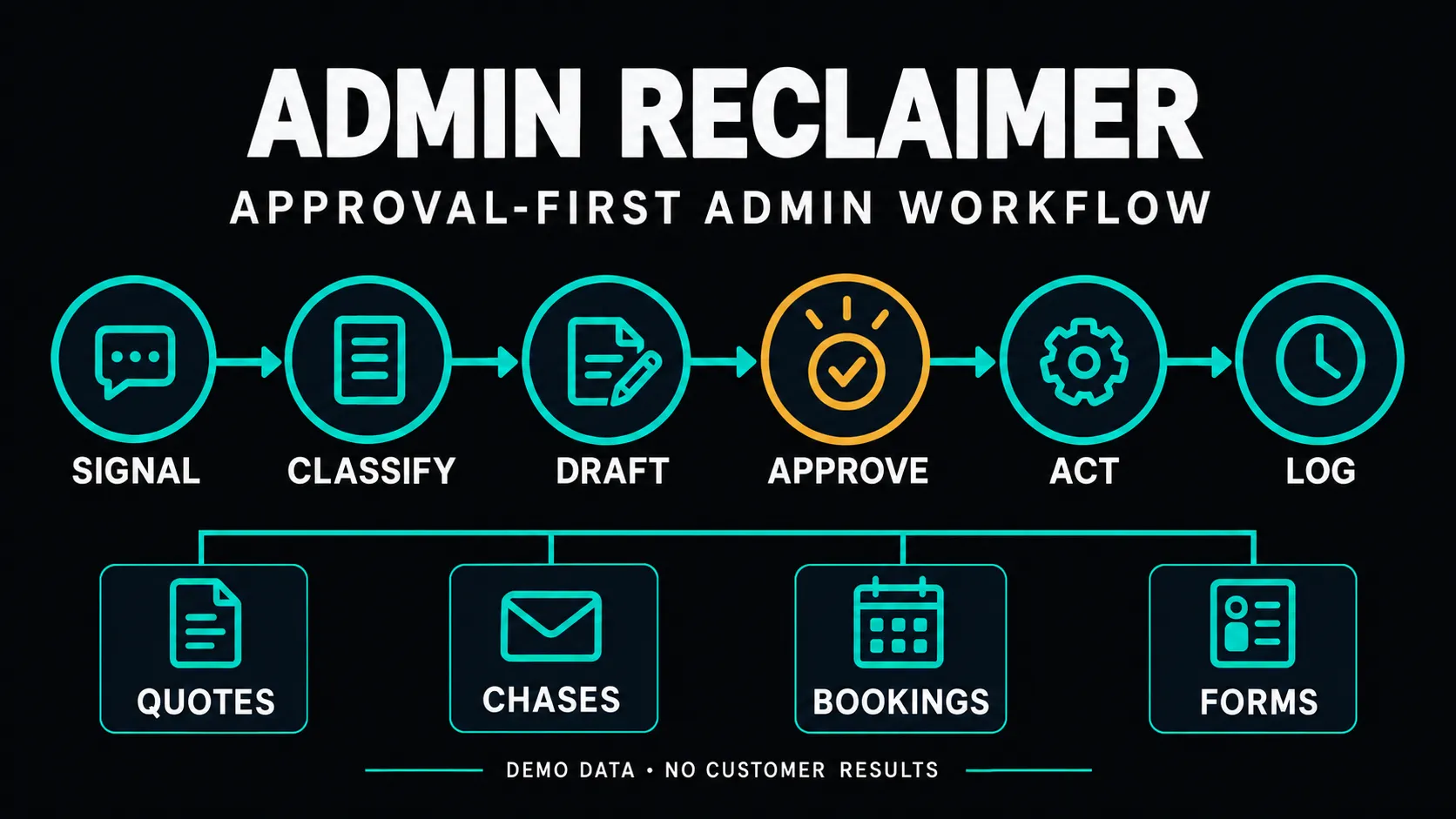
The MVP is designed for a UK residential plumbing and heating firm of four to twelve people. It routes each eligible job through one pipeline: capture a signal, classify it, draft a concrete action, apply a trust gate, execute once, and record the result. The four playbooks cover quote-request triage, supplier and invoice chasing, job scheduling, and a trade-specific compliance form pack.
The owner starts at My week, which compares admin areas against the business's own declared baseline, separates system-handled time from time the owner logs, and keeps uncovered categories visible. The approval queue ranks proposals and shows the reasoning and full outbound email. Owners can approve, edit, or dismiss with a reason; approval and edit history can inform later drafts.
The trust boundary is enforced outside the playbooks. Email sending is not on the unattended-action allowlist by default. The executor checks for an approval record, verifies that the approved message still matches the payload being sent, and uses an idempotency key to prevent a retry from sending the same action twice. Mail arrives by forwarding, avoiding a Gmail body-reading permission flow in this MVP.
03 · Result
The project combines a Next.js and TypeScript application with a framework-independent domain core, Prisma and PostgreSQL, Auth.js, an Anthropic adapter, Postmark mail, and an Upstash QStash integration. Its local seeded demo can run offline with fake AI and mail adapters while exercising the product pipeline.
The supplied screens show fictional, seeded activity. For example, the 16-hour weekly baseline and 3h 47m handled on My week are demo values, not measured customer results. The project notes that no primary interviews were conducted; personas and time assumptions come from secondary research and domain analysis. Adoption, approval rate and hours reclaimed remain unvalidated outcomes.
The MVP still has concrete scope gaps: chase timing is seeded rather than scheduled, recurring admin runs lazily when the owner opens the week view, proposal generation runs inside the inbound webhook, and the forms playbook cannot yet produce a document because it lacks job context. The project also lists an evaluation harness, end-to-end tests, and production security hardening as unfinished.
The reusable pattern is a narrow, trade-specific workflow with a person in control of customer-facing actions and a time ledger tied to actual decisions. The next validation step is to observe real trades owners setting up email forwarding and reviewing proposals, then measure draft quality and time saved against their own baseline before making a performance claim.
Gallery
Related insights
The thinking behind the system.
-
Marketing System Build: Keeping Strategy Alive Through Delivery
A case study of the 19-document marketing system I built to carry strategy, research, and brand rules from intake to published content.
Read article → -
Claude Code in Production: Build Apps Without Vibe Coding
Use Claude Code in production with a one-page PRD, vertical task slices, test gates, and release checks. A practical app-build workflow.
Read article → -
GPT-6 Astra Is a Capability Leap. The Workflow Is Still the Product.
GPT-6 Astra can carry more work across browsing, computer use, and creation. The advantage now comes from supervised creator and agent workflows.
Read article →