Sixty Second Responder
An AI first-response workflow with a reliable human handoff
- Client
- Internal MVP
- Services
- AI Automation
01 · Challenge
Inbound questions arrive through website chat, forms, email, and messaging channels while small teams are busy or away from the inbox. Slow replies risk losing a prospect before a person sees the inquiry.
Four points shaped the build
Slow first response: A person cannot watch every connected channel throughout the day, so a new inquiry can wait for someone to notice it.
Repeated qualification: Teams ask the same intake questions and then reconstruct the answers from a long conversation.
Unclear ownership: A warm lead can remain in the shared inbox without a clear handoff or a concise summary for the person who follows up.
Unsafe answers: A model may be asked about prices or availability the business has not supplied, and a model failure should not leave the lead unanswered.
02 · Goal
A first response tied to the shared inbox
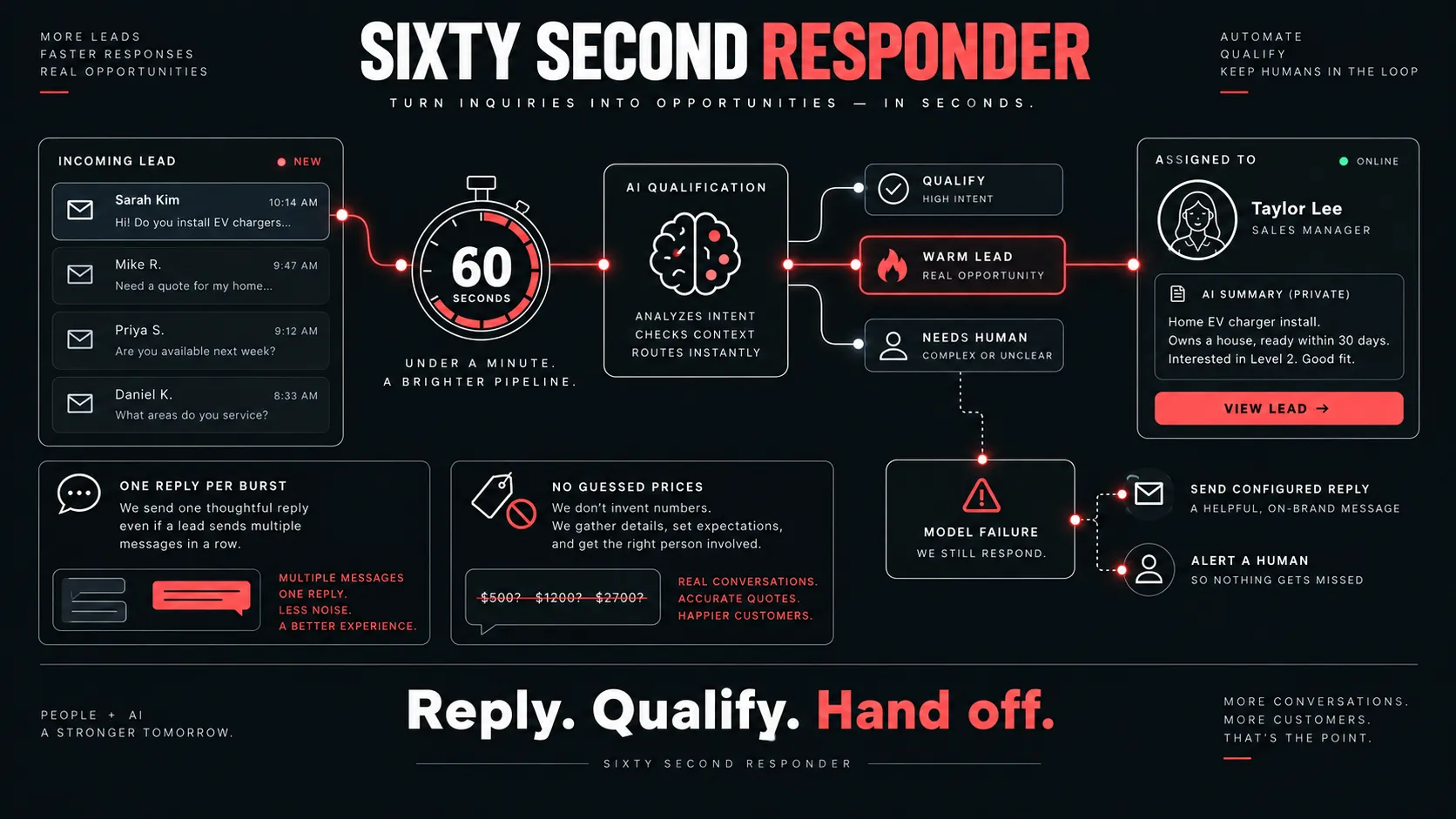
Sixty Second Responder connects to Chatwoot as an Agent Bot. It receives a message-created webhook, uses client-specific business facts and qualification rules, and sends a structured reply while the conversation is pending.
Five decision stages: qualifying, warm, cold, unqualified, and needs human.
Client-configured YAML provides approved facts, question prompts, tone, warm and unqualified rules, fallback text, and an optional Chatwoot owner.
Safe fallback: model errors, timeouts, refusals, malformed decisions, and unsafe drafts route to the client's fallback reply and a human.
Human handoff: warm and needs-human conversations receive a private summary note, move to open, and can be assigned to a configured owner.
Operational record: SQLite stores messages plus lead-received, first-reply, stage, escalation, and fallback events.
The local demo uses a scripted brain to demonstrate the workflow. Claude supplies the decision-making brain when configured for a live integration.
03 · Result
A working MVP for the first minutes of an inbound lead conversation
The build connects Chatwoot, a FastAPI responder, Claude structured output, client-specific YAML, and a SQLite event log. Duplicate message IDs are ignored, quick message bursts receive one response, and the bot stops speaking after a conversation is opened for a human.
The default Claude request has a 20-second timeout and one retry. If the model path fails or a reply fails the safety checks, the configured fallback reply still gives the lead an answer and the team a reason to take over.
The included demo runs four sample leads with a scripted, non-AI brain. Its captured Chatwoot report shows 7 conversations and a 2-second first-response-time reading for that local demo period. These are demo observations, not production or customer performance claims.
Per-lead model cost, hosting cost, and production response benchmarks have not been measured. Calendar booking, owner alerts, form intake, missed-call text-back, and the response-time proof dashboard remain planned.
The reusable pattern fits appointment inquiries, service quotes, ecommerce questions, and professional-service intake: answer only from approved facts, collect context, and give people a clean point to take over.
Gallery
Related insights
The thinking behind the system.
-
Claude Code in Production: Build Apps Without Vibe Coding
Use Claude Code in production with a one-page PRD, vertical task slices, test gates, and release checks. A practical app-build workflow.
Read article → -
GPT-6 Astra Is a Capability Leap. The Workflow Is Still the Product.
GPT-6 Astra can carry more work across browsing, computer use, and creation. The advantage now comes from supervised creator and agent workflows.
Read article → -
Marketing System Build: Keeping Strategy Alive Through Delivery
A case study of the 19-document marketing system I built to carry strategy, research, and brand rules from intake to published content.
Read article →