AI Automation10 min read
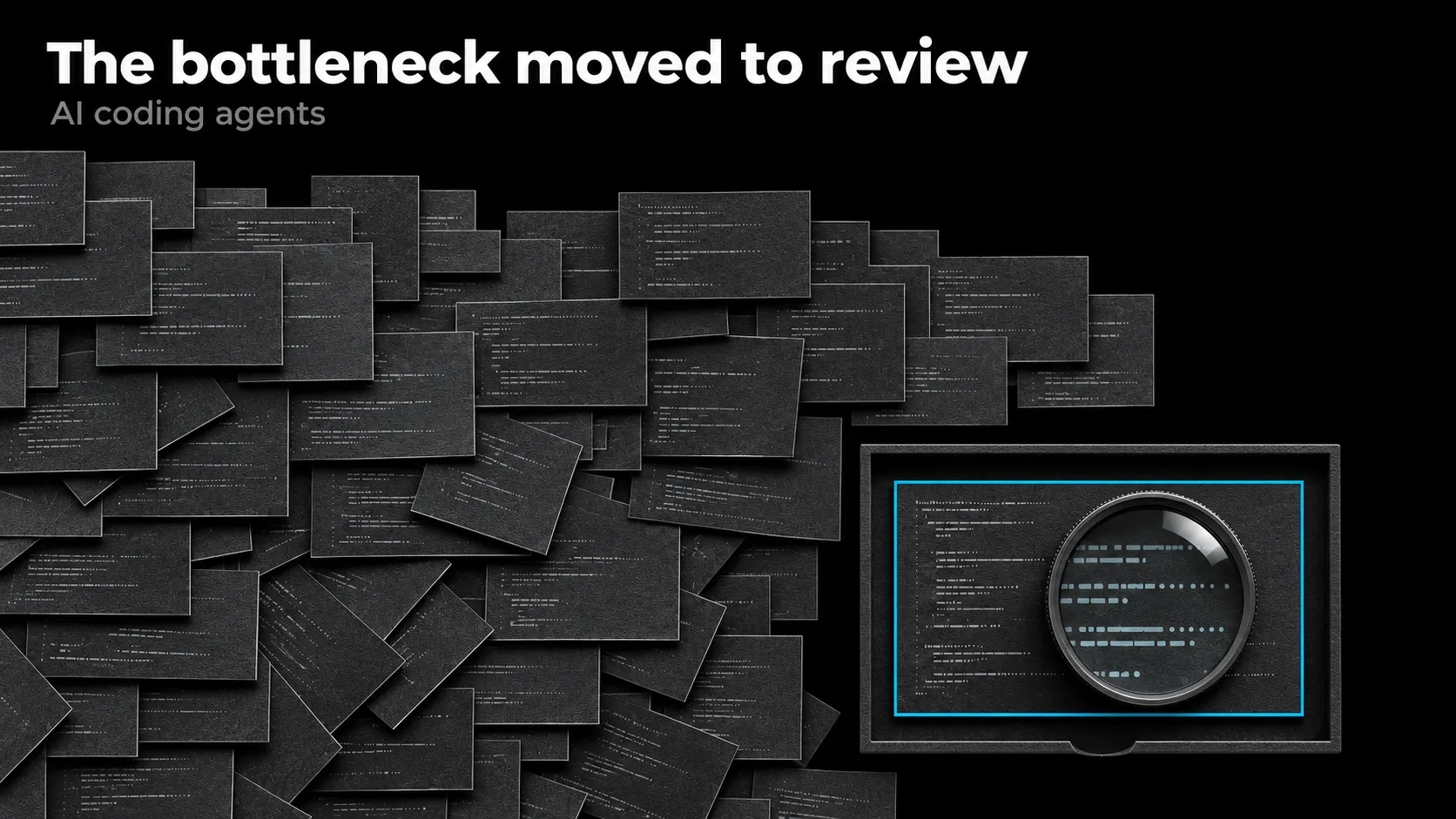
AI coding agents moved the bottleneck to code review
AI coding agents add 30% more code and 23% more pull requests per engineer, but no more finished work. Review is where the gain stalls, and how to fix it.
[ Key takeaways ]
- A Harvard working paper on Jellyfish data from 718 firms found coding agents raised lines of code by about 30% and pull requests by 23% per engineer, with no significant rise in resolved Jira issues.
- The extra output piles up in review: PR-to-merge time rose by 3.45 days from a 7.03-day baseline, and the share of PRs with changes requested roughly doubled, from 13% to about 25%.
- LinearB's 2026 benchmarks found agentic AI pull requests wait 5.3x longer to be picked up than unassisted ones, because a reviewer has to reconstruct intent the agent never wrote down.
- The engineering role is shifting with it: in the same study the share of engineers doing code review rose 14% while the share writing code stayed flat.
- The fix is to treat review as infrastructure: make every pull request carry proof it works, filter AI review comments before a human sees them, and route only risky changes to people.
AI coding agents make engineers write more code, but on the largest dataset published so far, they do not make teams finish more work. A Harvard working paper covering 718 firms found agents raised pull requests by 23% per engineer while resolved issues barely moved. The missing output is sitting in code review, which is now the real constraint in an AI engineering workflow.
In 1984 Eliyahu Goldratt wrote a novel about a failing factory to make one point: an hour saved at a step that is not the bottleneck is a mirage. The plant manager in The Goal speeds up machines all over the floor and inventory just piles up in front of the one oven that was always the constraint. I kept coming back to that book this month, because the software industry has spent two years buying faster machines and is now staring at a pile of unmerged pull requests.
Do AI coding agents actually make teams ship more?
Not on the best evidence we have. Coding agents raise every input metric, code, commits and pull requests, but finished work stays roughly flat. The study behind that finding is large, recent and built on real work logs rather than surveys, so it is hard to wave away as a small-sample result.
The paper is “Artificial Intelligence in the Firm: Bottlenecks in Software Production” by Fiona Chen and James Stratton at Harvard, with the current version dated August 4, 2026. It uses Jellyfish engineering data, about 300 million commits, pull requests, tickets and calendar events from 718 firms between January 2021 and March 2026, and compares firms that adopted AI tools with firms that had not yet.
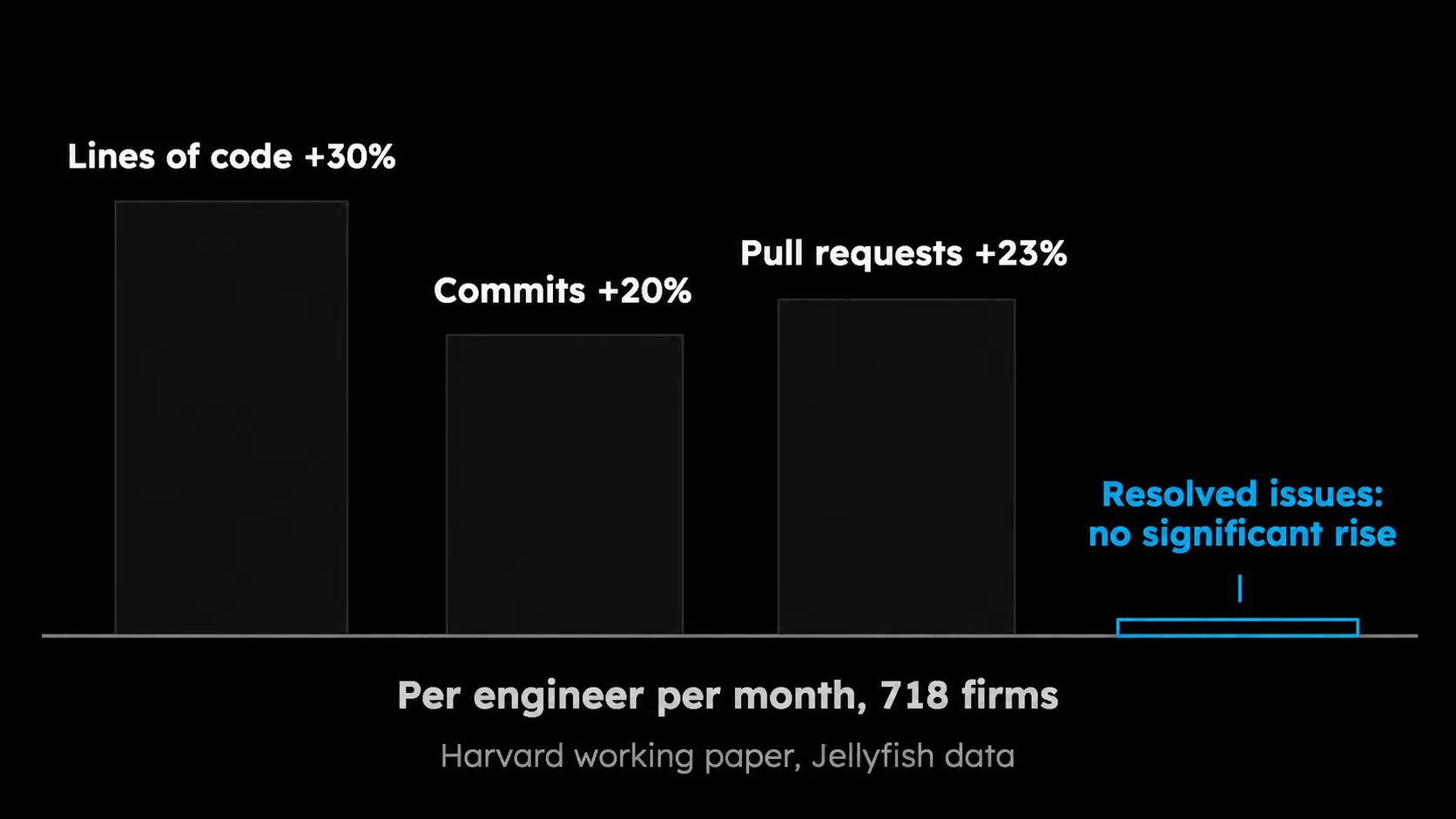
After teams adopted coding agents, per engineer per month:
- Lines of code rose about 30%.
- Commits rose about 20%.
- Pull requests rose about 23%.
- Resolved Jira issues did not rise significantly.
The authors’ own conclusion, as Ars Technica reported it, is that the coding-phase gains are absorbed by downstream constraints. Older autocomplete-style assistants barely moved anything, which says something about where the gains were never going to come from.
What the study does not prove
Two limits are worth keeping in view. It is a working paper, not yet peer reviewed, and resolved Jira issues are a rough proxy for delivered value: one ticket can be a typo or a quarter’s work. The data runs to March 2026, so teams that have since rebuilt their review process are not in it. What it does show, across hundreds of firms, is the direction.
Where does the extra AI-generated code get stuck?
In review. Pull requests from agent-using teams take longer to merge, get sent back more often, and collect more comments. The writing step got cheaper while the reading step got more expensive, so the queue in front of the reviewer grows with every agent you add.
The numbers from the same Harvard paper, as summarized in Dromeas’ breakdown of the study:
| Review metric after agent adoption | Before | After |
|---|---|---|
| PR-to-merge time | 7.03 days | about 10.5 days (+49%) |
| PRs with changes requested | 13% | about 25% |
| Review comments per PR | baseline | +35% |
| PR size | baseline | no significant change |
That last row matters. The PRs are not bigger. They are worse on the first pass and harder to read.
LinearB’s 2026 Software Engineering Benchmarks Report, as cited by Codacy, found agentic AI pull requests wait 5.3x longer to be picked up than unassisted ones. CircleCI’s 2026 State of Software Delivery, covering more than 28 million CI runs, shows the same shape from the pipeline side: feature-branch throughput up 15% for the median team, main-branch throughput down nearly 7%, and main-branch success rates at 70.8%. Work enters faster than it can be accepted.
Why agent PRs are harder to review
A human-written PR arrives with a human you can ask. An agent PR arrives as a finished diff with no decision trail, so the reviewer reconstructs intent from the ticket and the code. That is slower than writing a fresh review, and it is why a doubled changes-requested rate hurts twice: every round trip repeats the reconstruction.
I made the same mistake in my own pipelines
For most of the last year I assumed generation was the expensive part of everything I automated. So I made generation faster. The systems that actually broke, every time, broke at the point where a human had to decide whether the output was right.
The clearest case was a lead-research pipeline. An early version found company founders by searching first and writing the result straight into a sheet. It confidently attached the wrong person to row after row: an unrelated notary, a stranger who shared a surname, an art director listed as a co-founder. Generating those names was trivial. Checking them was the entire job.
The fix was not a better generator. It was a review rule: anything the pipeline found through search never auto-writes, it lands in a review queue, and only facts read off the company’s own website go straight in.
The review queue is infrastructure too
Then the review queue itself broke. It was keyed by row number, and after I sorted and deduplicated the sheet, one run misrouted 113 of 163 queued entries to the wrong rows. A review step is a system in its own right, and it needs the same integrity checks as anything else you ship. The fix became a required step after every reorder, not a reminder.
How are engineering roles changing with AI coding agents?
The job is moving from writing code to specifying, checking and owning it. In the Harvard data, the share of engineers doing code review rose 14% after agent adoption while the share writing code stayed flat. More people are reading, and the skill that pays is judging what is safe to merge.
The doubled changes-requested rate points at the other half of the shift. A vague task produces a plausible diff that takes longer to verify than it would have taken to write. A task with a written spec and a test that defines done gives the reviewer something to check against. That is why the agent systems I build start from a written contract and a test plan before any code gets generated. The spec and the check are where the hours go now.
Why open source is hurting first
The same shift explains why the open-source world is hurting first. Maintainers have the least review capacity and the most anonymous contributors. The Jazzband Python collective shut down in 2026, with its lead maintainer citing unsustainable AI-generated spam, and curl’s Daniel Stenberg ended the project’s bug bounty after a flood of low-effort AI submissions, according to Signadot’s roundup. A CodeRabbit analysis of 470 open-source PRs cited there found AI-co-authored PRs carried roughly 1.7x more issues. When generation is free and review is volunteer time, review loses.
Can AI code review tools fix the review bottleneck?
Partly, and only if they are filtered. AI reviewers are already widespread but lightly used: by March 2026 nearly 80% of firms in the Harvard sample had tried one, yet only 10.8% of pull requests received an AI comment. The tools that help are the ones that cut noise, not the ones that add comments.
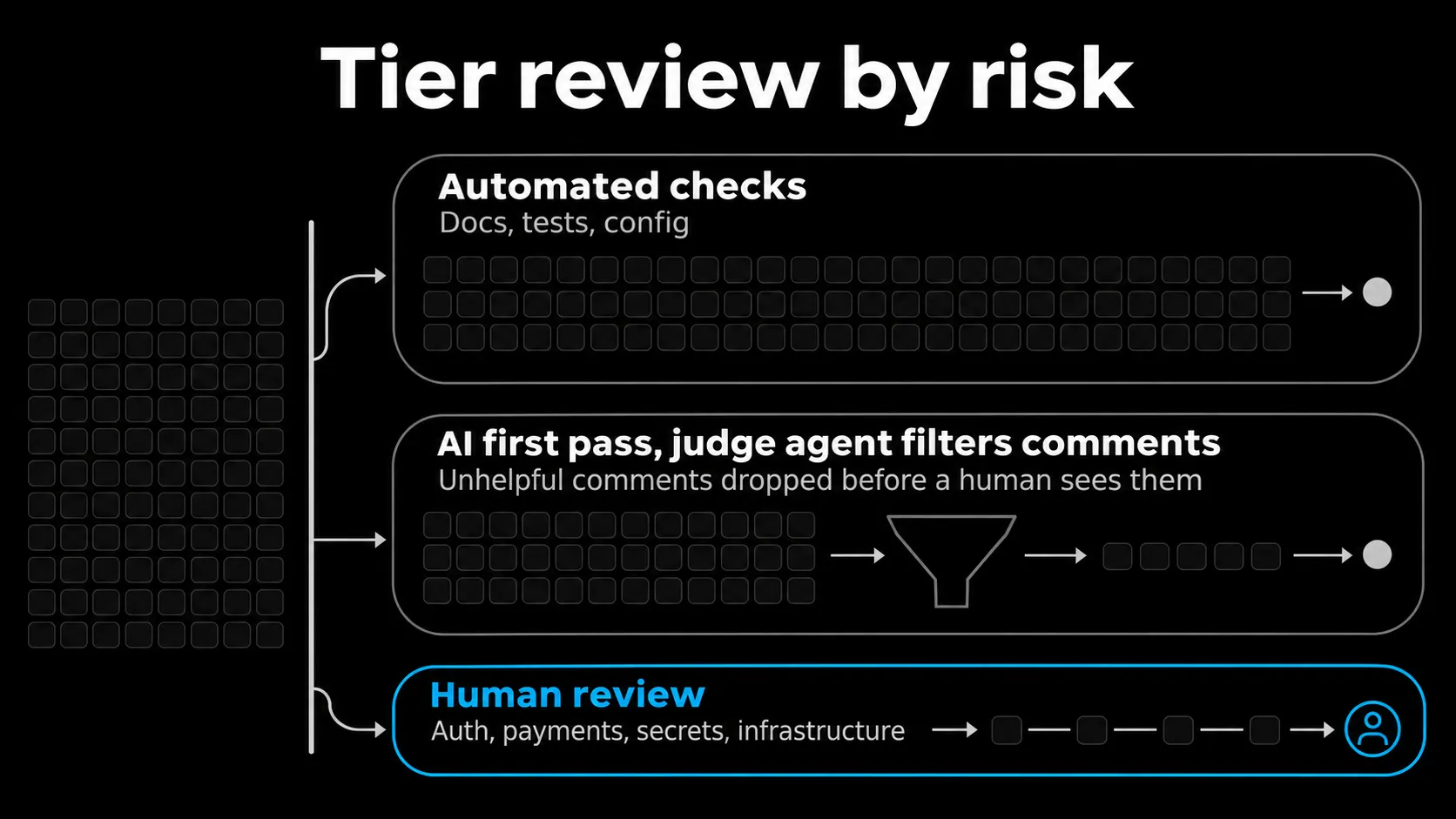
HubSpot’s write-up of its internal reviewer, Sidekick, from March 2026, is the most useful public account I have found. Its main early failure was unhelpful feedback, comments that were congratulatory, verbose or nitpicky, more than wrong feedback. Prompt tuning did not fix it. What fixed it was a second judge agent that checks every draft comment for being succinct, accurate and actionable, and drops the rest before a human sees it. HubSpot calls that two-stage design arguably the single most important factor, and reports feedback wait times down 90% with over 80% thumbs-up on comments.
What AI review costs per pull request
Price is now a real line item. Codacy’s 2026 roundup puts Anthropic’s Claude Code Review at $15 to $25 per pull request depending on how much verification it does, and GitHub Copilot review now bills both AI credits and Actions minutes. At 23% more PRs per engineer, a per-PR price scales with exactly the volume that caused the problem. I covered the same denominator problem for raw token bills in my token spend reality check.
How to rebuild your engineering workflow around review
Treat review as the constraint and design everything else to feed it. That means making each pull request carry its own proof, filtering automated comments before people read them, and spending human attention only where a wrong merge is expensive. More generation on an unchanged review process just makes the queue longer.
Six rules for an agent-ready review process
Six rules now shape every agent system I build, and each one targets the review step rather than the generation step.
- Measure review before you buy more generation. Track PR-to-merge time and changes-requested rate per team. If they are rising, another agent seat makes them worse.
- Make the PR carry its proof. An agent PR should arrive with the tests it ran, the output it produced and a short note on intent. The contributor, human or agent, supplies the evidence. The reviewer should not have to generate it.
- Re-run the checks yourself. In my headless content pipeline, the agent writes into a fenced folder, the platform re-runs every hard check itself, gives the agent one automatic fix-up turn, and only then puts it in front of a person. The agent’s own claim that it passed is not evidence.
- Filter before a human reads. Copy HubSpot’s judge pattern. An AI comment that is not actionable costs reviewer attention, which is the scarcest thing you have.
- Tier by risk. Docs, tests and config typos can pass on automated checks. Auth, payments, secrets and infrastructure always get a human.
- Turn every false positive into a test. Two wrong findings in one of my audit tools became permanent regression tests, so the review layer gets more trustworthy each run instead of resetting.
What I would not do
I would not let agents merge their own work into main on the strength of an AI review alone, and I would not judge adoption by PR counts. The Harvard data is exactly a case of PR counts rising while delivered work did not. I’d be wrong about the first rule if public benchmarks like GitHub’s ReviewBench start showing AI reviewers catching behavioral bugs as reliably as experienced humans. On the evidence so far, they are not there.
The constraint always moves
Goldratt’s point was never about ovens. Every time one step gets cheap, the constraint moves to the next step, and the teams that win are the ones that notice where it went. Two years ago the constraint in software was typing. Today it is trust: deciding, quickly and correctly, that a change is safe to ship.
If you run a team with coding agents, pull last month’s PR-to-merge time and changes-requested rate this week and compare them with the quarter before adoption. If either went up, your next investment is review infrastructure, not another agent. For how task type changes which agent produces reviewable work in the first place, see my Codex vs Claude Code comparison, and for testing models on your own tasks before you commit, my guide on how to test AI models.
Frequently asked questions
Do AI coding agents make engineering teams ship more software?
Not yet, on the best data available. A Harvard working paper by Fiona Chen and James Stratton, using Jellyfish data from 718 firms through March 2026, found agents raised code volume by about 30% and pull requests by 23% per engineer, but resolved Jira issues did not rise significantly. The gain is absorbed downstream, mostly in code review.
Why do AI-generated pull requests take longer to review?
Because the reviewer gets a finished diff without the reasoning behind it, and has to rebuild intent from the ticket and the code. LinearB’s 2026 benchmarks put pickup time for agentic AI pull requests at 5.3x that of unassisted ones. Changes-requested rates also roughly doubled in the Harvard study, which suggests first drafts are weaker.
Are AI code review tools worth it for agent-generated PRs?
Partly. By March 2026 nearly 80% of firms in the Harvard sample had used an AI review tool, yet only 10.8% of pull requests got an AI comment. The useful pattern is HubSpot’s: an AI first pass, a second judge agent that drops unhelpful comments, and humans reserved for risky changes.
How are AI coding agents changing software engineering roles?
The work is shifting from writing code to specifying, checking and owning it. In the Harvard study the share of engineers doing code review rose 14% after agent adoption while the share writing code stayed flat. Judgment about what to merge is becoming the scarce skill.
What should a team change first when adopting coding agents?
Measure review before buying more generation. Track PR-to-merge time and changes-requested rate, require every agent pull request to carry test or run evidence, and tier review by risk so auth, payments and infrastructure always get a human. More agents on an unchanged review process just lengthens the queue.
Frequently asked questions
01Do AI coding agents make engineering teams ship more software?
Not yet, on the best data available. A Harvard working paper by Fiona Chen and James Stratton, using Jellyfish data from 718 firms through March 2026, found agents raised code volume by about 30% and pull requests by 23% per engineer, but resolved Jira issues did not rise significantly. The gain is absorbed downstream, mostly in code review.
02Why do AI-generated pull requests take longer to review?
Because the reviewer gets a finished diff without the reasoning behind it, and has to rebuild intent from the ticket and the code. LinearB's 2026 benchmarks put pickup time for agentic AI pull requests at 5.3x that of unassisted ones. Changes-requested rates also roughly doubled in the Harvard study, which suggests first drafts are weaker.
03Are AI code review tools worth it for agent-generated PRs?
Partly. By March 2026 nearly 80% of firms in the Harvard sample had used an AI review tool, yet only 10.8% of pull requests got an AI comment. The useful pattern is HubSpot's: an AI first pass, a second judge agent that drops unhelpful comments, and humans reserved for risky changes.
04How are AI coding agents changing software engineering roles?
The work is shifting from writing code to specifying, checking and owning it. In the Harvard study the share of engineers doing code review rose 14% after agent adoption while the share writing code stayed flat. Judgment about what to merge is becoming the scarce skill.
05What should a team change first when adopting coding agents?
Measure review before buying more generation. Track PR-to-merge time and changes-requested rate, require every agent pull request to carry test or run evidence, and tier review by risk so auth, payments and infrastructure always get a human. More agents on an unchanged review process just lengthens the queue.