Claude Code9 min read
Rebuild Karpathy's Claude Code workflow, then count the work you accept
Karpathy's Claude Code workflow went viral. Rebuild it as a timed test on your own backlog and count the work you accept, not the work Claude produces.
[ Key takeaways ]
- Karpathy's own post describes Opus 5.5 on medium effort in the Claude Code desktop app, with Claude doing all code reading, writing and terminal work.
- Several habits in the viral breakdown, like very short prompts and simplified English explanations, come from Nick Saraev's retelling rather than Karpathy's post, so test them before treating them as rules.
- Copying the habits proves nothing. Run them as a timed replication on 10 real tasks and log every output as accepted, edited, rejected or abandoned.
- The metric that transfers is minutes of your own time per accepted result, compared against a baseline week on the same kind of work.
Nick Saraev’s five-minute breakdown of how Andrej Karpathy uses AI passed 494,000 views within days of its November 5 upload. Most of those viewers will now type shorter prompts, switch Opus to medium effort and feel more productive. Almost none of them will know whether anything improved.
To rebuild Karpathy’s Claude Code workflow, copy the habits he actually describes, then run them as a timed replication on your own backlog. Write an acceptance rule for each task first, and log every output as accepted, edited, rejected or abandoned. Minutes of your time per accepted result is the number that tells you whether the workflow transferred.
I care about that distinction because the most expensive failures in my own automation work looked finished. The output existed. It just was not work I could accept.
What does Karpathy’s Claude Code workflow actually look like?
Karpathy uses the Claude Code desktop app on Mac with Opus 5.5 on medium effort as his default. He does not read code, write code or run terminal commands. He talks to Claude, and Claude does the engineering. His manual work on HackerTube was an API key, a VPS and a domain.
That comes from his own HackerTube post, dated October 31, 2026, where he puts it plainly: “I only talk to Claude and have it do everything.” He says Opus downloaded the Hacker News comment archive, filtered it, ran Sonnet over it in a Claude Code Workflow, removed spam and narrowed it to about 40,000 comments recommending a YouTube video. The result was 6,454 videos from 2007 to 2026 across 150 topics, built in roughly two hours. Deployment was one instruction: he gave Claude the server IP and told it to update, deploy, secure, harden and optimize.
The Hacker News submission gives the comment count as 39,834. The numbers agree. That matters, because the rest of the viral version is less firmly sourced.
Which parts come from Karpathy and which from the retelling?
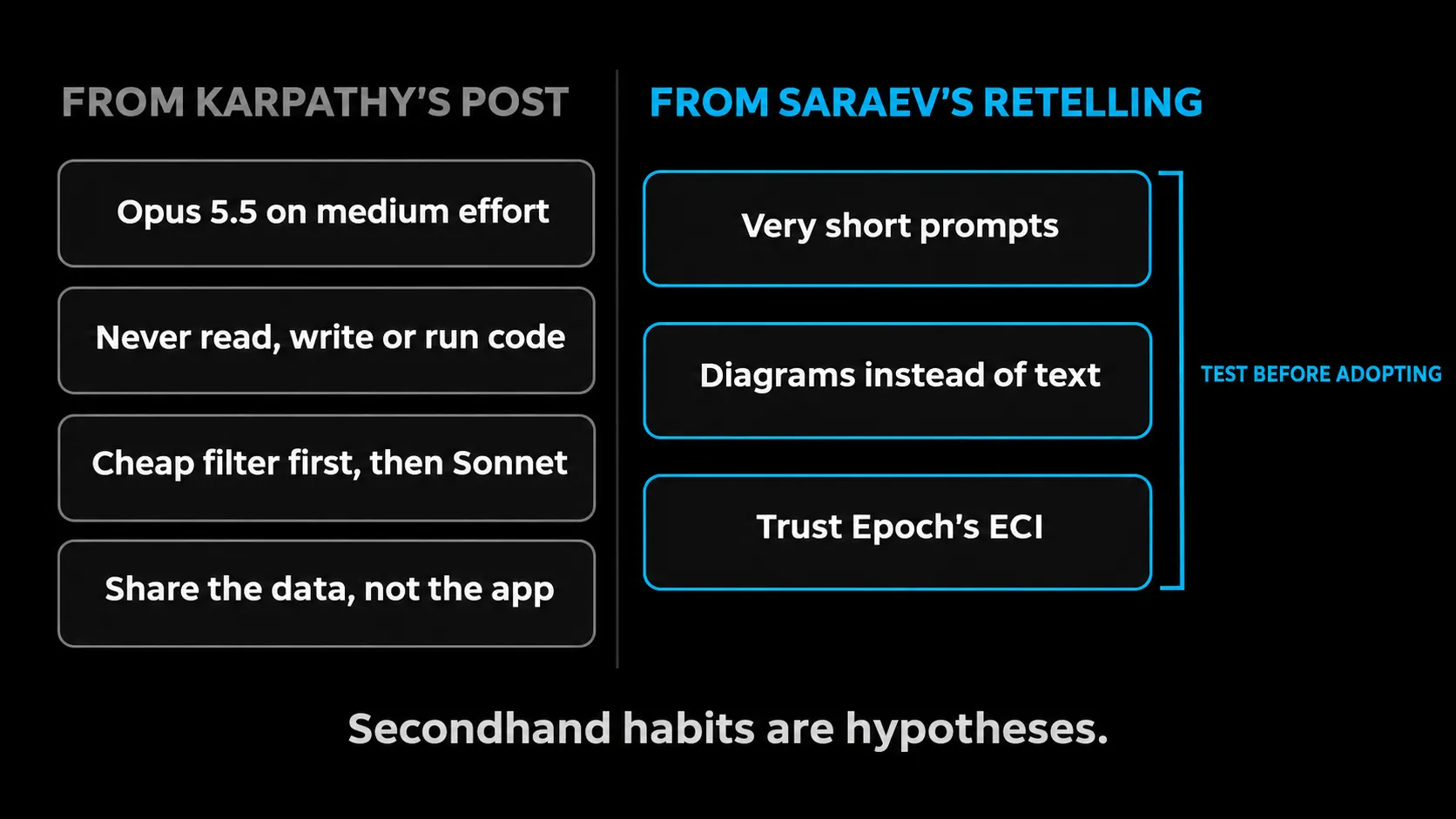
Only some of the viral habits appear in Karpathy’s own writing. Medium effort, the hands-off rule, Opus delegating to Sonnet and sharing data instead of apps are in his post. Short prompts, simplified-English explanations, diagrams on request and the benchmark skepticism come from Saraev’s video.
That does not make the second group wrong. It means they are a secondhand account, and secondhand accounts compress. Here is how I split them before testing anything:
| Habit | Where it comes from | What it saves | What it risks |
|---|---|---|---|
| Opus 5.5 on medium effort by default | Karpathy’s post | Tokens and wait time | Underpowered on hard reasoning |
| Never read, write or run code yourself | Karpathy’s post | Your attention | Silent wrong changes |
| Cheap filter first, then Sonnet over what is left | Karpathy’s post | Model spend on junk input | Filter drops real signal |
| Share the data and prompt, not the app | Karpathy’s post (data export) | Maintenance | Others rebuild something different |
| Very short prompts | Saraev’s video | Prompt writing time | Missing constraints |
| Diagrams or HTML explainers instead of text | Saraev’s video | Reading time | Pretty but wrong summaries |
| Trust Epoch’s ECI over single benchmarks | Saraev’s video | Hype filtering | Still not your workload |
Epoch’s Capabilities Index combines many benchmarks into one capability scale. It is a sensible place to look. It still is not your backlog.
Why the view count is the wrong signal
A view count measures how many people wanted to watch an expert work. It says nothing about whether his habits survive contact with your tasks, your codebase and your clients. The only way to know is to rebuild the workflow and count what you would actually ship.
Two incidents from my own systems taught me this. My lead resolver, the step that finds the founder behind a business, kept attaching the wrong person: an unrelated notary with three strangers’ social profiles, a namesake with no connection to the company. Every row looked complete. The fix was not a better prompt. Search-sourced founder fields now never write automatically and go to a review queue instead.
The second was outreach copy. A prompt that handed the model example phrases produced a batch where the same wording repeated across messages. Each message passed on its own. The batch did not.
Both runs would have scored well on output produced. Neither scored well on output accepted. Karpathy’s workflow deserves the same scrutiny.
How do you run a timed replication of the workflow?
Pick 10 tasks from your real backlog, write each task’s acceptance rule before starting, and time-box the run to one working week. Use the Karpathy settings exactly as described, log every output with the minutes you spent, then compare against a baseline week of similar work.
- Choose 10 tasks you would do anyway. Mix a few small fixes, two or three features, one deploy and one data job, so the cheap-filter pattern gets exercised.
- Write acceptance first. “Tests pass and the diff touches only the billing module” is a rule. “Looks good” is not.
- Lock the setup. Opus 5.5, medium effort, desktop app, no manual code edits. If you break a rule, log it rather than hiding it.
- Run the prompt split. For three tasks, send a short prompt and a detailed prompt in separate sessions. This is the cheapest way to test the short-prompts claim.
- Start a timer per task. Count your minutes, not Claude’s. Waiting while you do other work is not your time; reviewing a diff is.
- Pull last month’s numbers as the baseline. Same task types, your normal setup.
If you have read my guide to testing AI models on your own tasks, this is the same discipline pointed at a workflow instead of a model.
What counts as accepted work?
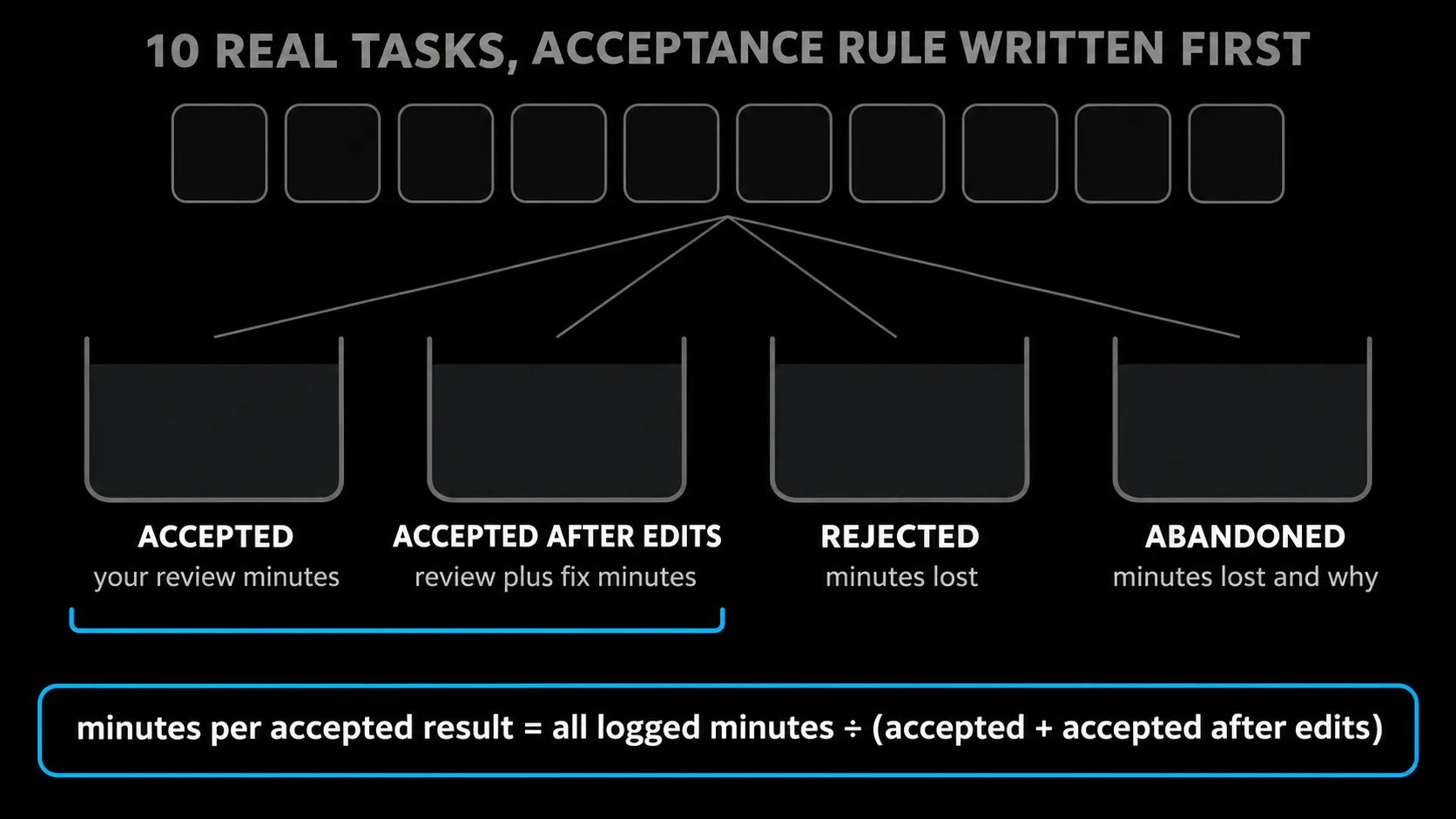
Accepted work is output you would ship or hand to a client with no further changes, judged against a rule written before the run. Everything else lands in one of three other buckets, and each bucket has a cost you need to see separately.
Use four outcomes per task:
| Outcome | Definition | What to record |
|---|---|---|
| Accepted | Meets the pre-written rule as delivered | Your review minutes |
| Accepted after edits | Meets the rule after you or Claude fixed it | Review plus fix minutes, number of rounds |
| Rejected | Does not meet the rule and you start over | Minutes lost |
| Abandoned | You stopped because the approach was wrong | Minutes lost and why |
Then compute three numbers for the week. First-pass acceptance is accepted divided by attempted. Minutes per accepted result is all your logged time divided by accepted plus accepted-after-edits. Rework rounds is the average number of fix cycles on edited tasks.
Be honest about the limits. Ten tasks over one week is a pilot, not a settled answer, and a single person’s log cannot separate the workflow from a lucky task mix. Treat a small difference as noise and run a second week before changing anything important.
The middle number is the one I would decide on. A workflow can lift first-pass acceptance and still cost more of your time if every rejection takes an hour to diagnose.
Which habits transfer to client work, and which do not?
The delegation pattern and the cheap-filter step transfer almost anywhere. The hands-off rule transfers only where a wrong change is cheap to see and cheap to undo. Short prompts are a hypothesis to test per task type, not a default to adopt.
HackerTube is a personal site built on public data. If Claude gets a recommendation wrong, Karpathy notices a bad video. In a client project with a payment flow or customer records, the same unreviewed change can cost a refund or a breach notice. Those are different blast radii, and the workflow should differ with them.
Notice what Karpathy still did by hand: credentials, infrastructure and the domain. Those are the steps where a mistake is hard to reverse. That is the real principle underneath “never touch the code.” Keep your hands on the irreversible parts.
I would keep the Opus-to-Sonnet split without hesitation. It is the same reason I put deterministic filters before any model call in my own pipelines: you stop paying a strong model to read junk.
For a longer build where review stayed in the loop, see what it took to ship a production app with Claude Code.
What should you publish after the replication?
Publish the log, not the feeling. A table of 10 tasks with outcomes, minutes and the acceptance rule for each is more useful to the next person than another breakdown of an expert’s habits, because it shows what happened on ordinary work.
Include the baseline next to it. Note every rule you broke during the week. If the short-prompt split went the other way on your tasks, say so, since that is the most interesting result you could have. Karpathy already models this: HackerTube ships with a data export so others can give it to their own agent. Sharing the data behind a claim is the same move.
The habit worth copying is the measurement
The viral version of any expert’s workflow is a list of settings. The part that made it work for him is that he could see, quickly, whether the result was good. Most of us copy the settings and skip the seeing.
Run one week. Ten tasks, acceptance rules written first, every minute logged. If your minutes per accepted result drop against the baseline, keep the workflow. If they do not, you just saved yourself a month of feeling productive.
Frequently asked questions
What is Karpathy’s Claude Code workflow?
In his October 31, 2026 HackerTube post, Karpathy says he uses the Claude Code desktop app on Mac with Opus 5.5 on medium effort as his default. He does not read or write code or run terminal commands himself. He talks to Claude and lets it do the engineering, handling only things like API keys, a VPS and a domain.
Does Karpathy really use short prompts?
That claim comes from Nick Saraev’s video, not from Karpathy’s own post. Saraev says Karpathy believes extra requirements can make the model do worse because they contradict each other. It is plausible, but it is a retelling, so test it on your own tasks with a short and a detailed version of the same prompt.
What does Opus orchestrating Sonnet subagents mean?
Opus orchestrating Sonnet subagents is a delegation pattern. A stronger model plans and coordinates while a cheaper model handles bulk work. For HackerTube, Karpathy says Opus filtered Hacker News comments and ran Sonnet over them in a Claude Code Workflow, narrowing them to about 40,000 comments that recommended a YouTube video.
How do I measure whether an AI coding workflow works for me?
Pick 10 real tasks, write the acceptance rule for each before you start, and time-box the run. Log every output as accepted, accepted after edits, rejected or abandoned, with the minutes you spent. Compare minutes per accepted result against a baseline week of the same work.
Should I stop reading the code Claude writes?
Only where a wrong change is cheap to notice and cheap to undo. HackerTube is a personal site built on public data. For client work involving payments, personal data or production systems, review stays part of the definition of done.
Frequently asked questions
01What is Karpathy's Claude Code workflow?
In his October 31, 2026 HackerTube post, Karpathy says he uses the Claude Code desktop app on Mac with Opus 5.5 on medium effort as his default. He does not read or write code or run terminal commands himself. He talks to Claude and lets it do the engineering, handling only things like API keys, a VPS and a domain.
02Does Karpathy really use short prompts?
That claim comes from Nick Saraev's video, not from Karpathy's own post. Saraev says Karpathy believes extra requirements can make the model do worse because they contradict each other. It is plausible, but it is a retelling, so test it on your own tasks with a short and a detailed version of the same prompt.
03What does Opus orchestrating Sonnet subagents mean?
Opus orchestrating Sonnet subagents is a delegation pattern. A stronger model plans and coordinates while a cheaper model handles bulk work. For HackerTube, Karpathy says Opus filtered Hacker News comments and ran Sonnet over them in a Claude Code Workflow, narrowing them to about 40,000 comments that recommended a YouTube video.
04How do I measure whether an AI coding workflow works for me?
Pick 10 real tasks, write the acceptance rule for each before you start, and time-box the run. Log every output as accepted, accepted after edits, rejected or abandoned, with the minutes you spent. Compare minutes per accepted result against a baseline week of the same work.
05Should I stop reading the code Claude writes?
Only where a wrong change is cheap to notice and cheap to undo. HackerTube is a personal site built on public data. For client work involving payments, personal data or production systems, review stays part of the definition of done.