Jev Judgment Models Are Fast. That Does Not Make Them Better Than LLMs.
Jev judgment models make fast, typed decisions inside software. Learn where they beat LLMs, where they do not, and how to test them safely.
Most AI automation stacks have the same expensive habit: they ask a language model to write a paragraph when the software only needs a decision.
Jev is TypeSafe AI’s new answer to that problem. It takes text or structured state and returns typed choices, scores, or yes-or-no probabilities that code can use directly. It belongs inside repeated, bounded decisions in an agent loop. It does not replace GPT, Claude, or another LLM when the job needs open-ended reasoning, synthesis, code, or language. TypeSafe’s launch announcement calls this a “System One” model. The more useful framing is simpler: use a judgment model to decide, an LLM to think and generate, and ordinary software to execute.
Why does a decision layer matter in an agent?
That division matters because the bottleneck in an agent is often not the first good answer. It is the thousands of small questions around it: is this source credible, is this draft ready, should the agent call another tool, does this customer request need a human, is the confidence high enough to continue? That is also the practical line between an AI agent and an automation: fixed rules are cheap until the inputs become messy enough to need a judgment.
I have not run Jev in a production system yet. This is a design analysis based on TypeSafe’s public material, Vercel’s integration description, and the review gates I already use in agent and content workflows. The thesis is testable: if a decision repeats, has a defined rubric, and can fail safely, a small decision layer may be a better fit than a general chat model.
What is Jev, and what is a judgment model?
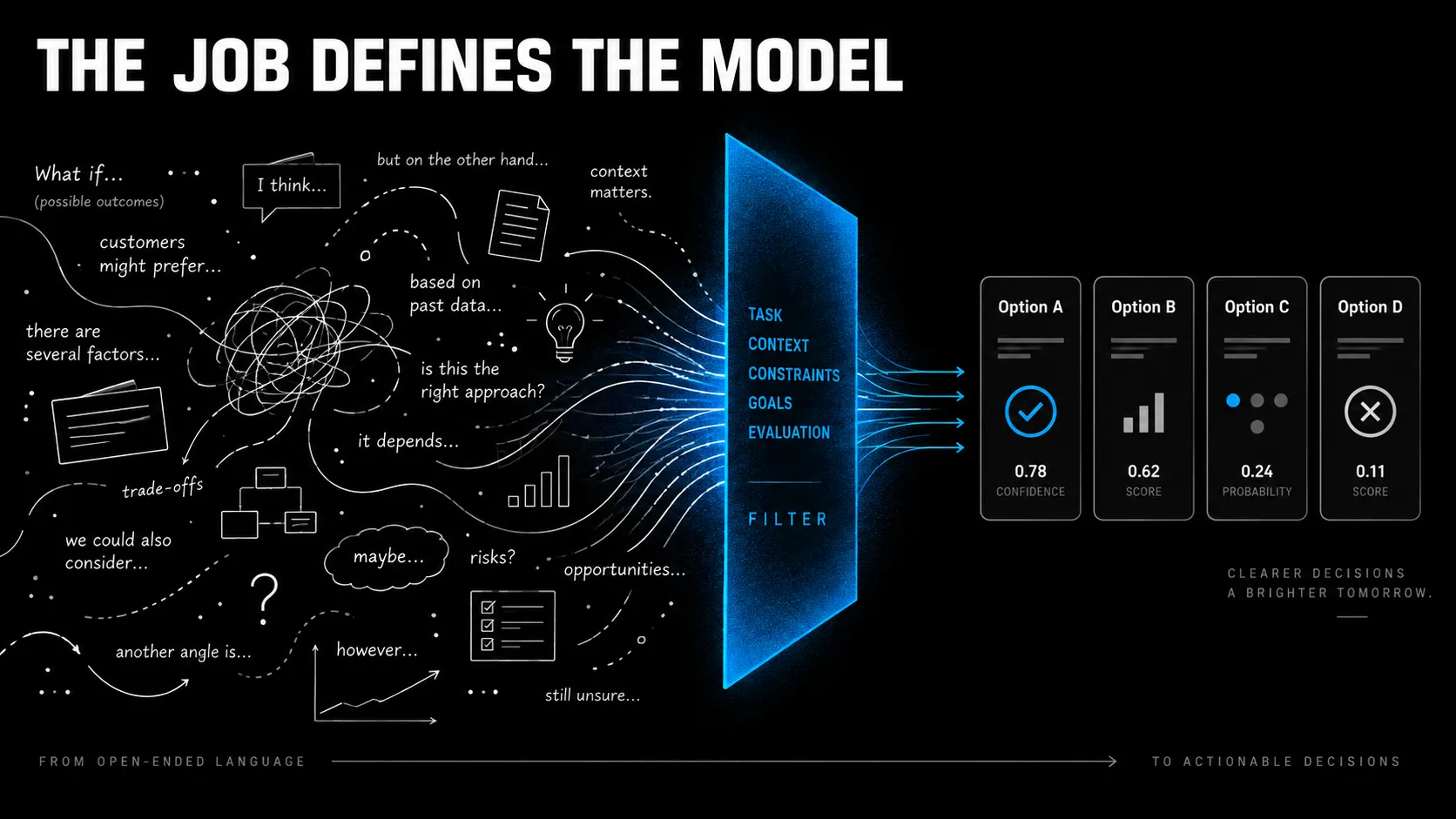
Jev is a model for bounded decisions. You provide the state plus the possible answers or scoring criteria. It returns a typed output and probability information rather than a generated explanation. That makes it useful when an application needs to classify, route, score, gate, or escalate work without parsing a chat response first.
TypeSafe released Jev on September 15, 2026 in early access. Its API is built around choices, scores, and a yes-or-no primitive called Noul. The company says it samples answers in parallel and trains for calibrated decisions using an approach it calls RLCD. That is TypeSafe’s product description, not an independently reproduced architecture or benchmark. Its launch post is refreshingly explicit that the bold performance claims come from its own workflow evaluations.
The important design change is the output contract. A general LLM can return structured JSON. Jev starts from the narrower premise that the valid decision space is known before the call. Software can set the question, inspect the probability, apply a threshold, and decide whether to act or hand off.
How are Jev judgment models different from LLMs?
The difference is not that Jev is “smarter” or that LLMs are obsolete. They are optimized for different parts of the job. LLMs are flexible because they generate sequences of text. Judgment models trade that flexibility for a bounded, machine-readable decision that can be called frequently.
| Question | Jev judgment model | General-purpose LLM |
|---|---|---|
| Best job | Repeated bounded decision | Open-ended generation and reasoning |
| Output | Choice, score, or probability | Text, code, JSON, explanation |
| Good examples | Route, rank, verify, guardrail, escalate | Research, draft, synthesize, plan, code |
| What must be defined first | Decision criteria and valid outcomes | The task, context, and desired response |
| Main risk | A well-formed but wrong decision | A plausible answer that is wrong, malformed, or outside scope |
| Where it belongs | Inside a high-frequency control loop | At the reasoning or creation step |
JSON mode does not erase this difference. It can give an LLM a safer interface, but the model still has to generate a response token by token and your application still has to decide what to do with its uncertainty. TypeSafe’s claim is that Jev returns probabilities and confidence with a type-safe output shape, which removes schema errors, not factual errors. A result can be perfectly typed and still be the wrong call. That is why confidence thresholds, audit logs, and human escalation remain part of the design.
Where should Jev sit inside an agent workflow?
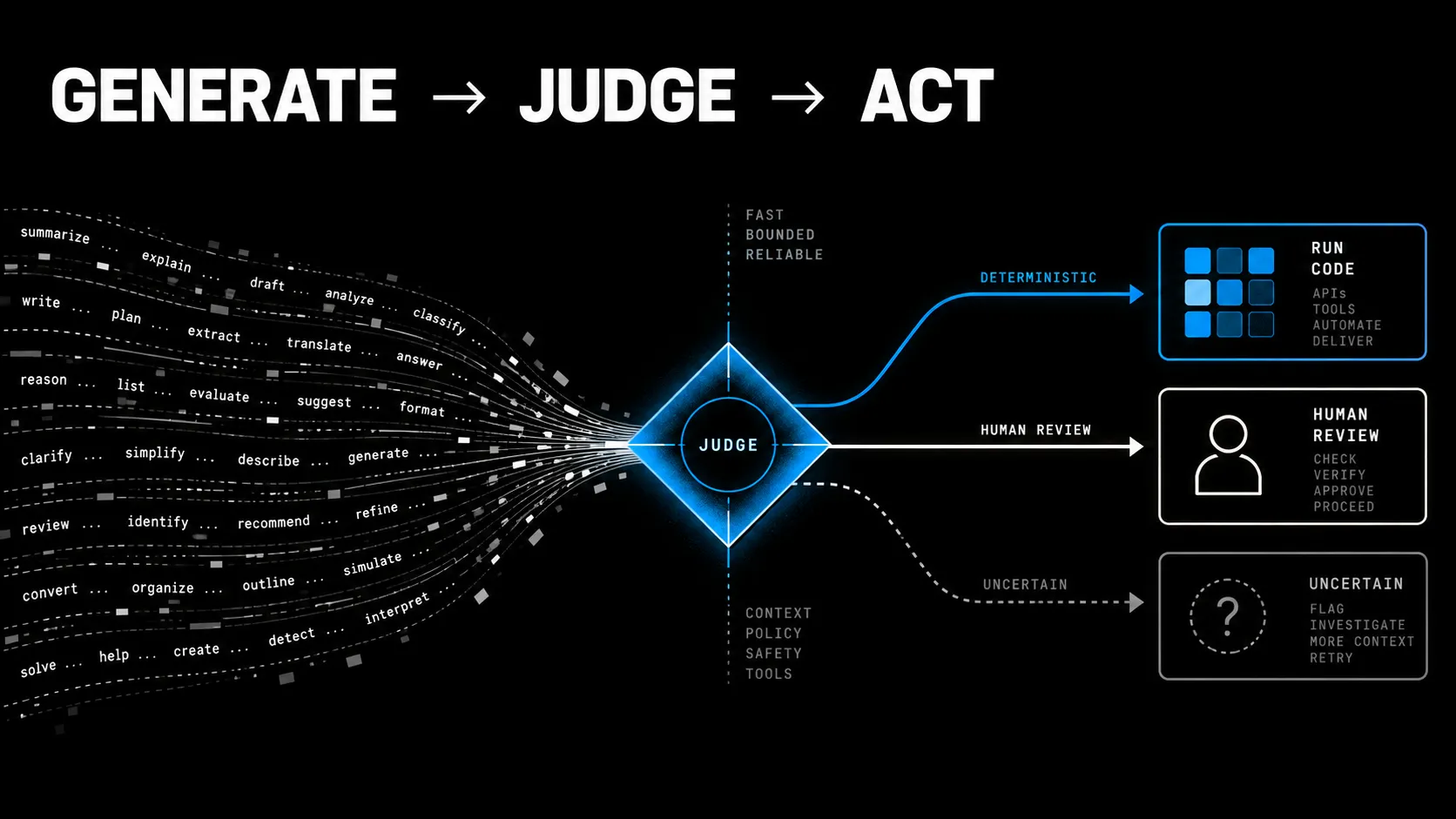
The best place for a judgment model is between reasoning and action. An LLM can interpret the goal and produce a draft plan. Jev can repeatedly decide whether each next move satisfies a defined rule. The workflow code then executes only the allowed move and records why.
For an agent workflow, I would separate the loop into four layers:
- Generate: an LLM researches, writes, plans, or proposes code.
- Judge: Jev scores the proposal against a narrow rubric, such as relevance, policy fit, completeness, or risk.
- Act: deterministic code routes, retries, saves, or escalates based on a threshold.
- Review: a human takes the cases where confidence is low, risk is high, or the decision changes the public record.
Vercel describes the same practical fit in its AI Gateway launch note: use Jev to choose an agent’s next tool, decide whether a workflow continues or stops, score risk, verify outputs, and send uncertain cases to human review. Vercel’s description is a useful implementation list, not evidence that every one of those decisions should be automated.
This gives a content workflow a cleaner shape. An LLM can research and draft. A fast decision layer can score source relevance, flag unsupported claims, check whether a brief is complete, and decide whether a draft needs another revision. It should not publish the post simply because a confidence score crossed a number. Public claims remain a human decision.
What are the first decisions worth testing?
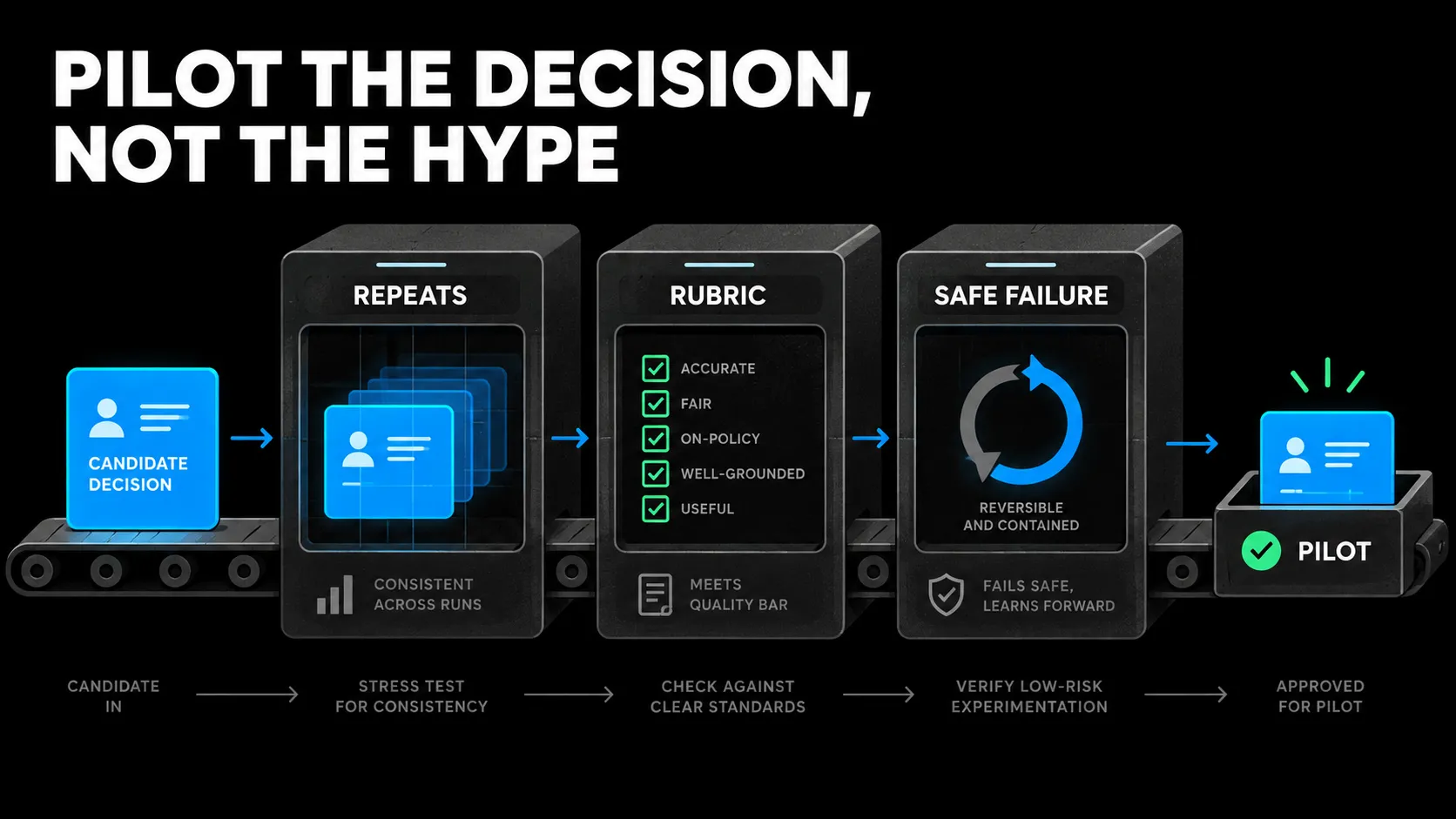
Start with decisions that are high-volume, reversible, and already expressed as a repeatable rubric. Do not begin with a decision where a wrong answer creates legal exposure, customer harm, or an irreversible public action.
Four good pilot candidates are:
| Decision | What the model judges | Safe action |
|---|---|---|
| Inbox triage | Urgency, category, and whether a person should respond | Route into a queue |
| Agent tool selection | Whether another browse, search, or validation step is needed | Choose from an allowlisted tool set |
| Draft QA | Whether a claim has a source and whether the brief was answered | Flag or return for revision |
| Lead enrichment | Whether available evidence meets your field-completion rule | Mark as review-ready, not auto-contacted |
The common trait is simple: you can write down what “good” looks like before the model sees the input. If you cannot define the rubric or name the safe failure mode, the decision is not ready for a cheap automated judge. Keep it with a person or use an LLM to surface evidence for a person to assess.
Should you believe the speed and cost claims?
Treat the headline numbers as vendor-reported evidence, not as a procurement conclusion. TypeSafe says its workflow evaluations show Jev at 193.6 times faster and 444.6 times cheaper than the LLM comparisons it selected. The company also notes that its own capabilities team created the workflows and that those gains are probably at the high end of real-world results. The launch details include those caveats.
That does not make the underlying idea weak. It tells you how to evaluate it correctly. Measure your own decision set against the best practical alternative, not against the biggest model in a demo. Keep the same context, rubric, thresholds, and fallback path for both systems. Then track:
- false approvals, where bad work passes;
- false rejections, where good work gets blocked;
- calibration, whether a 0.9 score is actually right about nine times in ten over a large enough sample;
- median and p95 latency;
- total workflow cost, including retries and human review.
Vercel’s report that Jev reached nearly 13% of paid AI Gateway teams within 24 hours is real adoption evidence, but it is not a reliability benchmark. Its first-day usage data tells us developers want this category. It does not tell us which of your business decisions it should own.
Why LLMs still own the hard part
LLMs still own work where the answer space is unclear, where context must be discovered, or where the output itself needs language. Asking Jev to invent a campaign angle, diagnose a messy customer dispute, write code, or explain a tradeoff misses the point of the model.
The strongest systems will probably look less like an LLM versus a judgment model and more like a division of labor. The LLM sees the messy world, proposes an interpretation, and creates the artifact. The judgment layer makes many small, constrained calls around that work. Code enforces permissions and thresholds. A human retains the decisions that need taste, accountability, or an understanding of consequences that is not present in the rubric.
That is the shift I would watch. Not whether Jev replaces chat. Whether we stop paying a frontier model to answer every small question in an automated system.
Frequently asked questions about Jev judgment models
Is Jev a smaller LLM?
No. TypeSafe presents Jev as a System One decision model that produces typed probabilistic outputs rather than generated text. The practical distinction is the job: use it for bounded choices, scores, and probabilities inside software. Use an LLM when the job needs open-ended generation, reasoning, or an explanation.
Can Jev make wrong decisions?
Yes. A typed output prevents schema errors, but it does not guarantee the model understood the state or applied the rubric correctly. Treat its probabilities as a signal to threshold and test against real labeled cases, not as permission to remove monitoring.
When should an agent use a judgment model instead of an LLM?
Use a judgment model when the possible actions are known, the decision repeats often, and you can define a safe threshold and escalation path. Use an LLM when the system must interpret an unfamiliar situation, create a new artifact, or explain its reasoning to a person.
What is the safest first Jev pilot?
Start with a reversible classification or review queue that already has human decisions you can use as a test set. Measure false approvals, false rejections, calibration, latency, and total review cost before letting the result influence any consequential action.
Newsletter
New notes, in your inbox.
Get each new article from the workbench by email. No spam, unsubscribe anytime.
Related reading
Continue through the system.
-
Always-on AI agents: what OpenAI Dots actually changes
Always-on AI agents can carry work between conversations. Learn what OpenAI Dots changes, where agent computers help, and how to run a useful pilot.
Read article → -
Claude Opus 5.5: What Creators Are Making
Claude Opus 5.5 is helping creators build games, videos, and interactive projects. Here is what changed, what examples show, and where review matters.
Read article → -
GPT-6 Astra Is a Capability Leap. The Workflow Is Still the Product.
GPT-6 Astra can carry more work across browsing, computer use, and creation. The advantage now comes from supervised creator and agent workflows.
Read article →