SEO Skill Suite: how I turn an audit into a work plan
My SEO Skill Suite connects keyword research, page checks, technical audits, and AI visibility. See the workflow, real findings, and its limits.
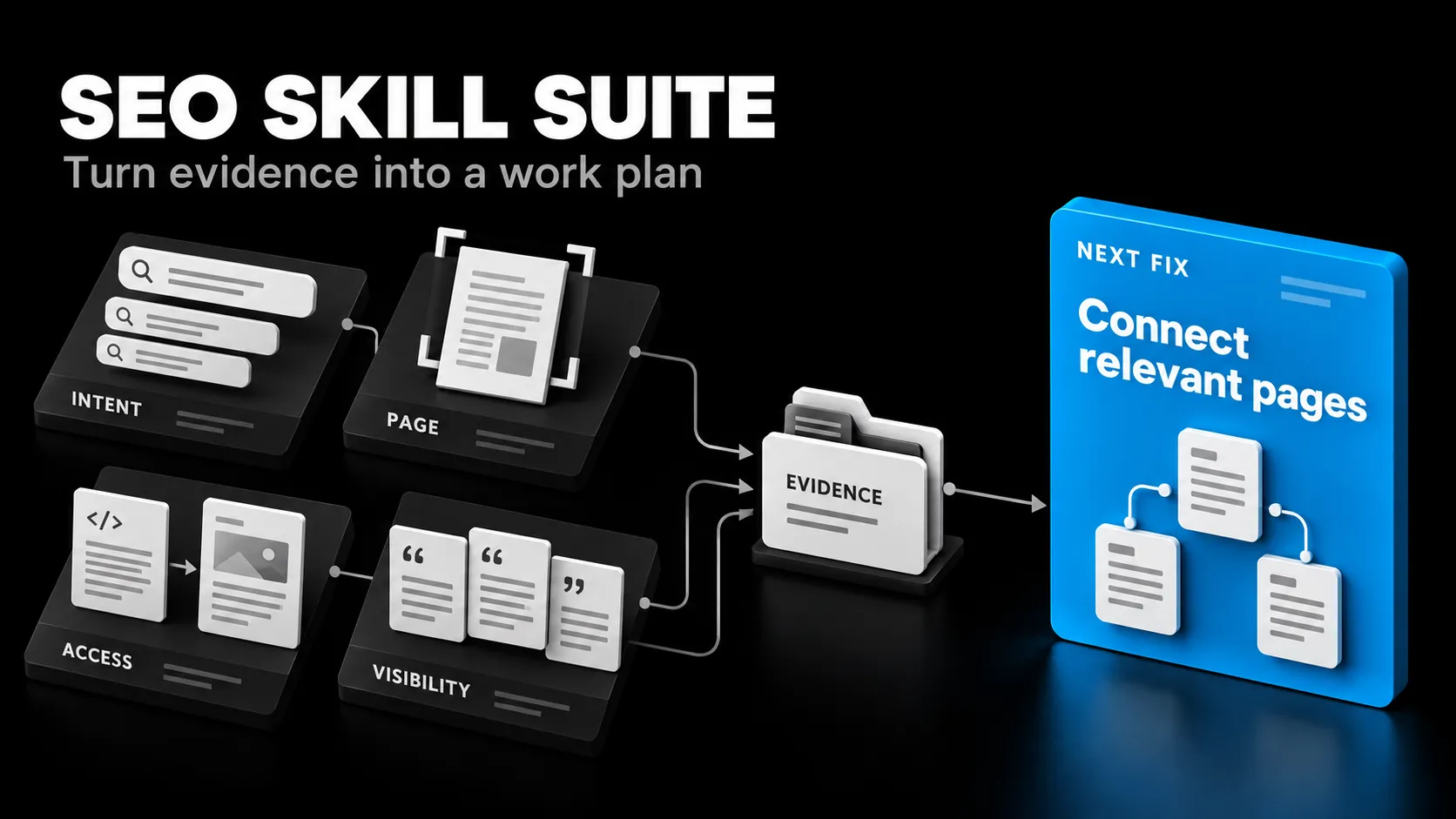
My portfolio had unique titles and one H1 on every page. Three important pages still had no incoming body links.
That finding captures why I built the SEO Skill Suite in Nexis. It connects four jobs: deciding which searches matter, checking the pages that target them, inspecting the site’s technical accessibility, and measuring authority and AI-search visibility. An advisory layer supplies the research behind the checks.
The useful output is a work plan with evidence: what to fix first, what already works, and what the available data cannot establish. I care about that distinction because an audit competes with the same delivery hours as building the fixes.
What is the SEO Skill Suite?
The SEO Skill Suite is my modular SEO workflow inside Nexis. Four execution skills combine written instructions, Python scripts, reference material, and structured deliverables. SEO Advisor supports them with explanations and a cited research corpus. Each part has a defined job, so a keyword question and a rendering problem get different checks.
| Skill | Question it answers | Working output |
|---|---|---|
| SEO Foundation | What do buyers search, and which page should answer? | SERP research, keyword clusters, URL map |
| SEO On-Page | Does the page deliver on that intent? | Metadata, content and link findings, proposed edits |
| SEO Technical | Can crawlers fetch, render, and navigate the site? | Crawl findings, rendering comparisons, technical fix files |
| SEO Authority and AI | Can systems retrieve, identify, and cite the business? | Access checks, entity findings, repeated visibility samples |
The reference layer separates official guidance from practitioner advice. That matters when a useful working rule starts being repeated as a ranking fact.
The distinction between a skill and an agent matters here. The suite defines repeatable methods. The assistant uses those methods and available tools to do the work. Installing instructions alone does not supply credentials, data, or reliable judgment.
What my portfolio audit actually found
The August 22, 2026 on-page audit covered 20 sitemap URLs. All 20 had unique titles, unique meta descriptions, and exactly one H1. Those mechanical checks passed. A separate 15-page link crawl found no incoming body links to /about, /blog, or /services. Navigation links still existed; the gap was contextual linking.
That changed the priority. My work pages needed to connect their evidence to the service it demonstrated and to related work. A visitor could then move from a specific build to the relevant offer, while crawlers gained more meaningful paths through the site.
The image check supplied another useful constraint. Four homepage images totalled 568 KB. The tested WebP recompression offered just 766 bytes of aggregate savings. Spending a delivery session on that particular recommendation would have bought very little.
These are dated audit findings. They do not describe every page on the site today, and they do not prove a subsequent increase in rankings or enquiries. They show how measured evidence changed the proposed work.
How the four skills work together
I start with the business question and check technical blockers early. Then Foundation assigns search intent to pages, On-Page evaluates their content, Technical investigates access and structure, and Authority/AI examines retrieval and visibility. The modules share evidence, but an obvious access failure moves ahead of content polishing.
Foundation reads live search results, groups queries using overlapping results, and maps each cluster to a URL. Its relevance filter matters. My August research found that much of the broad “AI automation agency” query family concerned starting an agency. That audience differs from someone looking to hire help. An easy keyword can still be a poor business target.
On-Page checks the actual page or draft. Technical preserves raw HTML and compares it with a separately rendered sample. Google can render JavaScript, but its documentation still recommends server-side rendering or prerendering because it helps users and crawlers. Google’s JavaScript SEO guide.
Local checks can reuse the same crawl snapshot. After a site change, verification needs fresh evidence. The crawler has a --refresh option for that reason.
Why the suite has four possible verdicts
The suite reports pass, fail, review, and unknown. A measured title length can pass or fail a defined threshold. Whether the title makes the right promise needs review. A missing data source produces an unknown. Those distinctions keep the report from presenting a judgment call as a measurement.
I treat this like separating a software test from acceptance of the feature. A parser can count headings. It cannot establish that the page answers the customer’s question or makes the offer worth buying. Passing the count check covers the count check.
The thresholds need context too. The suite’s 50-to-60-character title range is an editorial guardrail. Google says titles have no fixed length limit and may be truncated to fit the device width. A useful title should survive a human read as well as the counter. Google’s title-link guidance.
In my August audit, Search Console was not connected. That limited what I could establish about impressions, click-through rate, and content decay. The report kept the gap visible instead of filling it with estimates.
How I approach AI-search visibility
The Authority/AI skill separates three questions: can a system retrieve the page, does it name the business, and does it cite the site’s URL? It requires at least three runs per prompt before reporting sampled visibility. The run count stays attached to the result so readers can judge the evidence.
My August 22 baseline used ten buyer prompts with three runs each on Google AI Overviews. The site was neither named nor cited in those 30 samples. That describes one prompt set, engine, and date. It cannot establish absence from every AI answer.
Making content accessible also does not guarantee selection. Google’s current guidance says foundational SEO remains relevant to its generative AI features. It says special files such as llms.txt do not help or hurt Google Search visibility because Google ignores them. That guidance concerns Google Search, not every AI service. Google’s generative AI search guide.
I would put effort into useful first-hand content, readable pages, and clear connections between claims and evidence. Then I would repeat the measurement and inspect what changed.
What using the suite looks like in practice
A useful brief gives the assistant a target page, the customer it should serve, the business outcome, and the evidence already available. That scope determines which modules to use. A draft can start with On-Page. A poorly indexed site needs Technical attention before a larger content plan makes sense.
For an existing service page, I would ask:
Review this page for buyers considering this service. Check intent, content, internal links, and technical access. Use available performance exports. Separate measurements from judgment, identify missing data, and return the three highest-priority fixes with evidence.
The deliverable should make the next action obvious. Each finding needs the affected URL, the observed problem, the proposed change, and a way to verify it. I also want a section identifying what is already fine, because unnecessary fixes consume time too.
This is how I try to keep strategy alive through delivery: the customer’s question travels with the work. The final check evaluates the published change against that question, with a new crawl or relevant performance data when available.
Frequently asked questions
Is the SEO Skill Suite one downloadable plugin?
In Nexis, it is a collection of four execution skills supported by SEO Advisor. It consists of instructions, reference files, and scripts. This article describes my setup; a packaged public installer or download is not part of the demonstrated workflow.
Can it work with Codex as well as Claude Code?
The instructions and Python scripts can be adapted for another assistant, including Codex. Tool names, invocation methods, dependencies, and permissions need to match that environment. A skill that references an unavailable connector needs a supported replacement before that step can run.
Does it replace paid SEO data tools?
It performs useful local checks and can use cached research. Live SERP collection and AI sampling may incur API costs. Search Console exports and other authenticated data can strengthen the analysis. It does not manufacture search volume, backlink coverage, or account metrics when those sources are unavailable.
Does a passing audit guarantee rankings or AI citations?
No. A pass applies to a particular check and its evidence. Rankings, citations, and business outcomes need separate observation over time. Google explicitly says meeting technical requirements and best practices does not guarantee crawling, indexing, or serving content. Google’s guidance.
Start with a decision you need to make
For me, the suite earns its place when it changes the next work item. The portfolio audit did that by exposing missing contextual links and showing how little one image recommendation would save.
If a smaller process produced equally sound evidence and equally useful priorities, I would use it. More modules only earn their cost when they improve the decision.
Pick one important URL. Ask what prevents that page from serving the right buyer, then use the relevant skill to establish the answer. Give the fix an owner and a verification step. That is how an audit becomes work you can finish.
Newsletter
New notes, in your inbox.
Get each new article from the workbench by email. No spam, unsubscribe anytime.
Related reading
Continue through the system.
-
AI game modding: build Minecraft mechanics in GTA V
Learn how AI game modding connects Minecraft and GTA V. Follow the source-based setup, test one mechanic, and adapt the workflow to other games.
Read article → -
Claude Code in Production: Build Apps Without Vibe Coding
Use Claude Code in production with a one-page PRD, vertical task slices, test gates, and release checks. A practical app-build workflow.
Read article → -
GPT-6 Astra Is a Capability Leap. The Workflow Is Still the Product.
GPT-6 Astra can carry more work across browsing, computer use, and creation. The advantage now comes from supervised creator and agent workflows.
Read article →