Agency Delivery OS
A white-label workspace for scoping, tracking and releasing agency client work.
- Client
- Internal MVP
- Services
- Internal Product
01 · Challenge
Agencies that deliver AI and automation work need a clear path from a client brief to an agreed scope, active delivery and final handover. When context, approvals, status updates and files are spread across chats and documents, both the operator and the agency have to reconstruct what happens next.
Four operational gaps
Incomplete intake
Without a consistent brief, the operator has to chase goals, audience, source material and offer-specific requirements before scoping can begin.
Quote decisions lose context
A scope or price can change during review. If the approved quote version and the agency's decision are not recorded together, delivery can begin against the wrong expectation.
Partners cannot see progress
Agencies need to know whether work is being scoped, awaiting approval, in build, in quality review or delivered without repeatedly asking the operator for a status update.
File handover can outrun QA
A file upload alone does not confirm that the work matches the approved scope, has been tested, has sensitive data removed and includes usable handover instructions.
02 · Goal
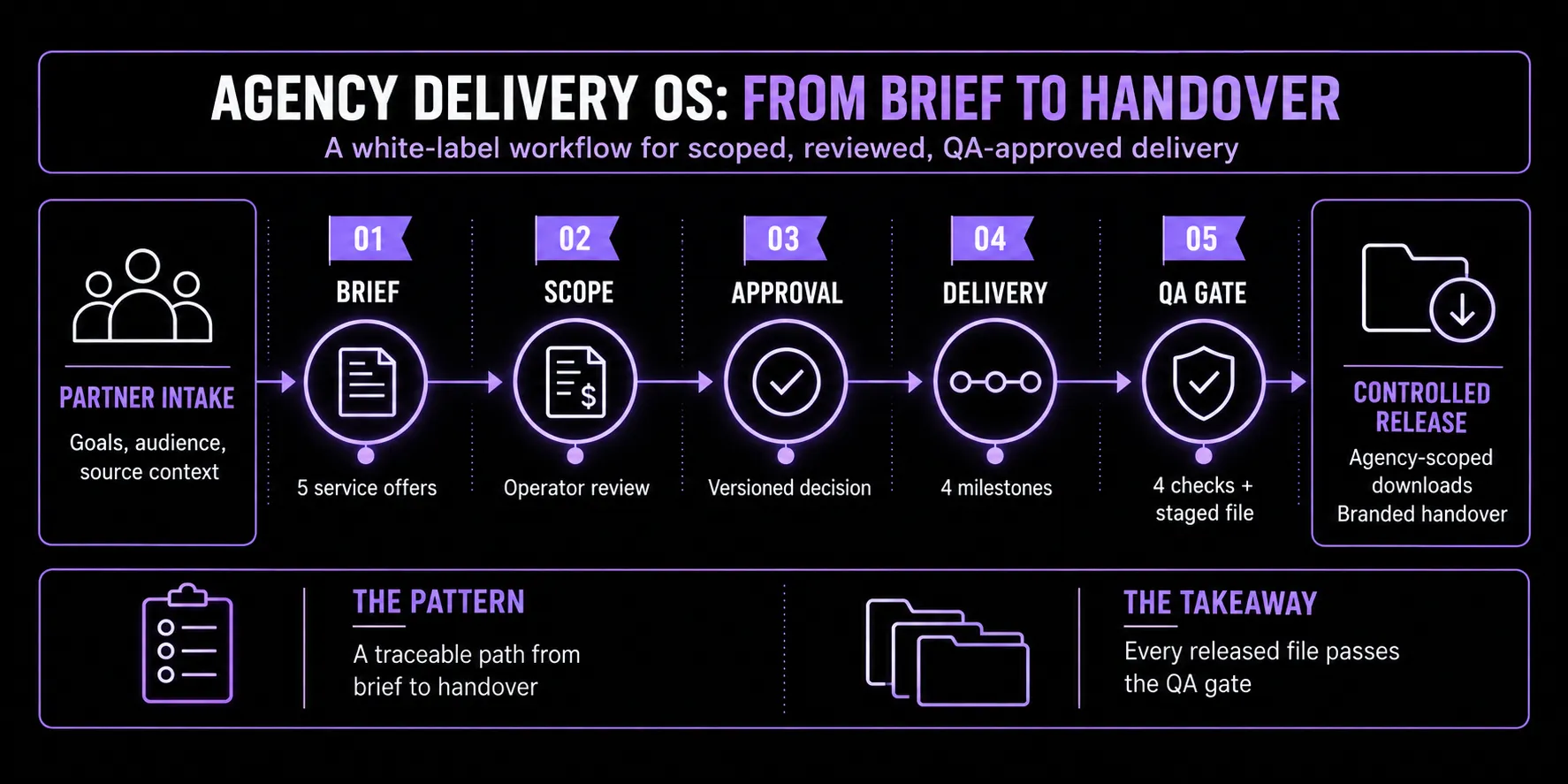
Agency Delivery OS is a local pilot for a white-label AI delivery service. It gives agencies a partner workspace to submit briefs, decide on reviewed quotes, follow milestones and retrieve released files. Operators maintain the service catalog, review scopes, move projects through delivery and control release.
Five reusable service offers
The catalog contains five editable starting offers: lead intake, content repurposing, proposal drafting, client reporting and knowledge search. Each has its own intake questions and inclusions. Seed prices and copy are illustrative, not validated pricing.
Reviewed, versioned quotes
Submitting a brief creates a draft quote from the selected offer. The operator edits scope and price before sending it. Revisions to a sent quote create a new version, and approval or change requests are recorded against the version the agency reviewed.
Four delivery milestones
Approved work moves from the build queue to active work and then quality review. The shared project record tracks Discovery, Build, Internal QA and Handover, along with a role-filtered activity history.
Four checks before release
Operators stage deliverable files privately. Each file is limited to 5 MB. Staging or replacing a file resets QA. Release requires quality-review status, all four checks passed, and at least one staged file. Agency users can download files only after release, and the printable handover carries the agency's branding.
03 · Result
The pilot implements a complete brief-to-handover workflow across separate operator and agency workspaces.
Journey verified in the browser
A Playwright end-to-end journey covers brief submission, operator quote review, agency approval, build start, file staging, all four QA checks, release, download and the branded handover view. The latest checked-in run record is passed. This verifies the workflow, not a client outcome or performance metric.
Demonstration data, not client results
Five demo projects populate the major delivery stages for a product walkthrough. They are labeled as demonstrations and use illustrative client records and deliverables. Seed offer prices are examples, not validated pricing.
An intentionally scoped pilot
The pilot does not generate AI artifacts, send email, collect payment, invoice, or create end-client accounts. There is no measured production adoption or time-savings claim.
A reusable delivery pattern
Design studios, marketing teams and software consultancies can use the same sequence to collect structured context, record approvals, show progress and release reviewed work under a partner brand.
Gallery
Related insights
The thinking behind the system.
-
Marketing System Build: Keeping Strategy Alive Through Delivery
A case study of the 19-document marketing system I built to carry strategy, research, and brand rules from intake to published content.
Read article → -
How I Turn SMART Marketing Goals Into Weekly Targets With Claude Code
Use Claude Code to turn vague marketing goals into a measurable weekly system. Set one outcome, choose the right metric, and review it every Monday.
Read article → -
GPT-6 Astra Is a Capability Leap. The Workflow Is Still the Product.
GPT-6 Astra can carry more work across browsing, computer use, and creation. The advantage now comes from supervised creator and agent workflows.
Read article →