AI Exposure Audit
A revenue-weighted service review that turns AI risk into offer design
- Client
- Internal MVP
- Services
- AI Strategy
01 · Challenge
Agency owners hear that AI can automate more marketing work, but a broad task-level claim does not show whether a real service is repeatable, context-heavy, accountable, or commercially significant.
Four points shaped the build
Service names hide the work: labels such as content or design do not explain how standardized delivery is or how much specialist judgment it requires.
Replaceability is only half the assessment: proprietary context and human accountability can make a service more defensible, so they need to count in the opposite direction.
Risk and revenue need a shared view: a high score on a small service line carries a different portfolio weight than the same score on a major revenue source.
A score needs an action: the review should lead to a clearer scope, a redesigned offer, and a cost scenario the agency can validate.
02 · Goal
An explainable review for agency service lines
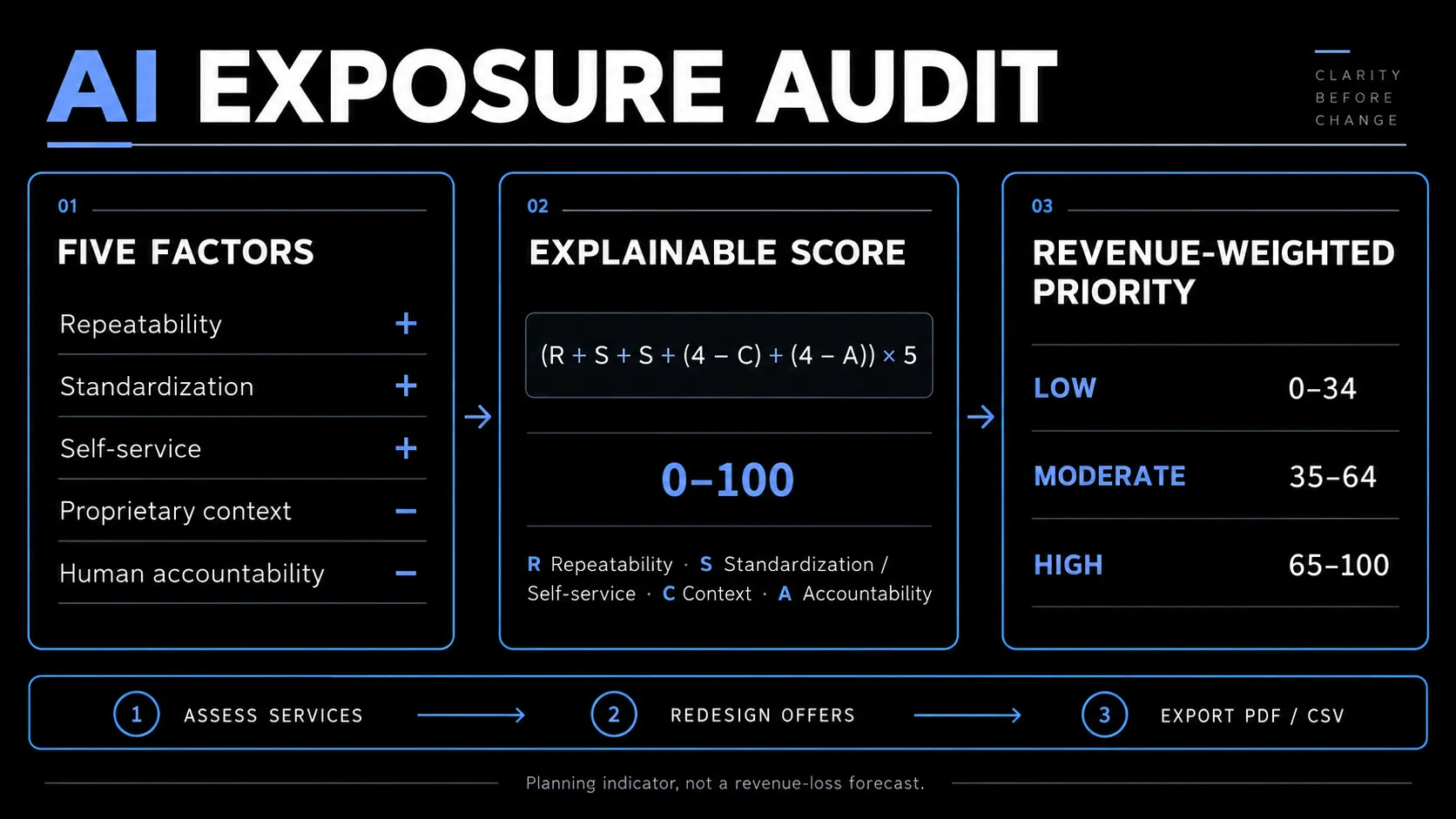
AI Exposure Audit is a browser-based workspace for agencies and consultants. Users describe a service, enter monthly revenue, and assess the actual work against five rubric factors scored from 0 to 4.
Three factors increase exposure: repeatability, standardization, and client self-service. Two protective factors are reversed in the formula: proprietary context and human accountability. The resulting service score ranges from 0 to 100.
Scores below 35 are low, 35 to 64 are moderate, and 65 or above are high. A completed portfolio index weights each score by its service's share of total revenue.
The workspace identifies the full revenue associated with high-scoring service lines, with an explicit warning that this is not a prediction of revenue loss. Consultants can apply a reviewed override if they document the reason.
Category-based offer templates, editable scope and deliverables, and a deterministic cost-based price scenario connect the assessment to service redesign.
Users can print a methodology-backed audit report or export a CSV service menu. Drafts autosave in browser storage and remain local to that site origin.
Optional OpenAI suggestions require an explicit Generate action. The request excludes the business name and private consultant notes; live provider use still requires server credentials and a smoke test.
03 · Result
A working MVP that replaces a broad AI conversation with a structured service review
The built-in Northstar Studio sample contains six service lines and $48,000 in illustrative monthly revenue. In that sample, high-scoring lines carry $18,000 of revenue, or 37.5%, and the revenue-weighted portfolio index is 54/100. These figures are sample data, not client outcomes.
The five-factor formula and score bands are visible to the user. The methodology describes them as rubric 1.0 assumptions, not empirically validated probabilities. The index is a prioritization aid, and the high-exposure revenue total is not a loss forecast.
Offer pricing uses hours × internal hourly cost ÷ (1 − target margin). Default values are illustrative assumptions that agencies should replace with actual delivery costs before making pricing decisions.
The app supports up to 30 services per audit and keeps up to 100 drafts in the current browser. The optional AI endpoint validates inputs and structured outputs, handles refusals and timeouts, and keeps provider credentials server-side.
A reusable pattern for agency strategy: score the delivery model transparently, weight priorities by business context, and connect the findings to a service offer a team can review and test.
Gallery
Related insights
The thinking behind the system.
-
Marketing System Build: Keeping Strategy Alive Through Delivery
A case study of the 19-document marketing system I built to carry strategy, research, and brand rules from intake to published content.
Read article → -
Always-on AI agents: what OpenAI Dots actually changes
Always-on AI agents can carry work between conversations. Learn what OpenAI Dots changes, where agent computers help, and how to run a useful pilot.
Read article → -
Sprinting the Frontier: Reviewing and Comparing Opus 5.5, Sonnet 5.5, GPT-6.1 Sol, and GPT-6 Astra
Compare Opus 5.5, Sonnet 5.5, GPT-6.1 Sol, and GPT-6 Astra on real work, pricing, benchmark limits, and cost per accepted result.
Read article →