Gemini RSI Leak: What the Evidence Actually Proves
Gemini RSI leak claims are outrunning the evidence. See what Google has confirmed about recursive improvement, RRSI, and AlphaEvolve.

By Aleem Ul Hassan. Last updated September 23, 2026.
The Gemini RSI story is a good example of how AI news now works: a thin signal lands in a room already primed for a breakthrough, then the interpretation becomes more confident with every retelling.
Here is the short version. There is real, public Google work on iterative systems that improve algorithms and agent harnesses. Google has also said Gemini 3.8 used long-running agentic loops to recursively evaluate and refine models. But I found no primary-source confirmation that a leaked Gemini system can autonomously build and train its own successor. The strongest claim in the narrative is not established by the evidence available on September 23, 2026.
That distinction is not semantic. It is the difference between a useful engineering loop and a claim that a lab has closed the loop on recursive self-improvement. It is also why an AI agent and an automation need different evidence standards: a fixed workflow needs proof it runs, while an adaptive one needs proof it stays inside its boundary.
What is the Gemini RSI leak actually claiming?
The public rumor does not amount to a technical disclosure. A secondary account of the story traces it to a cryptic post whose capital letters spelled “RSI,” followed by an unauthenticated screenshot and a wider wave of inference. That source itself says there was no comment from Google or DeepMind and describes the material as a rumor, not proof. Its reconstruction of the rumor is useful mainly because it shows how little original evidence exists.
The online version of the claim is much bigger: Google has achieved recursive self-improvement, Gemini can improve itself, and a rapid takeoff is now near. Those are three separate statements. They should not be bundled together.
I could not find an official Google or Google DeepMind announcement authenticating the screenshot, naming a leaked internal Gemini RSI project, or claiming that Gemini autonomously designs and trains successive versions of itself. Absence of a public confirmation does not prove that no internal work exists. It does mean the public should not present the conclusion as a confirmed milestone.
What has Google actually confirmed about Gemini and recursive improvement?
Google has confirmed narrower and more interesting work than the rumor gives it credit for. Its September 2 announcement for Gemini 3.8 Flash says the release was accelerated by long-running agentic loops designed to recursively evaluate and refine the underlying models. That is a meaningful statement about AI-assisted development. It is not a claim that a deployed Gemini model independently chooses its objective, rewrites its own weights, validates the result across domains, and launches its successor. Google’s Gemini 3.8 announcement leaves those operational details unspecified.
RRSI is a harness loop, not model training
The more concrete public artifact is Google’s RRSI repository, published September 21. RRSI stands for “Regularized Recursive Self-Improvement of Agent Harnesses.” Its README describes an LLM whose model is frozen while the loop proposes and evaluates changes to the harness around it: prompts, control flow, tools, memory, context management, and sub-agents. It also documents constraints against overfitting, noisy gains, and cost inflation. Google Research’s RRSI repository is evidence of iterative agent-system optimization. It is not evidence that the underlying Gemini model is recursively retraining itself.
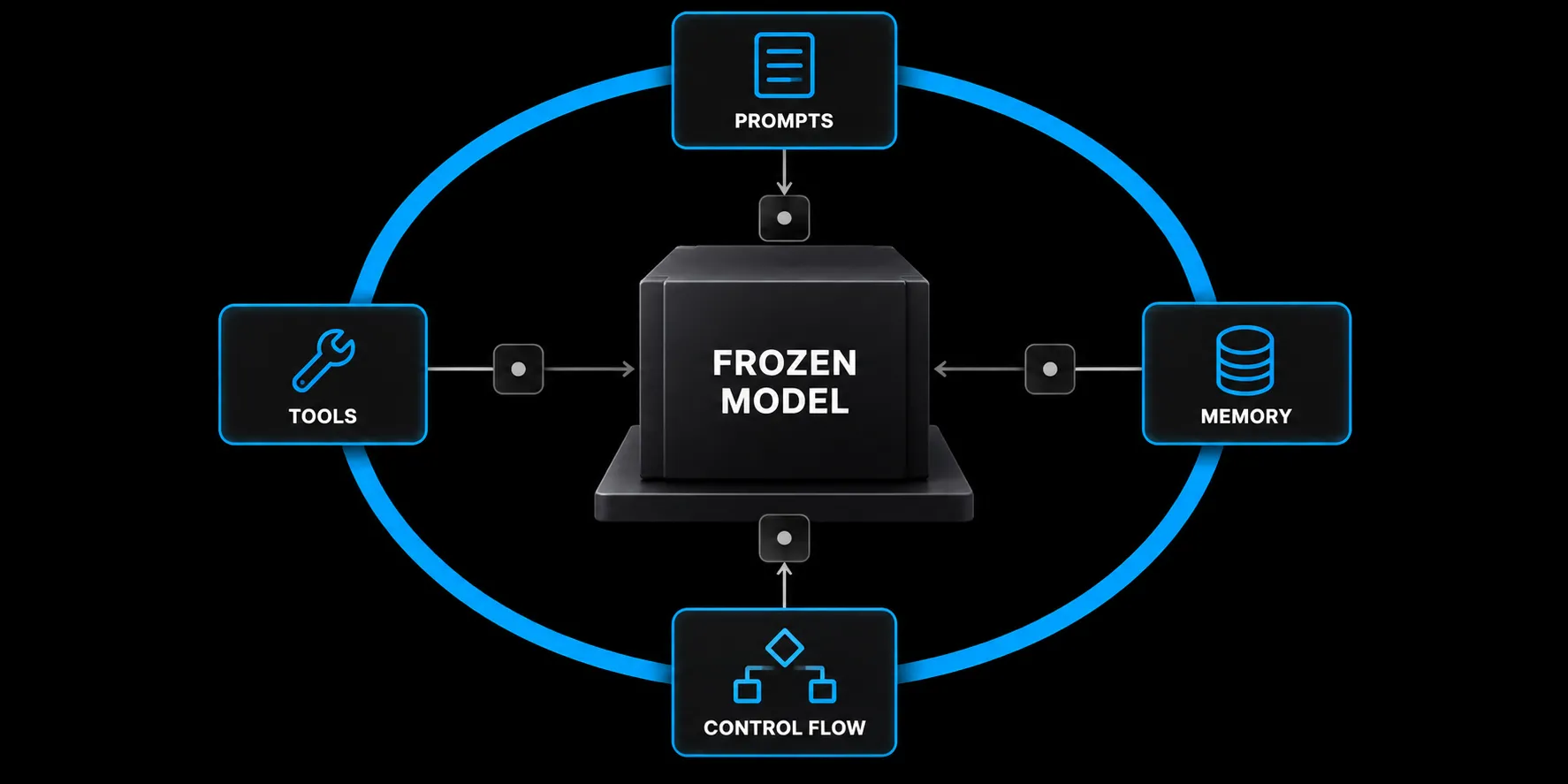
AlphaEvolve is a bounded search loop
Google’s earlier AlphaEvolve project makes the same engineering pattern easier to see. Gemini proposes algorithmic code changes, automated evaluators run and score them, and an evolutionary process selects promising candidates. Google reported that AlphaEvolve improved a kernel in Gemini’s architecture by 23%, contributing to a 1% reduction in training time. That is a real and valuable feedback loop. It still operates inside a defined search space, with measurable evaluation criteria and human-owned deployment. Google DeepMind’s AlphaEvolve write-up is specific about those boundaries.
Why does the phrase “recursive self-improvement” create so much confusion?
“RSI” is doing too much work. It can describe anything from an agent that rewrites a prompt after a test failure to a hypothetical system that repeatedly redesigns the machinery that builds its successor. Those are not comparable claims.
The Associated Press recently noted that labs use different definitions, ranging from any AI feedback used in model improvement to fully autonomous work toward the next generation of a system. AP’s explanation of RSI makes the key point: the definition changes the conclusion.
| What is improving? | What changes? | What proves it works? | What it does not prove |
|---|---|---|---|
| A model response | A draft, plan, or answer | A reviewer or task check | The system has changed itself permanently |
| An agent harness | Prompts, tools, memory, or control flow | A benchmark suite or task score | The base model trained a better successor |
| An algorithm | Code in a bounded search space | Automated tests and objective metrics | General research autonomy |
| A foundation model | Weights, data, training recipe, or architecture | Reproduced capability, safety, and cost gains | That future iterations will compound without human control |
The first three are already useful. In fact, they are where businesses should pay attention. A system that tests many implementation options, rejects weak candidates, and keeps an auditable history can save serious research and engineering time. A narrow decision layer, like the one described in Jev judgment models vs LLMs, is a practical example. Calling every such loop “the singularity” makes the practical lesson harder to see.
What would count as evidence of genuine Gemini RSI?
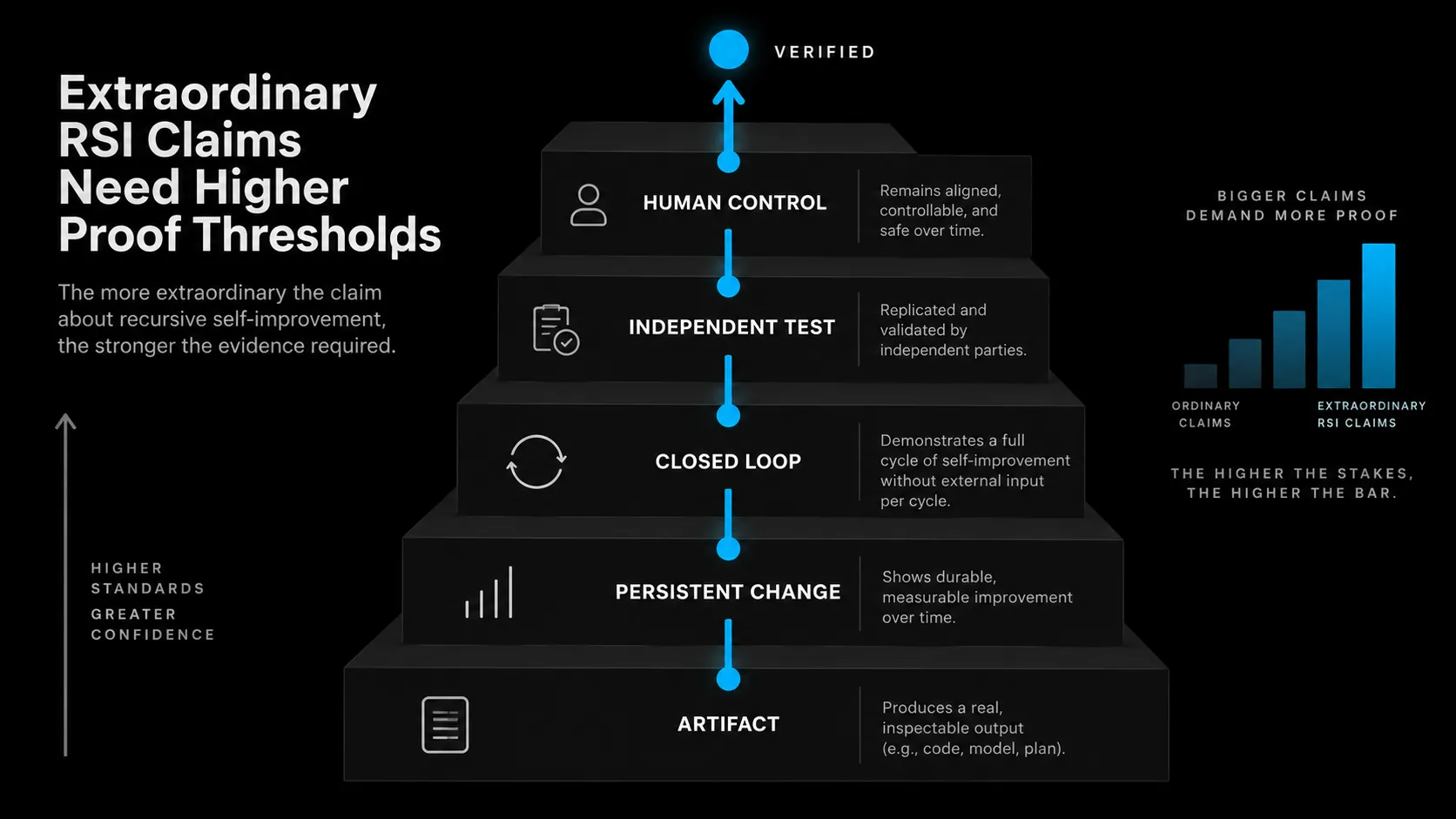
A real claim of recursive self-improvement needs more than a benchmark chart or a clever acronym. I would want five things before treating it as a milestone.
- An attributable artifact. A technical report, release note, or source with enough detail to establish what system exists and who is making the claim.
- A persistent change. Evidence that the system changes something durable, not just that it produces a better answer in one conversation.
- A closed improvement loop. The improved system needs to help generate, evaluate, select, or consolidate the next improvement, not merely act as a coding assistant for humans.
- Independent, out-of-distribution validation. Gains on the task used to tune the loop are not enough. RRSI’s focus on overfitting is a useful reminder of why this matters.
- A clear account of human control. Who sets the objective, allocates compute, approves changes, selects the data, and decides when the loop stops?
Without those details, “RSI” is a category label, not a technical conclusion. The burden of proof rises with the scale of the claim. “We improved an agent harness” requires a different standard from “we have a system that can autonomously improve the process that creates its successors.”
What should builders learn from the Gemini RSI narrative now?
Do not wait for a hypothetical autonomous research system to use the real capability already on the table. The near-term move is to build constrained improvement loops around work you can measure.
Optimize the workflow, not the mythology
In the agent and content systems I build, the valuable loop is rarely “make the model smarter.” It is “make the workflow less wrong.” A research step can rank sources against a defined evidence standard. A drafting step can flag a claim without a citation. A code agent can propose a change, run tests, and send only the passing diff to review. That is iterative improvement with an owner, a score, and a stop condition.
The rule is simple: optimize what you can verify, and keep a person responsible for what the system cannot verify. If an agent is improving a harness, record the hypothesis, edit, evaluation result, cost change, and decision. Google’s RRSI project follows that instinct by preserving an auditable edit history. That is much more useful than declaring a mysterious loop intelligent because it produced a better demo.
Use a five-question vendor test
For founders, this also prevents a common procurement mistake. Do not buy an “RSI-powered” product because the label sounds inevitable. Ask which layer changes, what evaluation selects a change, how persistent the change is, where it fails, and who can stop it. Those are the same task-boundary questions that matter in GPT-6 Astra creator workflows. If the vendor cannot answer them, the claim is ahead of the system.
Is Gemini close to autonomous recursive self-improvement?
There are public signs that Google is using AI more deeply inside optimization and model-development workflows. Gemini 3.8’s announced evaluation loops, RRSI’s harness optimization, and AlphaEvolve’s verified algorithm search are real examples of that direction.
They do not establish that Gemini has reached the stronger version of RSI that dominates the leak narrative. The public evidence shows scoped loops with explicit evaluation. It does not show a general system autonomously making and validating repeated, compounding improvements to the complete process that creates the next Gemini.
That could change. If it does, the important announcement will not be a riddle on a social feed. It will be a technical artifact that explains the loop, its limits, its safety controls, and how someone else can tell whether the claimed gains are real.
Frequently asked questions about Gemini RSI
Has Google confirmed a Gemini RSI leak?
No. I found no official Google or Google DeepMind statement confirming the public leak material, naming a leaked Gemini RSI project, or saying Gemini autonomously builds its successor. The rumor should be treated as unverified.
Does Gemini 3.8 use recursive self-improvement?
Google says Gemini 3.8 was accelerated by long-running agentic loops that recursively evaluate and refine underlying models. That supports a narrow claim about AI-assisted development loops. It does not, by itself, establish autonomous recursive self-improvement of a complete successor-building system.
What is RRSI from Google Research?
RRSI is “Regularized Recursive Self-Improvement of Agent Harnesses.” It optimizes the prompts, tools, memory, control flow, and other components around a frozen LLM. It is evidence of controlled agent-system optimization, not proof that a base model is retraining or redesigning itself.
Is AlphaEvolve an example of recursive self-improvement?
AlphaEvolve is an example of a bounded improvement loop. Gemini proposes programs, automated evaluators score them, and an evolutionary process selects better candidates. It can improve algorithms with objective tests, but that is different from a general system autonomously building successive versions of itself.
What should I ask when a vendor claims an AI system is self-improving?
Ask what changes, who sets the objective, which evaluation selects a change, whether the gain persists outside the tuning task, how the system records decisions, and who can stop or roll back the loop. Those answers reveal whether the claim is engineering or marketing.
Newsletter
New notes, in your inbox.
Get each new article from the workbench by email. No spam, unsubscribe anytime.
Related reading
Continue through the system.
-
Always-on AI agents: what OpenAI Dots actually changes
Always-on AI agents can carry work between conversations. Learn what OpenAI Dots changes, where agent computers help, and how to run a useful pilot.
Read article → -
88 Skills, 194 Decisions Logged, One AI System That Actually Runs My Business
I stopped chatting with AI and built it an operating system: 88 skills, a second brain, and 194 logged decisions.
Read article → -
Sprinting the Frontier: Reviewing and Comparing Opus 5.5, Sonnet 5.5, GPT-6.1 Sol, and GPT-6 Astra
Compare Opus 5.5, Sonnet 5.5, GPT-6.1 Sol, and GPT-6 Astra on real work, pricing, benchmark limits, and cost per accepted result.
Read article →