GPT Codex5 min read
GPT-6.2 Sol vs Claude Opus 5.5: When I'd Pay for Opus
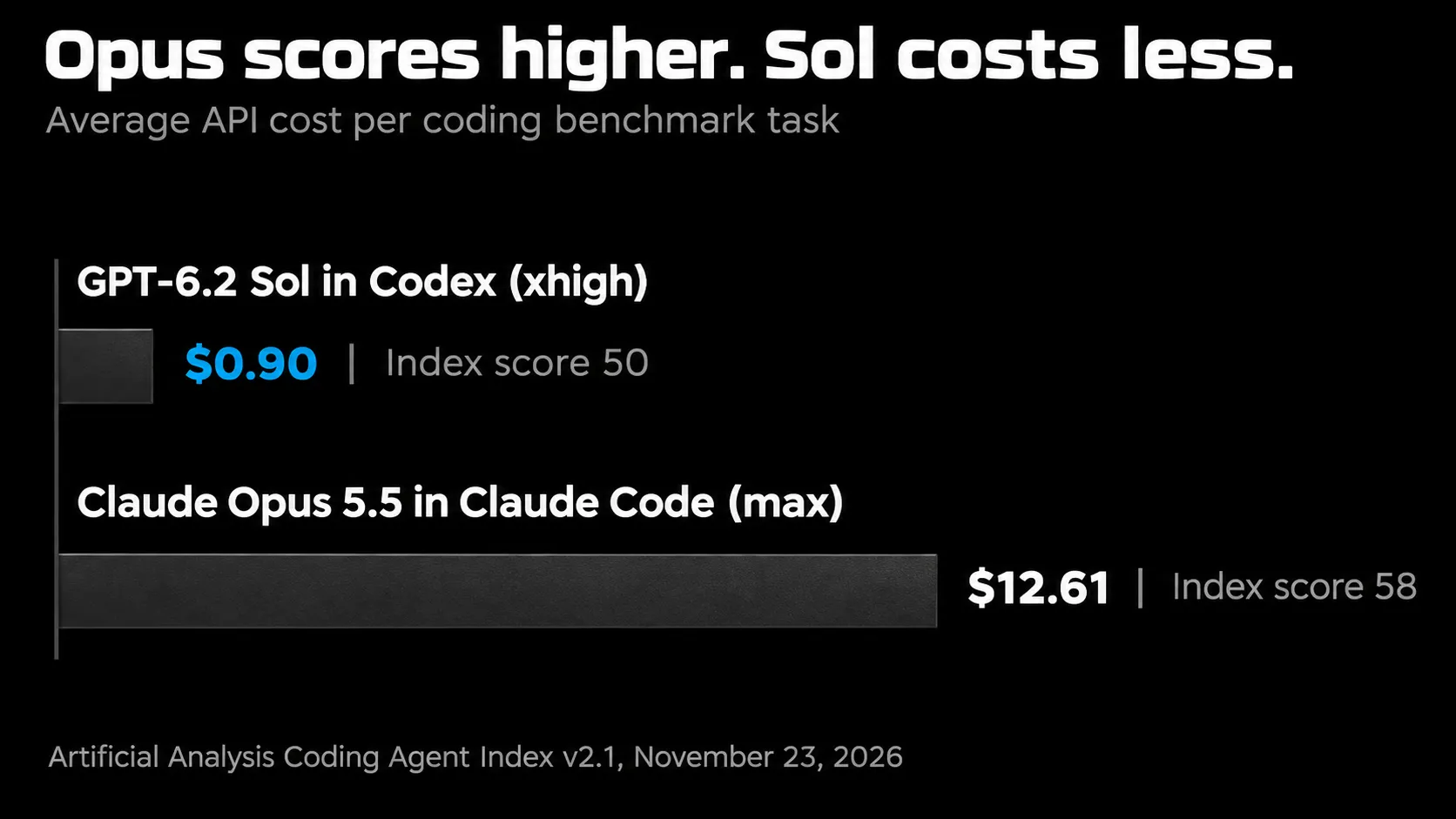
GPT-6.2 Sol vs Claude Opus 5.5: Opus leads 58 to 50 on the Coding Agent Index. Sol costs $0.90 per benchmark task versus $12.61 for Opus.
[ Key takeaways ]
- Artificial Analysis scored Opus 5.5 in Claude Code at 58 and Sol in Codex at 50. Average API cost on that coding index was $12.61 and $0.90, respectively.
- The $1.01 and $10.04 figures come from a separate, broader benchmark, where both models were evaluated at max effort.
- Start with Sol for tickets with a clear acceptance test. Try Opus when failed attempts or review time can erase the savings.
I’d buy GPT-6.2 Sol for coding tickets I can verify quickly. In Artificial Analysis’s coding benchmark, Sol in Codex scored 50 and averaged $0.90 per task in API usage. Claude Opus 5.5 in Claude Code scored 58 at $12.61. I’d pay for Opus where a wrong first pass is expensive to untangle.
Which setup wins the coding benchmark?
Claude Opus 5.5 in Claude Code leads GPT-6.2 Sol in Codex by eight points on the Coding Agent Index v2.1. That’s a result for two complete agent setups, each with its own model, coding tool, and reasoning effort. It tells me which setup scored higher on the suite. My backlog is a separate test.
| Artificial Analysis snapshot, November 23, 2026 | GPT-6.2 Sol | Claude Opus 5.5 |
|---|---|---|
| Coding tool | Codex | Claude Code |
| Reasoning effort | xhigh | max (default fallback) |
| Coding Agent Index v2.1 | 50 | 58 |
| Average API cost per coding benchmark task | $0.90 | $12.61 |
| Average active agent time per coding benchmark task | 12.6 minutes | 1.1 hours |
The Artificial Analysis coding-agent comparison combines repository, terminal, and codebase Q&A benchmarks. The effort setting matters even inside one tool. In the same table, Sol at max scored 49 and cost $1.22 per task. I’d use xhigh as the first comparison point for Sol and let my own tickets decide where extra reasoning earns its keep.
What does the price gap actually measure?
The $0.90 and $12.61 figures are average pay-per-token API costs per task on the Coding Agent Index. The roughly $1 and $10 figures come from a separate evaluation. That’s why I keep the score and the price from the same benchmark together when I make a budget decision.
On the broader Artificial Analysis Intelligence Index v5.0.1, both models were evaluated at max for those figures. Sol scored 57 at $1.01 per task. Opus scored 59 at $10.04. Those costs cover a mix that includes coding, knowledge work, and science.
At standard API list rates, Sol is $2 per million input tokens and $10 per million output tokens. Opus is $4 and $20. The coding benchmark gap is much wider than that twofold difference because total cost also reflects what each setup spends in tokens and how those tokens are billed. See the OpenAI Sol pricing and Anthropic Opus pricing.
How much review time would justify paying for Opus?
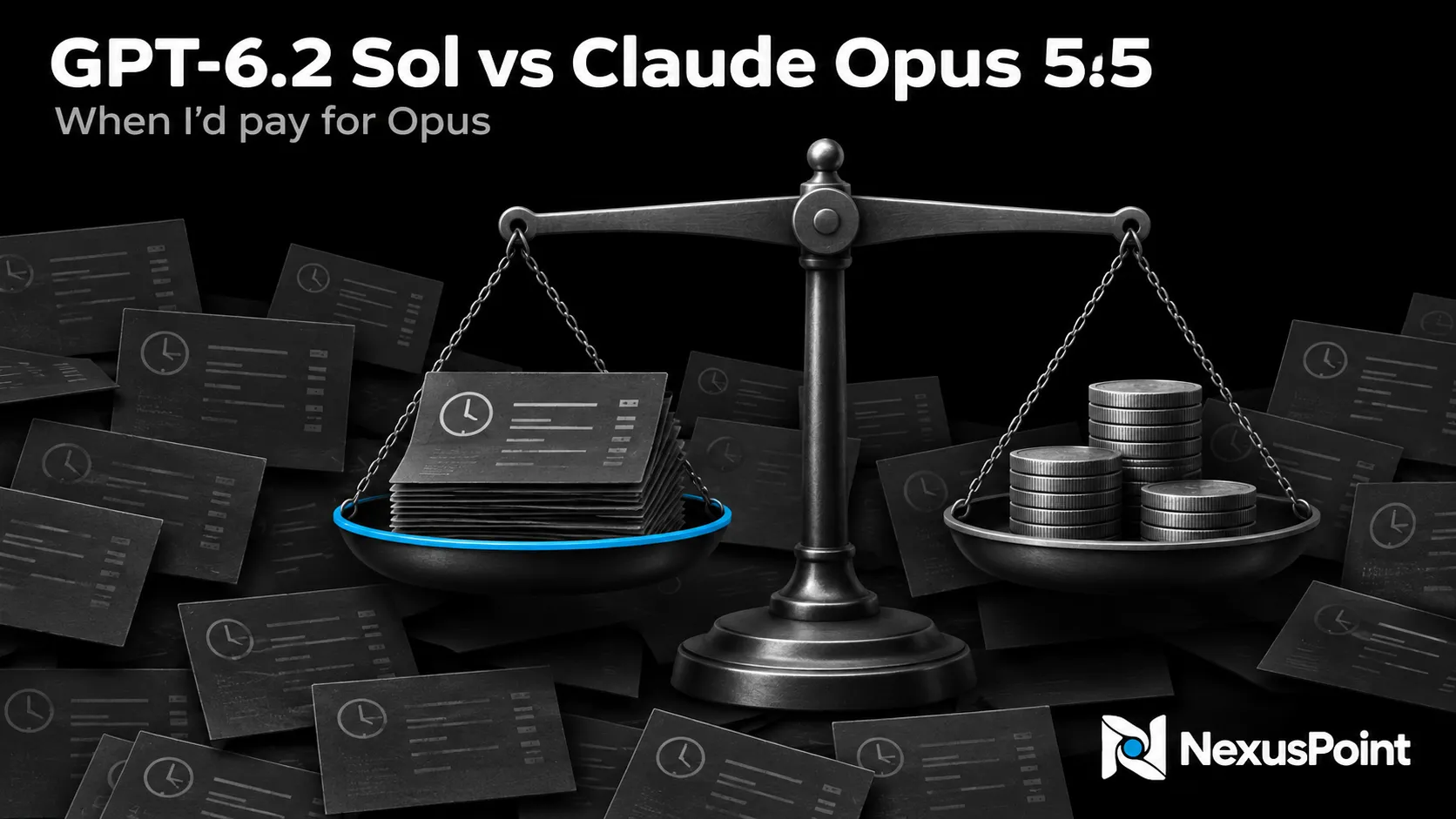
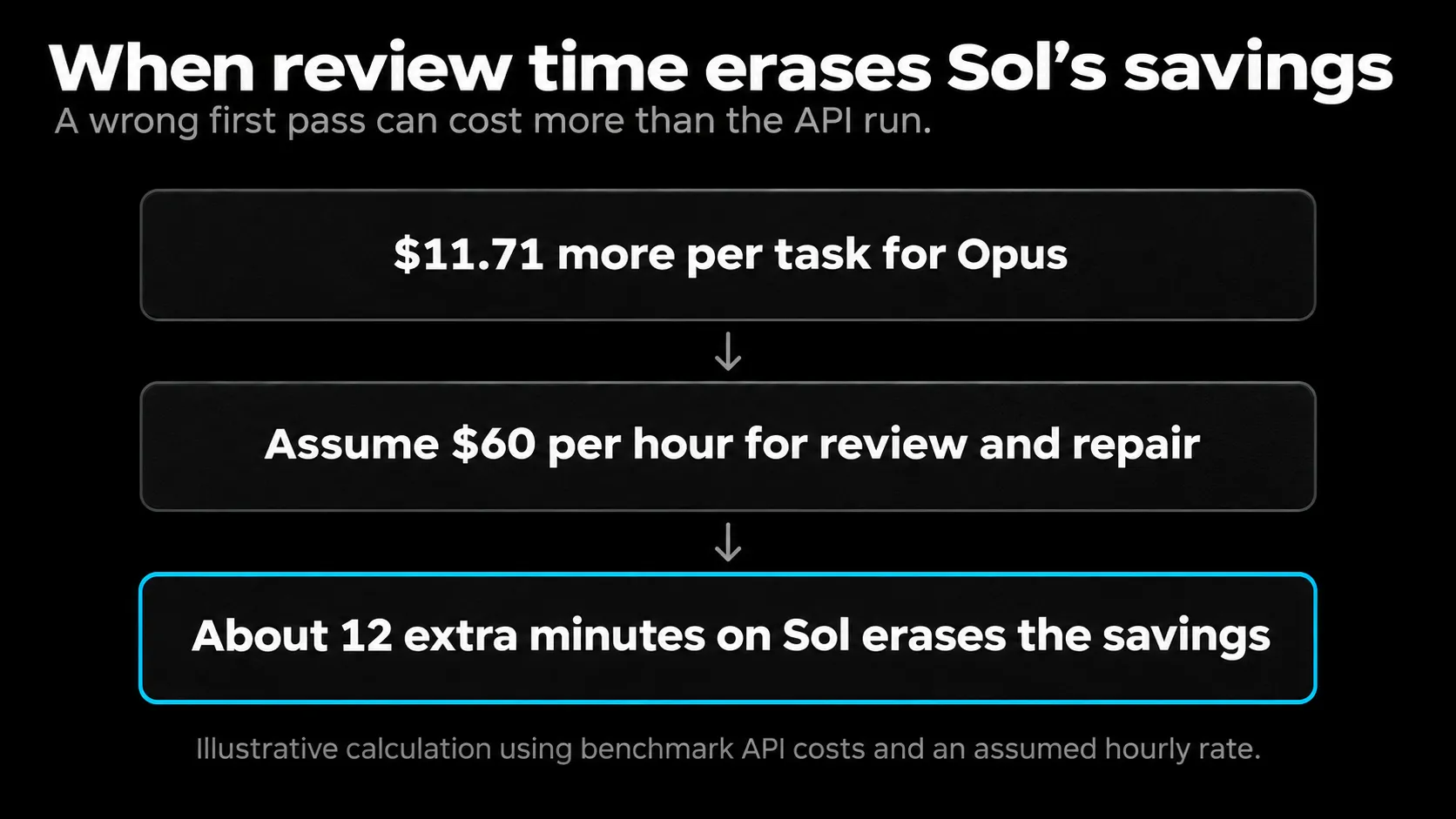
The benchmark API premium for Opus was $11.71 per task. At $60 an hour, about 12 extra minutes reviewing or repairing Sol’s patch would erase its savings. That’s illustrative math using the published benchmark costs and an assumed hourly rate. I’d swap in the spend and review time from my own queue before choosing a default.
I learned to price the checking step when I built a lead-research pipeline. It could find a founder’s name quickly, and sometimes the name belonged to a stranger with the same surname. Checking was the work. I moved search results into a review queue and let names from the company’s own site go straight through. I wrote up what broke in that pipeline.
For coding, I’d add API spend across every attempt to the cost of review and repair, then divide by the number of accepted changes. A cheap run that gets thrown out still belongs on the bill.
When would I start with Sol or go straight to Opus?
I’d start with Sol for a ticket with a clear finish line, like adding a known regression test. I’d put Opus on the shortlist when deciding what should stay the same takes longer than making the edit. A refactor that moves responsibilities between modules can look tidy in the diff while quietly changing behavior a caller relies on.
Take a few recent tickets from both kinds of work. Run each setup from the same starting commit with the same brief and acceptance checks. Write down the allowable retries before you start. A ticket that times out stays in the results. My guide to testing AI models on your own tasks has a scoring sheet for that comparison.
I’d start with one ticket from next week’s backlog. If the cheaper setup passes the tests and leaves me with a diff I can review quickly, it has earned the next ticket.
Coding costs and subscriptions FAQ
API pricing, benchmark scores, and subscription limits answer different buying questions. For metered usage, start with token prices and track what your runs consume. For a subscription, track how much reviewed work fits within the plan. Use the benchmark to decide which setup deserves a trial on your own tickets.
Is GPT-6.2 Sol cheaper than Claude Opus 5.5?
Yes, at standard API list rates. Sol costs $2 per million input tokens and $10 per million output tokens, versus $4 and $20 for Opus 5.5. Your bill also depends on token usage, caching, and any applicable pricing tiers.
Did Claude Opus 5.5 solve 58% of the coding tasks?
58 is a composite score on Artificial Analysis’s Coding Agent Index. Estimating first-pass success on your backlog requires testing comparable tickets against your own acceptance criteria.
Does switching to Codex cut my subscription bill by 14 times?
The roughly 14-fold gap describes benchmark API usage costs for two specific setups. For a subscription, check the plan price, how much eligible work fits within its usage limits, and the cost of any extra usage.
Frequently asked questions
01Is GPT-6.2 Sol cheaper than Claude Opus 5.5?
Yes, at standard API list rates. Sol costs $2 per million input tokens and $10 per million output tokens, versus $4 and $20 for Opus 5.5. Your bill also depends on token usage, caching, and any applicable pricing tiers.
02Did Claude Opus 5.5 solve 58% of the coding tasks?
58 is a composite score on Artificial Analysis's Coding Agent Index. Estimating first-pass success on your backlog requires testing comparable tickets against your own acceptance criteria.
03Does switching to Codex cut my subscription bill by 14 times?
The roughly 14-fold gap describes benchmark API usage costs for two specific setups. For a subscription, check the plan price, how much eligible work fits within its usage limits, and the cost of any extra usage.