AI News12 min read
Claude Fable 5.2 cost: cheaper tokens, pricier tasks, and when it pays
Claude Fable 5.2 cut token prices by 20%, but the effort dial decides your bill. What it does, what it costs per task, and when it is worth paying for.

[ Key takeaways ]
- Claude Fable 5.2 lists at $8 per million input tokens and $40 per million output tokens, 20% below Fable 5.1 and exactly double Opus 5.5.
- Cost per task is set by the effort level, not the token price. On Artificial Analysis, max effort used about 3.2x the output tokens of high for a 3-point higher index score.
- At high effort, commenters reading Artificial Analysis data put Fable 5.2 at 62 points for $9.08 per task, ahead of Opus 5.5 at max (59 points, $10.04).
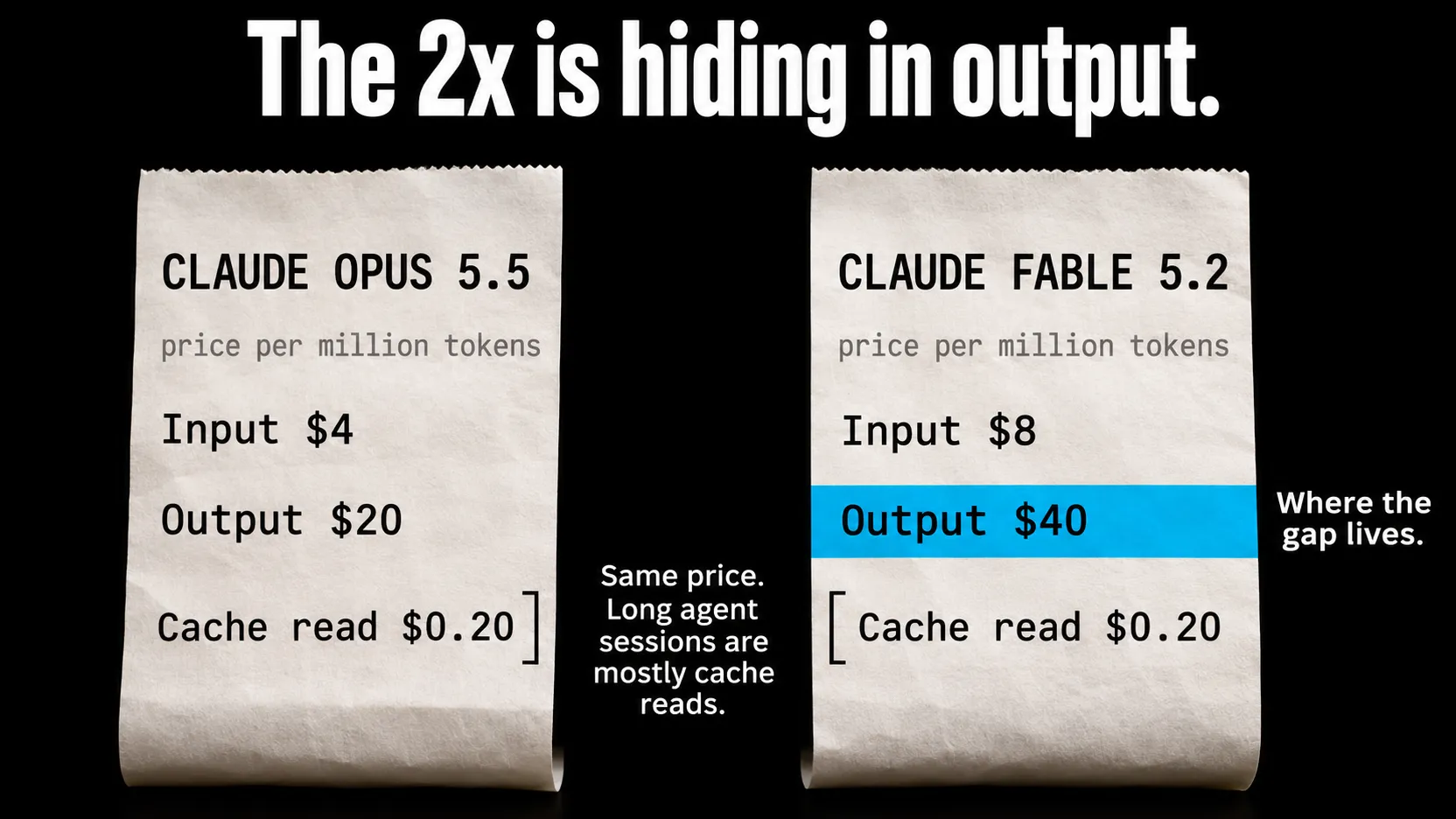
- Cache reads cost $0.20 per million on both Fable 5.2 and Opus 5.5, so the price gap in long agent sessions sits almost entirely in output and thinking tokens.
- Keep Opus 5.5 as the default, escalate to Fable 5.2 at high effort for hard, long-horizon work, and treat max effort as a measurement tool, not a setting.
Claude Fable 5.2 is cheaper per token than Fable 5.1, at $8 per million input and $40 per million output tokens, but it can cost more per task. The effort level decides the bill. At high effort it beats Opus 5.5’s best score for less money; at max effort a single benchmark task averages $26.54.
A taxi company can cut its per-kilometre rate by 20% and still hand you a bigger fare, if the driver now takes the scenic route by default. Nobody lied about the rate. The meter just counts something you were not watching.
That is the whole Fable 5.2 story in one picture, and it explains why the YouTube coverage split into two camps this week: the benchmark-hype videos and the “wait, why did my bill go up” videos. Both are looking at real numbers. They are looking at different meters.
What is Claude Fable 5.2?
Claude Fable 5.2 is Anthropic’s top generally available model, released on November 9, 2026, built for demanding reasoning and long-horizon agent work. It has a 1M-token context window, 128K max output, text and image input, and adaptive thinking that is always on. It shares one underlying model with Mythos 5.2, which ships with fewer safeguards to vetted organizations.
The model overview describes the target work plainly: agent sessions that run for hours, multistep research, and analysis carried through to a finished document, spreadsheet or deck. The API model ID is claude-fable-5-2, and it is available on the Claude API, Amazon Bedrock, Google Cloud and Microsoft Foundry.
Three details matter more than the spec sheet suggests. You cannot turn thinking off, so effort is your only real lever on cost. Forced tool use returns a 400 error. And Fable 5.2 requires 30-day data retention, so it is not available under zero data retention unless Anthropic authorizes it. If you handle client data under a ZDR agreement, that last line decides the question before any benchmark does.
What can Fable 5.2 do better than Opus 5.5?
Fable 5.2 leads on long, open-ended technical work. In Anthropic’s announcement it scores 69.9% on FrontierSWE v2 against 62.3% for Opus 5.5, and 41.3% on the Remote Labor Index against 21.3%. It does not win everywhere: it trails Gemini 4 Carbon on AutomationBench and ties Opus 5.5 on independent Terminal-Bench 4.0 runs.
Here are the numbers worth knowing, from Anthropic’s own table unless marked otherwise.
| Benchmark | Fable 5.2 | Fable 5.1 | Opus 5.5 | Best rival |
|---|---|---|---|---|
| FrontierCode 2.0 | 49.1% (xhigh) | 32.4% | 45.5% | GPT-6 Astra 42.8% |
| FrontierSWE v2 | 69.9% | 56.3% | 62.3% | GPT-6 Astra 65.5% |
| Remote Labor Index | 41.3% (high) | 17.9% | 21.3% | GPT-6 Astra 20.8% |
| Terminal-Bench-Science | 74.6% | 52.6% | 58.7% | GPT-6 Astra 68.1% |
| AutomationBench | 51.4% | 31.4% | 42.5% | Gemini 4 Carbon 53.9% |
| SWE-bench Multimodal (Vals AI) | 62.29% | n/a | 70.21% | n/a |
One limitation applies to the whole table: every Anthropic number is vendor-reported, run at effort levels Anthropic picked, on tasks that may not look like yours.
The Remote Labor Index jump is the one I would pay attention to. It nearly doubles Opus 5.5, and it measures the kind of end-to-end work an agency actually bills for. The SWE-bench Multimodal row, from Vals AI, is the counterweight: on visual coding tasks, Opus 5.5 is still ahead by about 8 points.
Independent rankings for Fable 5.2
On the independent side, Artificial Analysis ranks Fable 5.2 at max effort first of 81 models on its Intelligence Index with a score of 65. Opus 5.5 sits at 59. Vals AI also ranks it first on its own index, at 71.31% accuracy.
How much does Claude Fable 5.2 cost per token?
Claude Fable 5.2 costs $8 per million input tokens and $40 per million output tokens, a 20% cut from Fable 5.1’s $10 and $50. That is still exactly twice Opus 5.5’s $4 and $20. Cache reads cost $0.20 per million, the Batch API halves input and output prices, and fast mode doubles them for up to 2.5x faster generation.
| Model | Input / MTok | Output / MTok | Cache read / MTok | API default effort |
|---|---|---|---|---|
| Claude Fable 5.2 | $8 | $40 | $0.20 | high |
| Claude Fable 5.1 | $10 | $50 | $0.25 | high |
| Claude Opus 5.5 | $4 | $20 | $0.20 | medium |
| Claude Sonnet 5.5 | $2 | $10 | $0.10 | high |
The cache-read prices come from the docs’ rule that cache reads cost 2.5% of base input on the Fable and Mythos 5.x models and 5% on Opus 5.5 and Sonnet 5.5. The arithmetic is mine, and it produces the most useful line in the table: Fable 5.2 and Opus 5.5 charge the same $0.20 per million for cache reads.
That matters because long agent sessions are mostly cache reads. The context gets reread on every turn. So in the work Fable is built for, the 2x price gap is not spread evenly across the bill. It sits almost entirely in output and thinking tokens, which is exactly where the effort dial operates.
Why can a task cost more even though tokens got cheaper?
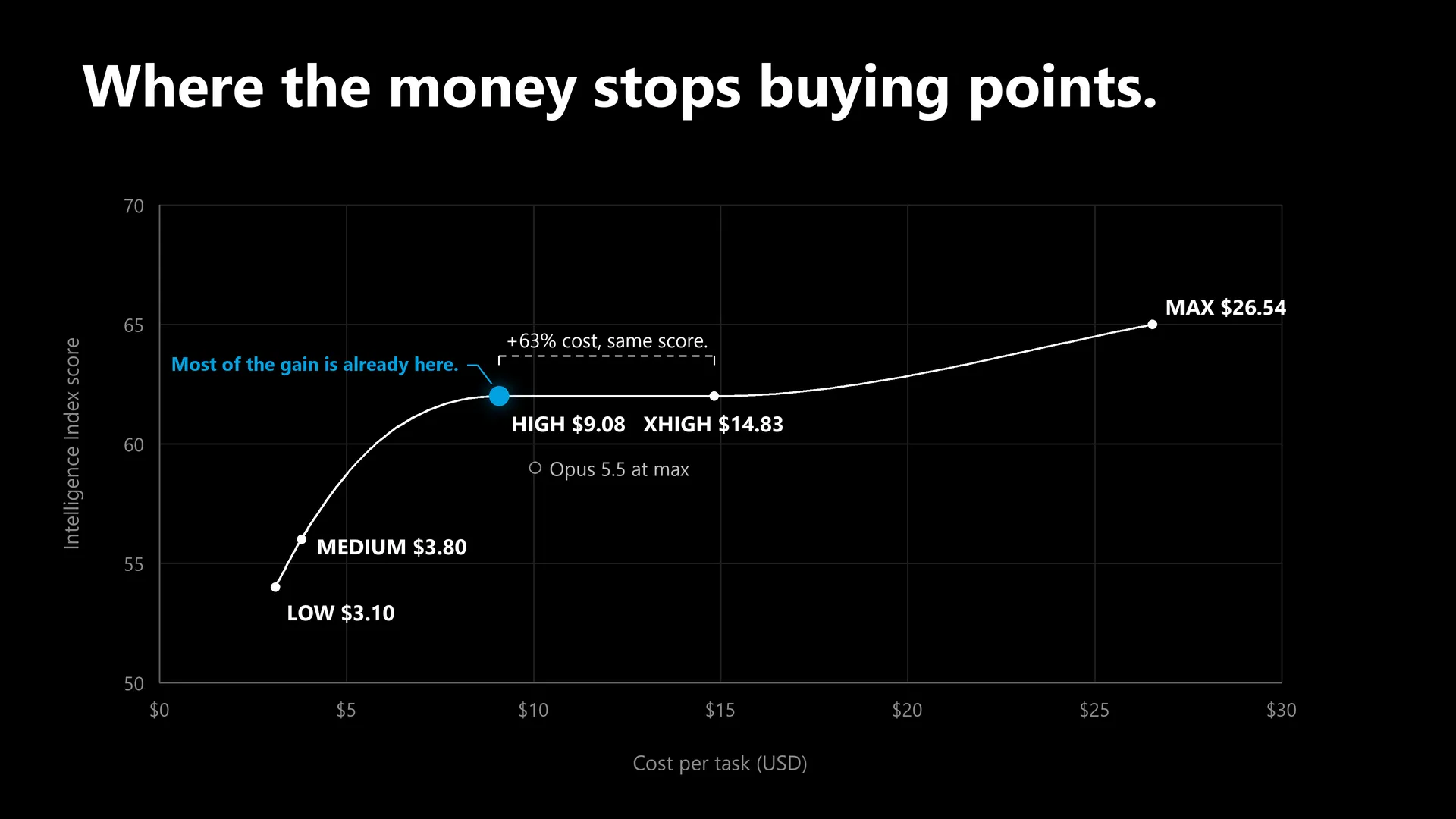
Because cost per task equals tokens used times the price, and Fable 5.2 uses far more tokens at its top settings. Artificial Analysis measured 275 million output tokens to run its index at max effort, against 85.3 million at high and 41 million at medium. Max effort bought 3 more points for roughly 3.2x the output.
This is where the “it doubled” headlines come from. A Hacker News thread opened with a commenter reading the data as output tokens per task rising from 118k on Fable 5.1 to 274k on 5.2. Other commenters then pulled the per-task costs by effort level from Artificial Analysis. Only the max-effort dollar figure appears on Artificial Analysis’s public model page, so treat the other cost figures as commenter-reported.
Fable 5.2 cost per task at each effort level
| Fable 5.2 effort | Index score | Cost per task | Output tokens (full index) | Minutes per task |
|---|---|---|---|---|
| max | 65 | $26.54 | 275M | 41.6 |
| xhigh | 62 | $14.83 | 144M | 26.2 |
| high | 62 | $9.08 | 85.3M | 15.2 |
| medium | 56 | $3.80 | 41M | 6.9 |
| low | 54 | $3.10 | 34.9M | 5.4 |
Fable 5.2 vs Fable 5.1 and Opus 5.5 per task
For comparison, the same commenters put Fable 5.1 at 50 points for $10.85 at xhigh and 43 points for $5.56 at medium, and Opus 5.5 at max at 59 points for $10.04.
Read that table one row at a time and three things fall out:
- xhigh is the worst deal. Same score as high, 63% more money, 11 more minutes per task.
- high beats Opus 5.5 at max. Three points higher, about 10% cheaper, which matches Anthropic’s own claim that Fable 5.2 at high roughly matches Opus 5.5’s best FrontierCode score at about half the cost per task.
- medium beats Fable 5.1 at its best. 56 against 50, for about a third of the price.
So the “Fable 5.2 doubled my costs” crowd and the “Fable 5.2 is cheaper” crowd are both right. They are reporting from different effort settings. As Sébastien Dubois put it in his breakdown: “The effort level decides the bill.”
How does Fable 5.2 work on Claude plans and in Claude Code?
Fable 5.2 is not on the Free plan. On Pro and standard Team seats it sits outside your usage limits and bills through usage credits. On Max, Ultra and premium seats it can use up to 50% of your weekly limit, and it drains that limit faster than other models. Claude Code needs version 2.1.321 or later.
Those are the terms in Anthropic’s help center article on Fable plans. The launch announcement adds time-limited offers: one to three Fable resets based on subscription length, and Fable included for up to 50% of weekly usage on Pro and standard Team seats. The help article does not give an end date for those offers, so plan around the permanent terms.
Fable 5.2 effort defaults in Claude Code vs the API
The effort defaults differ by surface, and this trips people up. The API default for Fable 5.2 is high. In the Claude apps and Claude Code, Anthropic says the default is medium. Most published benchmark numbers ran at high, xhigh or max. If you compare a headline score against what you see in Claude Code, you are comparing two different settings of the same model.
For anyone running headless jobs on a subscription, the 50% cap is the number that bites. A model that thinks for 15 minutes per task at high effort can eat a week’s allowance in an afternoon, and every other job on the same login waits behind it.
When is Claude Fable 5.2 worth paying for?
Fable 5.2 is worth it when the task is long, open-ended and expensive to get wrong, and when a cheaper model would need several attempts. Anthropic’s own advice is to start with Opus 5.5 for most coding and knowledge work. I agree, and I would go further: Fable should be an escalation tier you route to, never a default you leave on.
The standard advice on new frontier models is to switch the default and enjoy the upgrade. I think that is backwards for Fable 5.2. The effort docs say most of the capability gain is already present at high, and that max often costs more for only a small gain. That is the vendor telling you the top of the dial is for measurement, not production.
How I would route work between Fable 5.2 and Opus 5.5
Here is how I would route work:
- Default to Opus 5.5 at medium. Half the token price, and the same cache-read price for long sessions.
- Escalate to Fable 5.2 at high for multi-hour agent runs, cross-file refactors and research that ends in a deliverable. The Remote Labor Index gap is the case for it.
- Never ship on max. Use it once to see the ceiling on your own task, then step down.
- Skip xhigh unless your own evals show a gain. On the public data it buys nothing over high.
- Use Fable as the planner, not the worker. Anthropic positions it as an advisor or orchestrator that hands simpler subtasks to cheaper models, which keeps the expensive thinking tokens on the hard part.
Where Fable 5.2 is the wrong model
What I would not do: run Fable 5.2 for chat, content drafting or classification. Sonnet 5.5 or Haiku 5.5 handle those at a fraction of the price, and Fable’s always-on thinking is pure overhead on easy work.
I would be wrong about this if Opus 5.5 keeps failing a task that Fable 5.2 solves first time. Then the expensive model is the cheap one, because retries and human review cost more than tokens. That is a measurement you make on your own work, not something any benchmark can settle for you.
How I would wire Fable 5.2 into a cost-capped system
Pin the effort level explicitly, route to Fable only on an escalation rule, and check the budget before a run starts rather than after. Effort is a behavioral signal, not a hard token budget, so the guard has to sit outside the model.
My own systems already run this way, which is why this release reads to me as a routing decision rather than an upgrade. My headless content pipeline runs on a flat subscription login and reads the CLI’s rate-limit signals, holding the next run instead of falling through to metered billing. My outreach drafts go to a small model first and a larger one only as a fallback. My AI-visibility sampler refuses to start a run it cannot afford to finish.
Two Fable 5.2 settings that keep the bill predictable
Fable 5.2 slots into that pattern as the top rung. Two details from the docs make it practical. Effort can change per message mid-conversation while keeping the prompt cache, so a session can run cheap and step up only for the hard turn. And Anthropic’s guidance to set a large max_tokens at high and above is a reminder that max_tokens is the only hard ceiling you get, so set it deliberately.
Related reading on model choice and token spend
If you are deciding which model a task deserves, my guide on how to test AI models on your own tasks walks through a scoring sheet for quality, cost and review time. For the budgeting side, see when AI token spend is rational and when it is theater, and for the wider field, my frontier model comparison.
The bigger pattern behind Fable 5.2 pricing
Per-token prices keep falling while per-task spend can rise, because models now decide how hard to think. The price you see on the pricing page is the rate. The fare is rate times distance, and with adaptive thinking always on, you only control distance through effort.
That shift is permanent. Every frontier model from here will ship with a dial, and the teams that spend well will be the ones who set it per task instead of once for the whole company. This week, pull one real task, run it on Opus 5.5 at medium and Fable 5.2 at high, and compare cost per accepted result. That single number will tell you more than any leaderboard.
Frequently asked questions
How much does Claude Fable 5.2 cost?
On the API, Claude Fable 5.2 costs $8 per million input tokens and $40 per million output tokens. Cache reads are $0.20 per million, the Batch API is 50% off, and fast mode costs $16 and $80. Cost per task depends mostly on the effort level you run it at.
Is Claude Fable 5.2 cheaper than Fable 5.1?
Per token, yes, by 20% ($8 and $40 against $10 and $50). Per task, it depends on effort. Artificial Analysis data shared by Hacker News commenters shows Fable 5.2 cheaper than 5.1 at low and medium effort but more expensive at high and xhigh, while also scoring higher at every level.
Should I use Fable 5.2 or Opus 5.5?
Anthropic itself recommends starting with Opus 5.5 for most coding and knowledge work and moving up to Fable for the most ambitious tasks. Opus 5.5 costs half as much per token. Fable 5.2 earns its price on long-horizon agent work and hard reasoning where Opus fails or needs many retries.
What effort level should I use for Claude Fable 5.2?
Anthropic’s docs say to start with high, the API default, because most of the capability gain is already there. Step up to xhigh only where you have measured a gain, step down to medium or low where quality holds, and reserve max for measuring the ceiling.
Can I use Claude Fable 5.2 on a Claude Pro plan?
Anthropic’s help center says Fable models sit outside Pro usage limits and are billed through usage credits, with time-limited launch offers for eligible plans. On Max and premium seats, Fable 5.2 can use up to 50% of the weekly limit and drains it faster than other models. It is not on the Free plan.
Frequently asked questions
01How much does Claude Fable 5.2 cost?
On the API, Claude Fable 5.2 costs $8 per million input tokens and $40 per million output tokens. Cache reads are $0.20 per million, the Batch API is 50% off, and fast mode costs $16 and $80. Cost per task depends mostly on the effort level you run it at.
02Is Claude Fable 5.2 cheaper than Fable 5.1?
Per token, yes, by 20% ($8 and $40 against $10 and $50). Per task, it depends on effort. Artificial Analysis data shared by Hacker News commenters shows Fable 5.2 cheaper than 5.1 at low and medium effort but more expensive at high and xhigh, while also scoring higher at every level.
03Should I use Fable 5.2 or Opus 5.5?
Anthropic itself recommends starting with Opus 5.5 for most coding and knowledge work and moving up to Fable for the most ambitious tasks. Opus 5.5 costs half as much per token. Fable 5.2 earns its price on long-horizon agent work and hard reasoning where Opus fails or needs many retries.
04What effort level should I use for Claude Fable 5.2?
Anthropic's docs say to start with high, the API default, because most of the capability gain is already there. Step up to xhigh only where you have measured a gain, step down to medium or low where quality holds, and reserve max for measuring the ceiling.
05Can I use Claude Fable 5.2 on a Claude Pro plan?
Anthropic's help center says Fable models sit outside Pro usage limits and are billed through usage credits, with time-limited launch offers for eligible plans. On Max and premium seats, Fable 5.2 can use up to 50% of the weekly limit and drains it faster than other models. It is not on the Free plan.