AI News11 min read
Weight-Space Programming: What 'Improvement Without Training' Actually Means
Weight-space programming lets an LLM edit a model's weights with no training run. What MIT's results show, and what the 48.1% headline hides.

[ Key takeaways ]
- Weight-space programming means an LLM reads a network's weights and edits them directly, with no gradients, loss function or training loop.
- The headline Qwen3.5-0.8B jump from 7.9% to 48.1% on MATH-500 came mostly from removing a thinking loop, not from teaching the model math.
- The Gemma 3 270M control barely moved, which supports the authors' own line: an edit can remove an obstacle that hid an ability, but cannot add one the model lacked.
- The practical use today is repair: diagnose a specific failure mode in a small open model, remove it, and prove the fix on held-out questions against a random control.
- Edits this cheap fall well under compute-based rules like the EU AI Act's one-third test, so teams running open weights should pin, hash and behavior-test every model they deploy.
A model that loops forever on every math problem scores close to zero, whatever it knows. Stop the loop and it suddenly looks six times smarter. That is the most useful way to read the result everyone is sharing from MIT this month.
Weight-space programming is an LLM reading a neural network’s raw weights and editing them directly, with no gradients, loss function or training loop. “Improvement without training” is real in that narrow sense. In the published evidence, though, the big gains came from removing a failure that was hiding an ability the model already had. Treat it as a new way to repair models, not yet a new way to teach them.
What is weight-space programming?
Weight-space programming treats a network’s weights the way an engineer treats a program: something you can read to understand what it computes, and something you can edit to change what it does. The term comes from Sparks of Weight-Space Programming, published on November 2, 2026 by Rikiya Takehi, Jayden Teoh, Alex Zhang and Omar Khattab of MIT CSAIL.
The editor in their experiments is GPT-6 Astra, a general-purpose frontier model. It gets the weights as text or loaded in a Python sandbox, reasons about what each part of the network does, then writes new weights or edits existing ones.
The authors are careful about the claim. “Weight-Space Programming is not a method,” they write in a response section added on November 12. They frame it as an emerging concept and “a statement about sparks of a new model capability.” That distinction matters, because a lot of the commentary has treated it as a finished technique you can point at any model.
Binary patching for neural networks
The closest thing I know outside machine learning is binary patching. Before source code was easy to get, people fixed software by opening the compiled program, finding the one jump instruction that caused the crash, and changing a few bytes. No rebuild. Weight-space programming is that idea applied to a network, with an LLM doing the reading.
What did the MIT experiments actually show?
The paper reports eight experiments in three groups: reading weights to identify what a network does, fixing a broken network, and writing a network from scratch. Most targets were small reinforcement learning policies. Two were real language models, and those two are where the “improvement without training” headline comes from.
| Experiment | Task | Result reported by the authors |
|---|---|---|
| Game policies (17,253 weights) | Name the game from weights alone | Correct for all four networks |
| Kinetix car policy (171,664 weights) | Fix a policy that never succeeded | 0 of 256 episodes before, 1,024 of 1,024 after, changing 3.5% of weights |
| MinAtar Breakout (weights start at 0) | Write a policy from scratch, one shot | Scored 517.4 against 25.3 for PPO trained 500M steps |
| Gemma 3 270M sycophancy | Spot the sycophantic model | Failed in all four attempts from weights alone, correct in all three pairs with an attention-pattern tool |
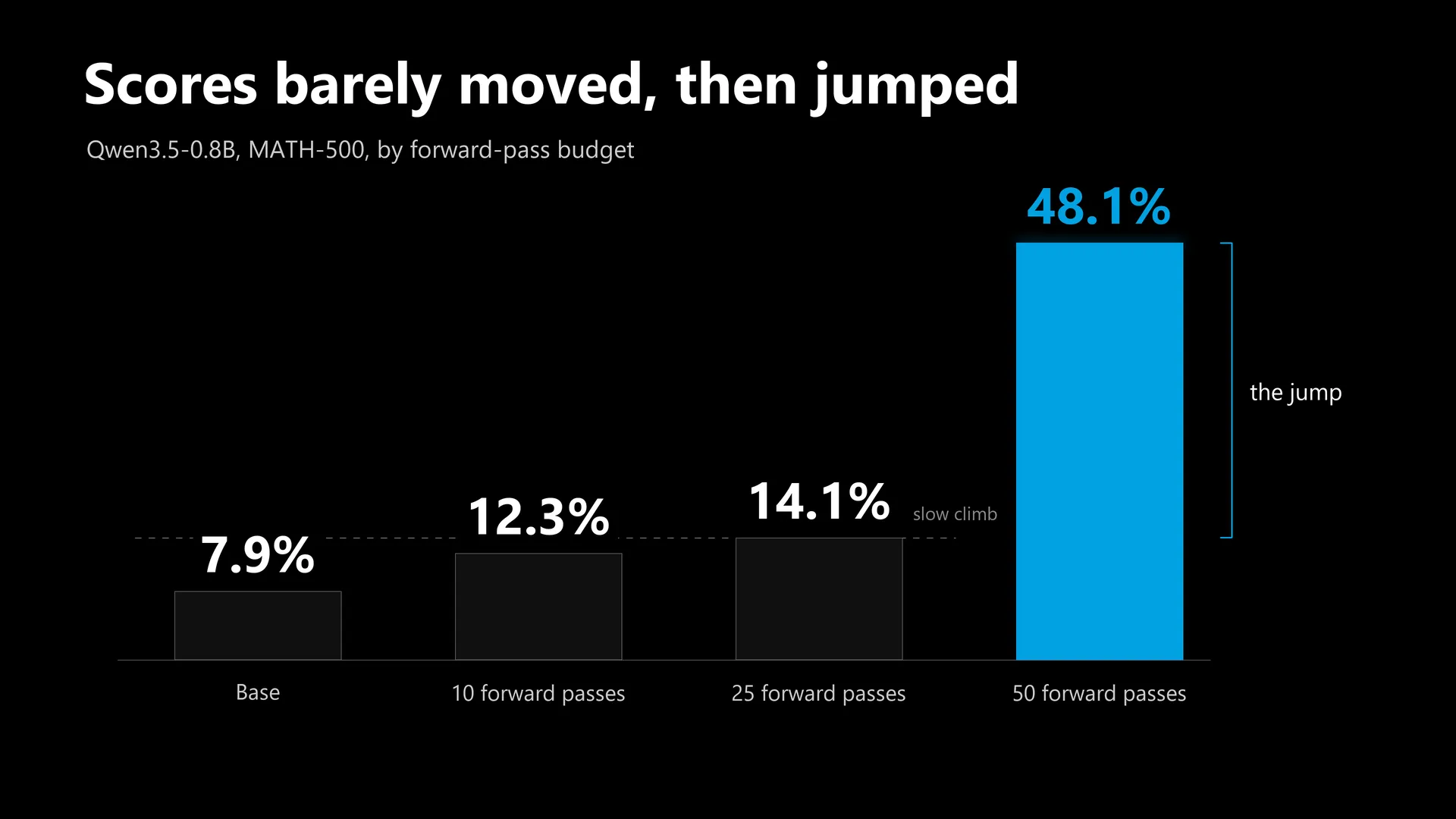
| Qwen3.5-0.8B math | Improve benchmark scores | MATH-500 rose from 7.9% to 48.1% after editing 0.016% of weights |
Not every result is a win. Breakout from scratch beat PPO by about 20 times, but Seaquest reached only 60% of the PPO-500M score. The sycophancy test only worked once the setup was relaxed. The authors call all of it “very early results,” and say capabilities are “still limited” by context length and harnesses.
What does “without training” actually mean here?
In the MIT experiments, “without training” means no training loop, no data fitting, no loss function and no gradients. The authors say they ruled those out deliberately to draw a clear line around what an LLM can do by reasoning about weights alone. It does not mean the model worked blind.
In the Qwen experiment, Astra had a Python kernel with the weights loaded, no GPU, and a budget of forward passes. One forward pass meant running the model on up to 512 practice problems or reading up to 1,024 texts. The practice problems came from the GSM8K and MATH training sets, not the test sets. So the editor could watch the model fail, measure what happened inside it, and then decide where to cut.
The authors are open about this. They write that “Python is a tool for that reasoning, not a tool for optimization,” and that the concept itself “does not rule out gradients” if the programmer is the one deciding what changes. The honest translation of “improvement without training” is this: improvement without an optimizer choosing the change. The reasoning model chose it.
Why did Qwen’s math score jump from 7.9% to 48.1%?
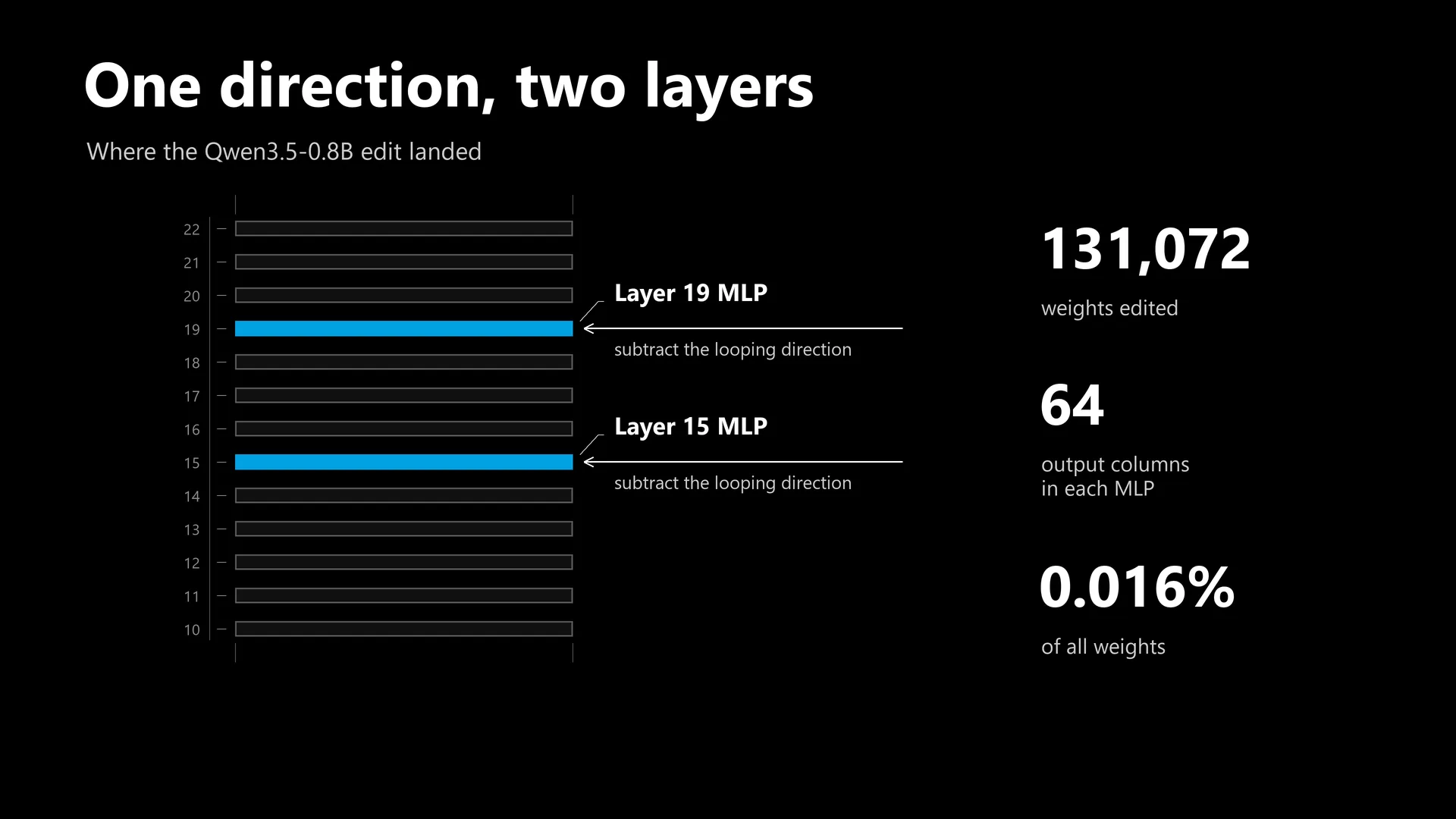
Qwen’s score jumped because the edit stopped it looping. The base Qwen3.5-0.8B hit its 32,768-token limit on 93% of answers, so most of its math attempts never finished. Astra traced the looping to one direction written by the MLPs in layers 15 and 19, then subtracted it.
| Qwen3.5-0.8B | MATH-500 | GSM8K | IFEval | Hit token limit |
|---|---|---|---|---|
| Base | 7.9% | 13.8% | 21.0% | 93.0% |
| 10 forward passes | 12.3% | 25.7% | 49.0% | 87.2% |
| 25 forward passes | 14.1% | 25.1% | 39.9% | 86.4% |
| 50 forward passes | 48.1% | 67.1% | 62.3% | 33.1% |
The edit touched 131,072 weights, 64 output columns in each of the two MLPs. Of Astra’s first 96 practice answers, 85 had hit the token limit, so the diagnosis was not subtle once someone looked.
The Gemma control tells you what kind of gain this is
The control experiment is the part I would put on the front page. The authors ran the same process on Gemma 3 270M, which only hits its token limit on 8.5% of answers. Its MATH-500 score went from 6.8% to 7.0% after 50 forward passes. Nothing to fix, nothing gained. In their words: “Editing weights could remove an obstacle that hid an ability, but it could not add an ability the model lacked.”
They also answer the obvious objection, that you could just turn thinking off: “Turning thinking off raises the base score, but it does not fix the weights.” Fair. But it confirms what kind of improvement this is.
Is weight-space programming just interpretability with a new name?
Partly, and the critics have a point. Simon Willison, who replicated the weight-reading test on a laptop using Qwen 3.8 27B, wrote that “the paper combines two topics that I think deserve to be treated separately.” One is reading raw weights with no tools. The other is a model armed with code running operations to improve another model.
His local run named Breakout with 88% confidence after 52 minutes, Pong at 75% and Pac-Man at 72%, and failed on Freeway. So the reading ability is not exclusive to frontier models. He also cited Matthew Honnibal calling the paper misleading for blending the two claims, and Sean Goedecke arguing the Qwen edit follows the same steps a human ML researcher would take.
That matches the technique. Finding a direction in activation space and removing it is a known interpretability move. The authors do not dispute this. They say they have “not compared Astra with interpretability researchers,” and expect progress to come partly from composing known techniques.
What is actually new
The edit itself is familiar. What changed is that a general model ran the whole loop itself, from noticing the looping, to locating it, to choosing the cut, to checking it, inside a budget of 50 forward passes. So the claim is about workflow. It still matters, for the same reason agents matter even though every step they take is something a person could do.
What does this change for people building with open models?
For builders, it changes where the cheapest improvement might come from. If you run a small open model in a pipeline and it fails in one repeatable way, such as looping, refusing, or answering “no” to everything, a targeted weight edit is now a realistic option next to prompt changes and fine-tuning. It needs no GPU training run and no labeled dataset of the kind fine-tuning wants.
The pattern I would follow mirrors how I already handle agent pipelines that misbehave: diagnose before reaching for a bigger fix. My first question is whether one mechanical failure, a loop, a truncated output or a broken format, explains the drop before I blame the model for being too weak. Weight-space programming is the first approach that targets that kind of failure inside the weights rather than around them.
Cheap edits slip past compute-based rules
The second change is governance. i-SCOOP points out that under the European Commission’s guidelines for general-purpose AI, a company that modifies a model becomes its provider only when the modification uses more than one third of the original training compute. The Qwen edit used no GPU. Compute is a reasonable signal for building a new model and a weak one for changing what an existing model does.
So if you deploy open weights, treat the weights file as code. Pin it, hash it, keep a change log, and judge any edited model by behavior tests, not by how much compute went into the edit. The same discipline I argue for in an AI agent security checklist applies here.
How should you test a weight edit before trusting it?
Test a weight edit the way you would test any vendor model claim: on your own held-out data, against a fair control, with the failure cases counted. A score jump on the problems used to find the edit proves very little, because the direction was built from those same problems.
The open-source weight-space programming skill for Claude Code is a good template, partly because its README is honest about its own numbers. It runs the Qwen-style edit and then:
- Screens each candidate edit against a size-matched random edit, so you know the gain is not from disturbing any weights at all.
- Runs a practice check, and admits it is partly in-sample: 17 of its 26 looping questions also built the direction.
- Confirms with a paired test on held-out questions and reports what was fixed and what broke.
Its own science result is the lesson. Held-out accuracy went from 40.0% to 50.0%, with 4 questions fixed and 1 broken, and a sign test p-value of 0.38. That is not significant. Its image-task edits showed no reliable gain, and one pushed the model toward answering “no.” As the README puts it, “No method can promise that an edit helps.”
I would add one rule from testing AI models in general: count regressions on tasks you did not target. The Qwen edit raised IFEval too, but a different edit on a different model might trade one failure for another.
Why “repair, not teach” is still the bigger story
The authors point at something larger. Today, recursive self-improvement usually means a model writing code that launches training jobs. They argue that “an LLM that can inspect, debug, and improve its own weights” is “a richer, more native path to it.” I covered why claims in that direction need hard evidence in the Gemini RSI leak breakdown, and the same bar applies here.
My read of the current evidence is narrower, and I would change it the moment someone shows an edit that adds a measurable ability to a model with no degenerate failure to remove. Until then, weight-space programming is binary patching for neural networks. Patching never wrote better software. It made broken software run. For anyone shipping small models into real workflows, that is still worth a lot, because most production failures look much more like a stuck loop than a missing skill.
The next step is concrete. Take the small open model you trust least, log where it fails, and check whether one mechanical failure explains most of it. If it does, you now have a third option besides a bigger model and a fine-tune.
Frequently asked questions about weight-space programming
What does weight-space programming mean in plain terms?
Weight-space programming is treating a neural network’s weights like a program that can be read and written. A general-purpose LLM inspects the weights, reasons about what parts of the network compute, and edits or writes them directly. The MIT CSAIL authors who coined it say it is a concept, not a method.
Does weight-space programming really involve no training?
In the MIT experiments, no training loops, data fitting, loss functions or gradients were used. The LLM did have a Python sandbox in some experiments, and in the Qwen experiment it could run up to 50 forward passes on practice problems to see how the model behaved before editing.
Did editing Qwen’s weights make it better at math?
It made Qwen3.5-0.8B score better on math, from 7.9% to 48.1% on MATH-500. The base model hit its token limit on 93% of answers because it looped. The edit cut that to 33.1%, so most of the gain came from letting the model finish answers it could already reach.
Can weight-space programming add new abilities to a model?
The evidence so far says no. On Gemma 3 270M, which rarely loops, scores stayed between 6.8% and 7.7%. The authors wrote that editing weights could remove an obstacle that hid an ability, but could not add an ability the model lacked.
Can I try weight-space programming on my own model?
Yes, on small open models. The authors released their logs and the edited Qwen model, and an open-source Claude Code skill packages the Qwen-style edit with a random-control screen and a held-out test. Its own science test moved from 40% to 50%, which was not statistically significant.
Frequently asked questions
01What does weight-space programming mean in plain terms?
Weight-space programming is treating a neural network's weights like a program that can be read and written. A general-purpose LLM inspects the weights, reasons about what parts of the network compute, and edits or writes them directly. The MIT CSAIL authors who coined it say it is a concept, not a method.
02Does weight-space programming really involve no training?
In the MIT experiments, no training loops, data fitting, loss functions or gradients were used. The LLM did have a Python sandbox in some experiments, and in the Qwen experiment it could run up to 50 forward passes on practice problems to see how the model behaved before editing.
03Did editing Qwen's weights make it better at math?
It made Qwen3.5-0.8B score better on math, from 7.9% to 48.1% on MATH-500. The base model hit its token limit on 93% of answers because it looped. The edit cut that to 33.1%, so most of the gain came from letting the model finish answers it could already reach.
04Can weight-space programming add new abilities to a model?
The evidence so far says no. On Gemma 3 270M, which rarely loops, scores stayed between 6.8% and 7.7%. The authors wrote that editing weights could remove an obstacle that hid an ability, but could not add an ability the model lacked.
05Can I try weight-space programming on my own model?
Yes, on small open models. The authors released their logs and the edited Qwen model, and an open-source Claude Code skill packages the Qwen-style edit with a random-control screen and a held-out test. Its own science test moved from 40% to 50%, which was not statistically significant.