Claude Code11 min read
Is Claude Ultra worth it? Measure your subscription with a usage diary
Is Claude Ultra worth $200? Log two weeks of real work, then divide the price by accepted results. A usage diary method for Pro, Max and Ultra.
[ Key takeaways ]
- API-equivalent value is the wrong test for a Claude plan. It counts tokens burned, including work you threw away, not results you kept.
- Since 30 October 2026, Max is $100 for 5x Pro usage per week and per five-hour window, and Ultra is $200 for 10x Pro per week with no five-hour limit on verified accounts.
- Per unit of weekly usage the two plans cost the same, so the real Max vs Ultra question is whether the five-hour wall is blocking work you would have kept.
- A two-week usage diary records the task, surface, model, outcome, review minutes, limit consumed and every wall you hit. That is enough to compute cost per accepted result.
- Cost per accepted result is the monthly price plus overage, divided by results that shipped. Add review time at your hourly rate for the fully loaded number.
Claude Ultra is worth $200 a month only if your own log shows one of two things: the five-hour limit on Max keeps stopping work you would have kept, or you routinely burn through more than half of Ultra’s weekly allowance on results you actually accept. You will not find that answer on a pricing page. You find it by keeping a usage diary for two weeks and dividing the price by what shipped.
In The Effective Executive, Peter Drucker gave an odd instruction for people who wanted to get more done. Do not start with your tasks, he argued. Start by recording where your time actually goes, because memory of how you spent a week is reliably wrong. I think about that every time someone argues over whether a Claude plan “pays for itself.” Almost nobody arguing has a record. They have a feeling and a screenshot of a token counter.
Why is API-equivalent value the wrong way to judge a Claude plan?
Because it measures consumption, not results. API-equivalent value prices every token you used at metered rates, including the drafts you deleted, the agent loops that went nowhere and the chats you abandoned. A plan can show thousands of dollars of “value” while producing very little you kept.
The number shows up everywhere. One heavy user told TechCrunch, as reported via Yahoo Finance, that the $200 Max plan often let him make “over $1,000 worth of calls (measured in API pricing) in a single day.” The daily.dev summary of Theo Browne’s video “Anthropic can’t stop winning” carries an unattributed FAQ line saying the verified Ultra weekly limit “is worth up to $12,000 a month in inference,” with no method given.
Both figures answer the question “how much compute could I pull out of this?” That is Anthropic’s cost problem. Yours is different. You care what the compute turned into, and a token meter cannot see that.
What does each Claude plan actually include now?
On 30 October 2026 Anthropic renamed Max 5x to Max and Max 20x to Ultra, with no price change. Max stays at $100 a month with five times Pro usage per five-hour window and per week. Ultra stays at $200 with ten times Pro per week and no five-hour limit once the account is verified.
Here is the current shape, from Claude’s pricing page and the Ultra help article:
| Plan | Price | Weekly usage | Five-hour limit | Notes |
|---|---|---|---|---|
| Pro | $20/month, or $17 billed yearly | 1x baseline | Yes | Fable via usage credits |
| Max | $100/month | 5x Pro | Yes, 5x Pro per window | Fable up to half the weekly limit |
| Ultra | $200/month | 10x Pro | None for verified accounts | Separate weekly Fable limit; API credits included |
Two details change how you read that table. First, Ultra’s verification is automatic, “using factors like your account and payment history,” and verifying a phone number does not lift the temporary limit. If you still see a “Current session” bar under Settings > Usage, you are not verified yet. Second, as a breakdown on mean.ceo points out, the old “20x” only ever described the five-hour window. The weekly allowance was 10x all along.
The math nobody mentions about Max vs Ultra
Divide price by weekly allowance and both plans land at about $20 per Pro-week of usage. Ultra does not buy cheaper capacity. It buys twice the weekly ceiling and the removal of the five-hour wall. So the honest Max vs Ultra question is narrow: are you hitting either of those, and is what you lose when you hit them worth $100?
What should a Claude usage diary record?
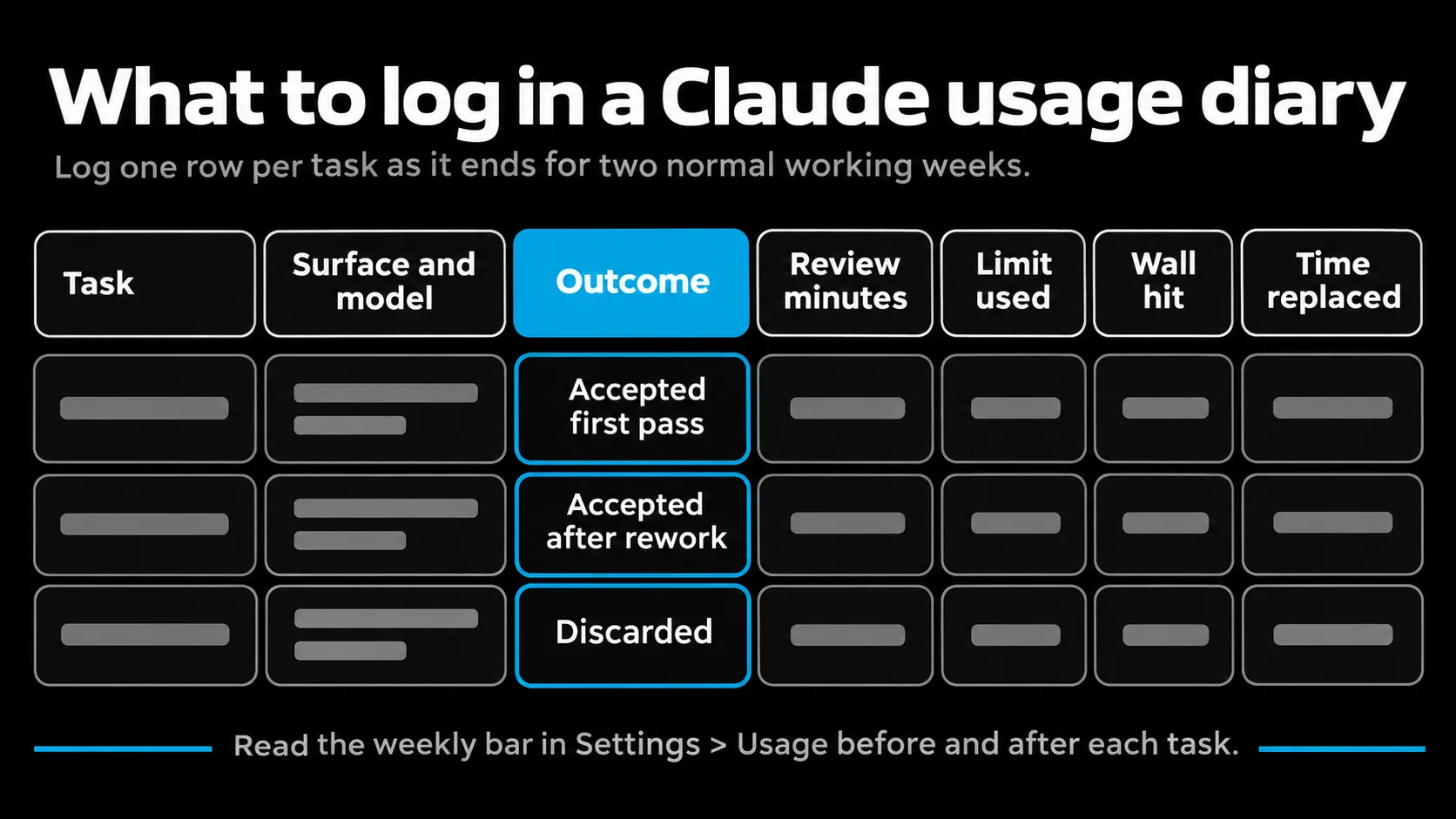
One row per meaningful task, logged when the task ends rather than reconstructed on Friday. Record the surface, model, outcome, review time, how much of your limit it consumed, and whether you hit a wall. Seven columns are enough. More than that and you will stop filling it in by Wednesday.
| Column | What to write | Why it matters |
|---|---|---|
| Task | One line: “refactor auth middleware”, “first draft of client proposal” | Lets you group by work type later |
| Surface and model | Chat, interactive Claude Code, or headless/SDK; Opus, Sonnet or Fable | Different surfaces and models drain limits at different speeds |
| Outcome | Accepted first pass, accepted after rework, or discarded | The numerator of everything that follows |
| Review minutes | Time you spent checking, fixing or re-prompting | The cost the subscription price hides |
| Limit used | Weekly bar before and after, from Settings > Usage | Turns “it felt heavy” into a percentage |
| Wall hit | None, five-hour, weekly, or Fable cap, plus what you did next | The only column that justifies an upgrade |
| Replaced | Rough minutes the task would have taken you by hand | Your break-even reference |
For Claude Code work, add a nightly pull from ccusage, an open-source CLI that reads Claude Code’s local JSONL logs and reports input, output, cache-creation and cache-read tokens per day with an estimated cost. Run ccusage daily --since <start date> at the end of each day. It gives you the API-equivalent figure as a reference column, which is useful precisely because you are not going to judge the plan by it.
Log the walls, not just the work
The “Wall hit” column is where the decision lives. A five-hour wall that lands at 6pm on a day you were stopping anyway costs nothing. One that lands in the middle of a debugging session and forces a context reload the next morning costs real work. Write down which one it was. Two weeks of those notes will settle the Max vs Ultra question faster than any review video.
How do you calculate cost per accepted result?
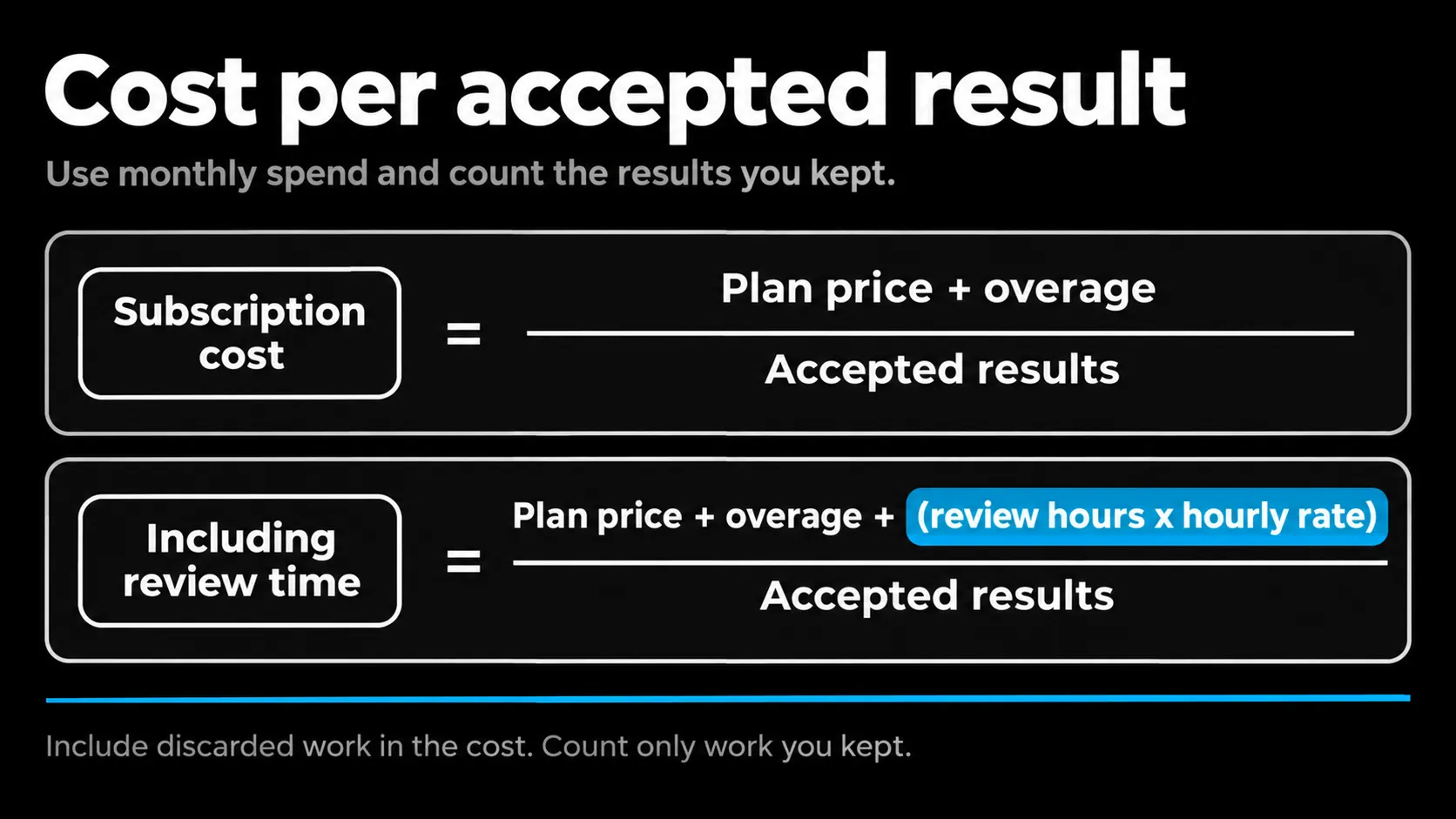
Divide what you paid for the month, including any usage credits bought after hitting limits, by the number of results you kept. For the fully loaded version, add your review minutes priced at your own hourly rate. Discarded work goes into the cost and never into the count, which is what makes the number honest.
The two formulas:
- Cost per accepted result = (plan price + overage spend) / accepted results
- Loaded cost per accepted result = (plan price + overage spend + review hours x your hourly rate) / accepted results
Here is how that plays out. These are illustrative numbers to show the arithmetic, not a real log. Say two diary weeks on Ultra record 46 tasks: 30 accepted first pass, 9 accepted after rework, 7 discarded. That is 39 accepted results, roughly 78 a month. At $200 with no overage, cost per accepted result is about $2.56. If review added 12 hours across the month at a $50 hourly rate, the loaded figure is ($200 + $600) / 78, about $10.26.
Notice which number moved. The subscription was a quarter of the loaded cost. Review time was the rest. That pattern matches what I argued in my piece on AI token spend: the bill is the visible cost, and the human checking the output is usually the bigger one.
Compare against the metered route
Now take the API-equivalent figure from ccusage for the same month and ask what it would have cost to do the same work on pay-per-token pricing. Opus 5.5 is listed at $4 per million input tokens, $20 per million output and $0.20 per million cache hits on Anthropic’s pricing docs. The metered route charges for the discarded seven tasks too. If that total sits well under $200, the subscription is buying convenience, not savings. If it sits well over, the flat price is doing its job.
How do you pick between Pro, Max and Ultra from the diary?
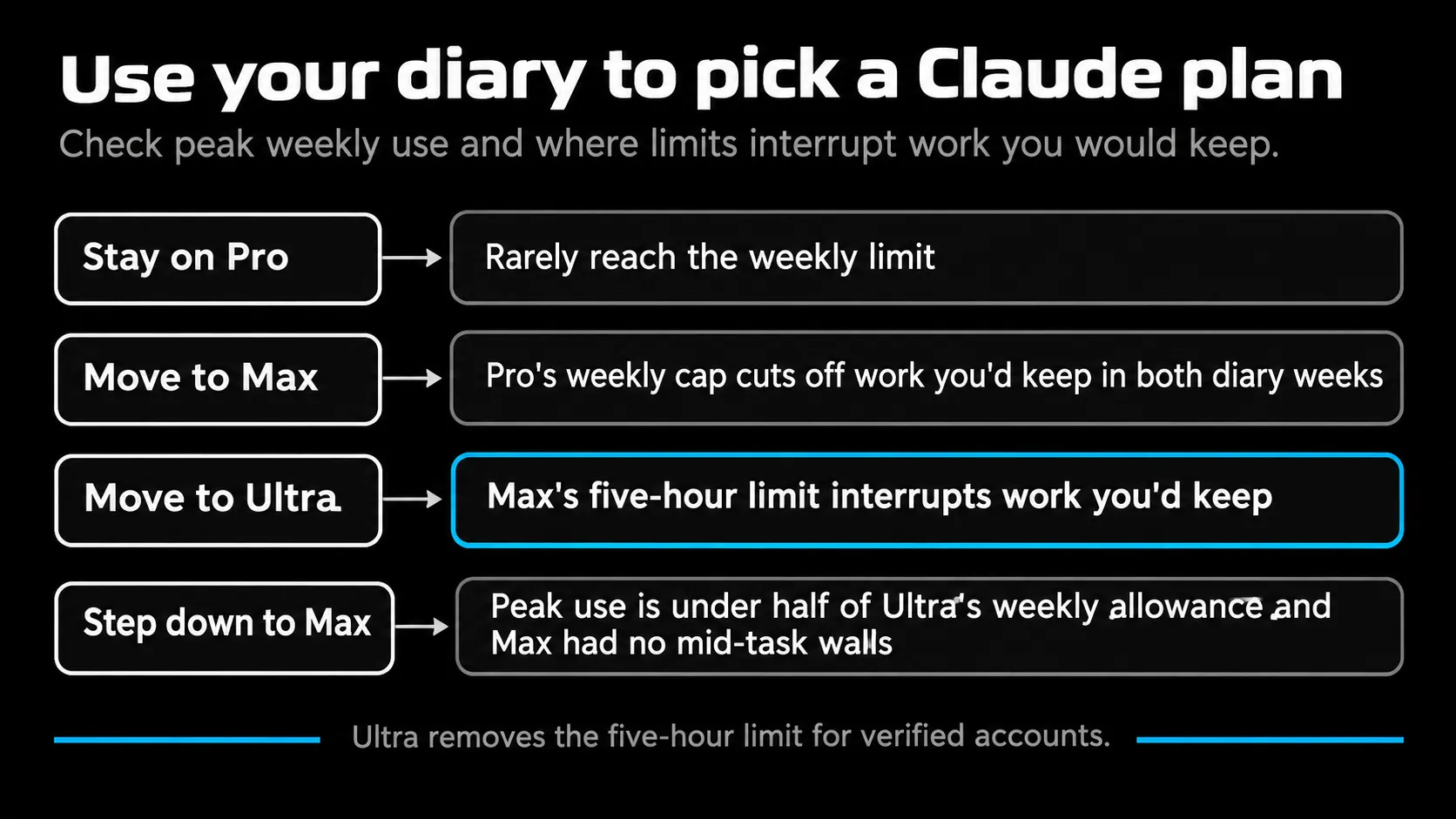
Read three numbers: peak weekly usage, how often a five-hour wall interrupted kept work, and cost per accepted result. Drop a tier if your peak week would fit inside the tier below. Move up only if walls are blocking work you would have shipped, not work you would have thrown away.
- Stay on Pro if you rarely touch the weekly limit and your five-hour walls fall on tasks you were close to finishing anyway.
- Move to Max if Pro’s weekly bar runs out before the week does on both diary weeks, and the tasks cut off were ones you accepted.
- Move to Ultra if the diary shows five-hour walls landing mid-task on accepted work, or your peak week on Max sits above 80%.
- Step down from Ultra if your peak week stays under 50% of the Ultra allowance, which is all of Max’s weekly allowance, and you never logged a mid-task wall on Max.
When should you judge a plan by its peak week?
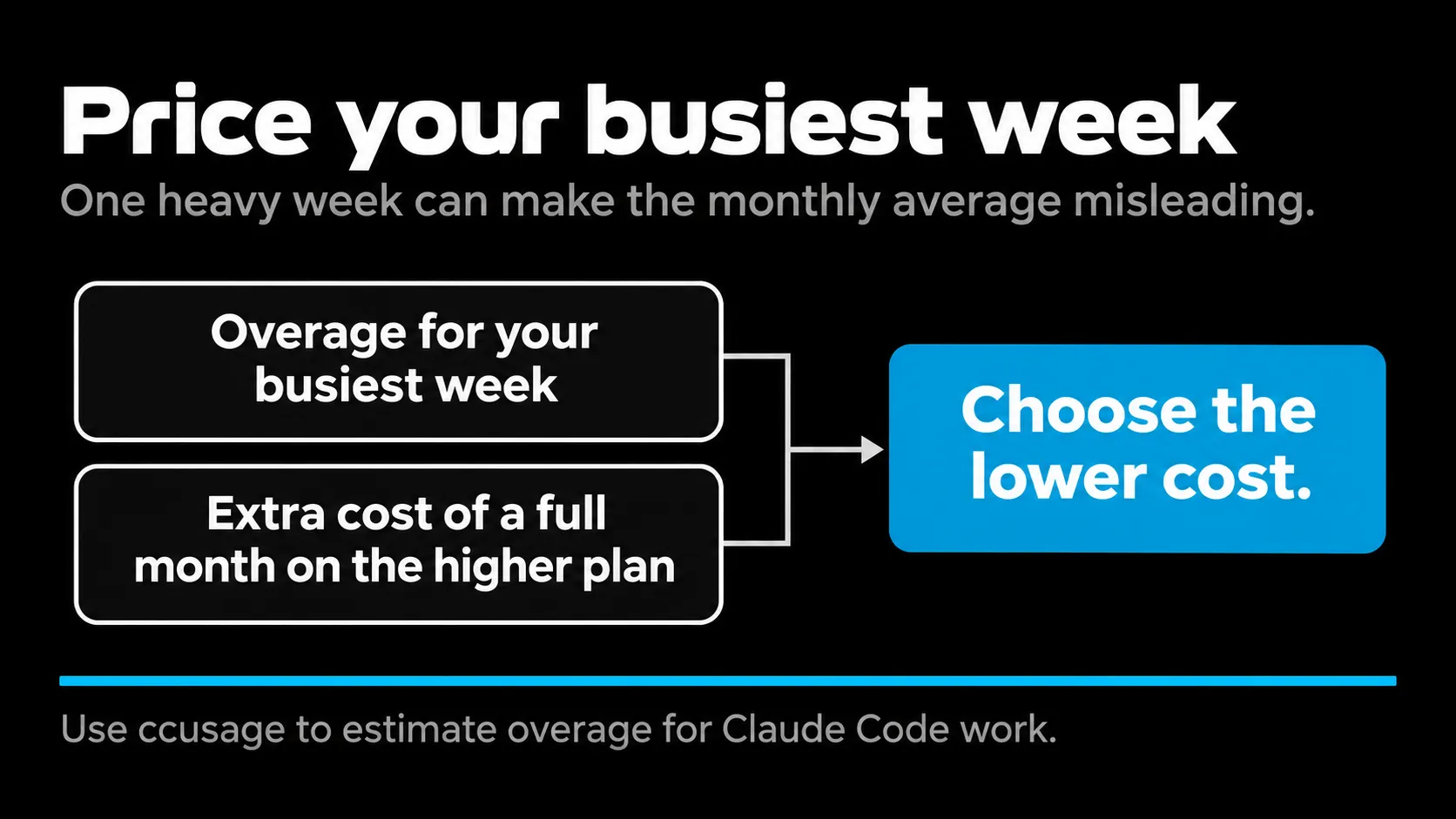
When your work is lumpy. If one launch week a month burns everything and the other three barely touch the bar, the average will tell you to downgrade and the launch week will punish you for it. Judge by the peak, then price the alternative.
The alternative is overage. On paid plans you can turn on usage credits and keep working at standard API rates once you hit a limit, with a monthly cap if you set one. Compare one heavy week of overage on the cheaper plan against a whole month of the pricier one. The ccusage figure for the peak week approximates the overage; the plan gap is a flat $100. Whichever is smaller wins. That is the one case where I would ignore my own step-down rule.
What makes a usage diary lie?
Four things skew the record: work outside Claude Code that ccusage never sees, third-party tools that drain limits faster, the separate Fable cap, and quietly reclassifying discarded work as “accepted after rework.” Each one makes the plan look better or worse than it is. Name them up front so you can correct for them.
Chat is invisible to ccusage
Chat, desktop and Claude Code draw on the same weekly pool, but ccusage only reads Claude Code’s local logs. The Settings > Usage bar is your only cross-surface measure, which is why the diary records it before and after.
Third-party harnesses burn faster
The same daily.dev summary of Theo’s video reports that apps built on the Agent SDK, such as T3 Code and Open Code, “consume the 5-hour rate limit window roughly 1.8 to 2 times faster per token than the interactive CLI does.” If you work through a wrapper, tag it in the surface column, or the diary will blame the plan for the tool’s overhead.
Fable has its own ceiling
On Ultra there is a weekly limit across all models and a separate one for Fable, so you can hit the Fable wall with plenty of weekly room left. On Max, Fable can use up to half of the existing weekly allowance; it is not an extra bucket. Log Fable walls separately from general ones.
Rework creep
The easiest lie is marking a task “accepted after rework” when you rewrote 80% of it yourself. My rule: if you changed more than you kept, it is discarded.
How I keep subscription usage visible in my own systems
The habit behind this diary comes from building automation that runs on a subscription rather than metered billing. My headless content pipeline refuses to start unless it is authenticated through a subscription login, and it reads the CLI’s own rate-limit events and holds the next run instead of falling through to API billing. A run that silently switches to metered pricing is the kind of cost you only discover on the invoice.
That design forced the same discipline the diary asks for. Every run has a known outcome, every limit event gets recorded, and nothing counts as done until a person approves it. Once outcomes are logged by default, the “is the plan worth it” question becomes arithmetic instead of mood.
Do the included API credits change the math?
They can, for headless work. Per the mean.ceo breakdown, Max includes $100 and Ultra $200 a month in Claude API credits, claimable after seven days, and they cover the Messages API, the Agent SDK and claude -p with an API key from the linked organization. They do not cover interactive Claude Code. If part of your diary is headless batch work, moving it onto those credits frees subscription headroom for interactive sessions. Log which bucket each headless task drew from.
What a subscription actually is
A subscription is a bet that your usage will be high and useful. The pricing page tells you the size of the bet. Only a record of outcomes tells you whether you are winning it, and the same logic applies to every flat-rate AI tool on your card.
Start the diary on your next Monday. Two weeks, seven columns, one honest outcome per task. If you want to extend it to comparing models on the same work, my guide on how to test AI models uses the same cost-per-accepted-result measure, and my Codex vs Claude Code comparison covers how task type changes which agent is worth paying for.
Frequently asked questions
Is Claude Ultra worth it?
Ultra is worth it if the five-hour session limit on Max is blocking work you would have kept, or if you regularly use more than half of Ultra’s weekly allowance on results you accept. If your diary shows neither, Max covers the same work for $100 less.
What is the difference between Claude Max and Claude Ultra?
Max costs $100 a month and gives 5x Pro usage every five hours and every week. Ultra costs $200 and gives 10x Pro usage every week with no five-hour limit for verified accounts. Both keep weekly limits, and Ultra has a separate weekly limit for Fable.
How do I see how much of my Claude limit I have used?
Open Settings > Usage in Claude. It shows your weekly usage and, on plans that have one, the current five-hour session. For Claude Code specifically, the open-source ccusage tool reads local logs and estimates the API-equivalent cost of each day’s tokens.
What does cost per accepted result mean?
Cost per accepted result is what you paid for a month of Claude divided by the number of outputs you actually kept that month: merged changes, sent drafts, finished analyses. Discarded and abandoned work counts toward the cost but not toward the results, which is the point.
How long should I keep a Claude usage diary?
Two normal working weeks is enough for a first decision, because weekly limits reset once a week and one week can be skewed by one big project. Repeat it after any plan change or major model release.
Frequently asked questions
01Is Claude Ultra worth it?
Ultra is worth it if the five-hour session limit on Max is blocking work you would have kept, or if you regularly use more than half of Ultra's weekly allowance on results you accept. If your diary shows neither, Max covers the same work for $100 less.
02What is the difference between Claude Max and Claude Ultra?
Max costs $100 a month and gives 5x Pro usage every five hours and every week. Ultra costs $200 and gives 10x Pro usage every week with no five-hour limit for verified accounts. Both keep weekly limits, and Ultra has a separate weekly limit for Fable.
03How do I see how much of my Claude limit I have used?
Open Settings > Usage in Claude. It shows your weekly usage and, on plans that have one, the current five-hour session. For Claude Code specifically, the open-source ccusage tool reads local logs and estimates the API-equivalent cost of each day's tokens.
04What does cost per accepted result mean?
Cost per accepted result is what you paid for a month of Claude divided by the number of outputs you actually kept that month: merged changes, sent drafts, finished analyses. Discarded and abandoned work counts toward the cost but not toward the results, which is the point.
05How long should I keep a Claude usage diary?
Two normal working weeks is enough for a first decision, because weekly limits reset once a week and one week can be skewed by one big project. Repeat it after any plan change or major model release.