AI News7 min read
What Lean Checked in the Claude-Assisted Riemann Hypothesis Proof Claim
Independent Lean checks back Levent Alpöge's Claude-assisted Riemann Hypothesis proof claim. Clay still lists the problem as unsolved.
[ Key takeaways ]
- Levent Alpöge announced a Claude-assisted proof claim on November 20, 2026. Lean and Mathlib maintainers reported independent verification of the formal Riemann Hypothesis proof the next day.
- Alessandro Masullo's separate human-written claim concerns the Generalized Riemann Hypothesis. Ravi Vakil reported that readers raised issues with the draft.
- Clay still lists the Riemann Hypothesis as unsolved. Prize consideration requires qualifying publication, at least two years after publication, and general acceptance.
Levent Alpöge’s Claude-assisted Riemann Hypothesis proof claim has passed independent checks in Lean. On November 21, 2026, the Lean and Mathlib communities reported that the code proves the standard formal statement. Mathematicians are still working through the argument, and the Clay Mathematics Institute still lists the problem as unsolved. Lean and Mathlib statement · Clay’s problem page
The detail I keep coming back to is that the people checking the proof put the target statement in a file of their own. I want the same independence when an AI workflow is about to write something I have to stand behind.
What did Alpöge claim Claude helped prove?
On November 20, Anthropic mathematician Levent Alpöge wrote, “I believe I have, working with Claude, discovered a proof of the Riemann Hypothesis.” He said the method extends to the Generalized Riemann Hypothesis for Dirichlet L-functions and released a Lean library for others to inspect. Alpöge’s announcement
Alpöge describes trying to combine two ideas in a simpler setting and guiding the work toward a similar setup for the harder problem. He credits Claude with major progress from there. The Lean and Mathlib communities put the library at about 17 million lines. The release gave reviewers an argument they could check even while they were still figuring out how to explain it. Alpöge’s account · Lean community statement
On August 10, Anthropic reported that Claude raised a lower bound on the share of zeros on the critical line from 41.6% to 67.2%. The November claim concerns every nontrivial zero. Anthropic’s August research note
Why does the Riemann Hypothesis matter?
The Riemann Hypothesis says that every nontrivial zero of the Riemann zeta function has real part one half. Bernhard Riemann proposed it in 1859. Its link to prime numbers is about precision. The hypothesis would constrain how far actual prime counts can stray from the estimates mathematicians use. Clay’s problem description
Think about counting the primes below a cutoff. The prime number theorem describes how that count grows on average as the cutoff rises. The harder question is how far an estimate could be off. The zeta function gives mathematicians a way to study that error, and the location of its zeros controls the size of the fluctuations. Clay’s official overview
The generalized version in these announcements asks about zeros across a family of functions called Dirichlet L-functions. It covers the classical case and reaches into how primes are distributed in arithmetic progressions, such as the numbers that leave remainder one when divided by four. Sutherland’s verification notes · MIT number theory notes
What did independent Lean checks verify?
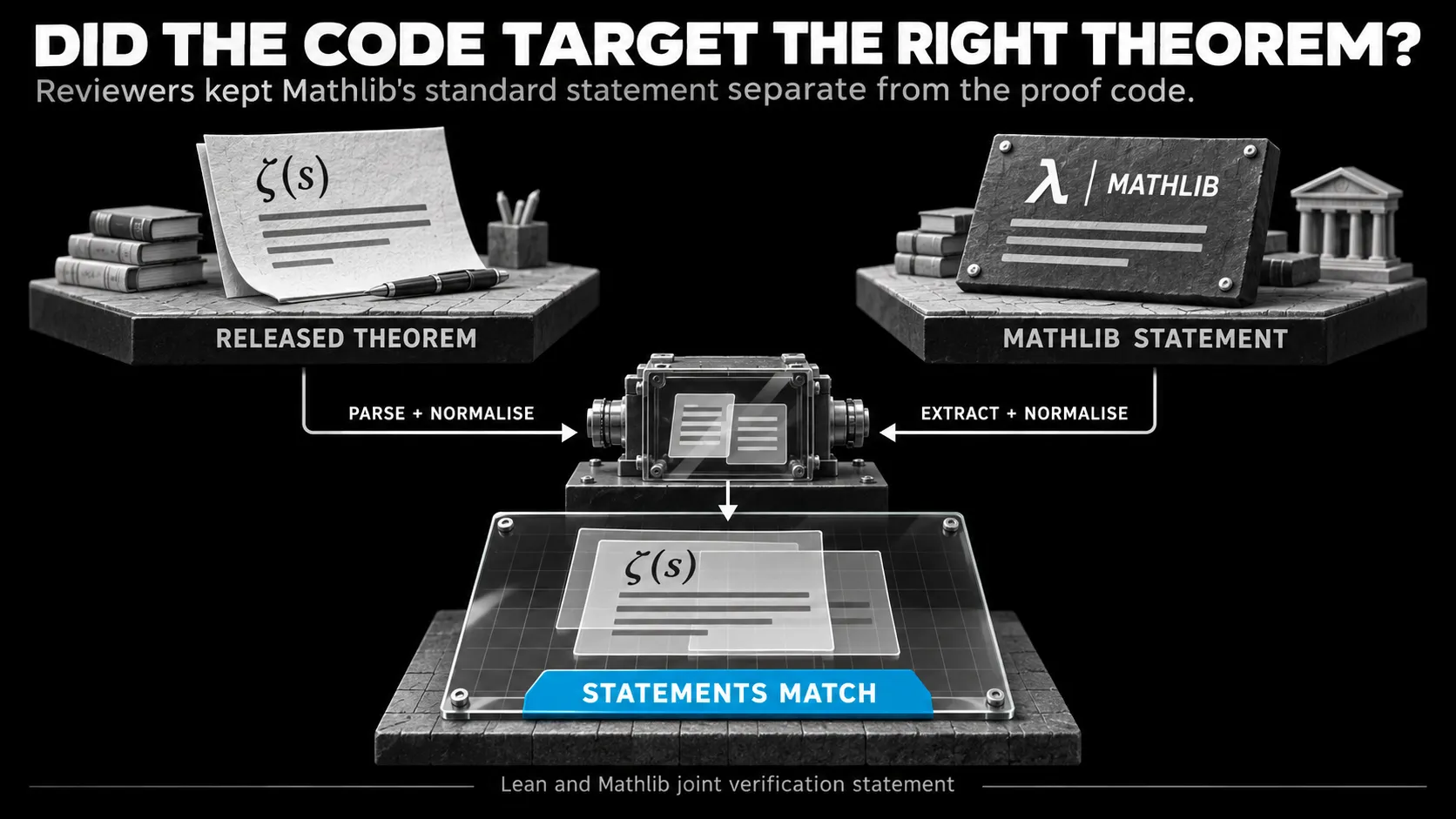
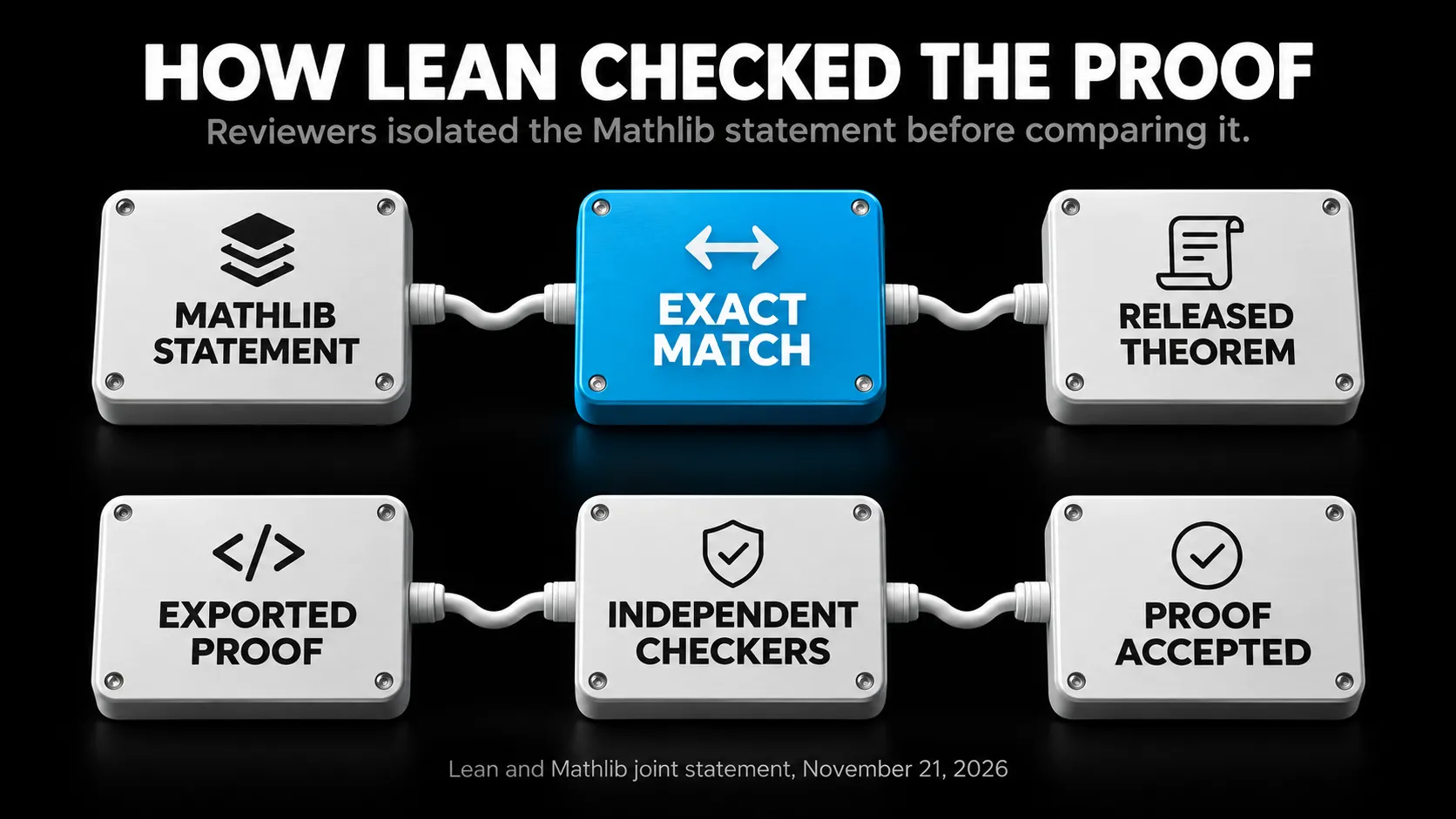
The Lean and Mathlib communities reported that independent tools matched Alpöge’s theorem to Mathlib’s existing Riemann Hypothesis statement. Multiple proof checkers also accepted the exported proof data. The checks answer two questions about the same release. Did the code target the right theorem? Does the formal argument establish it? Joint verification statement
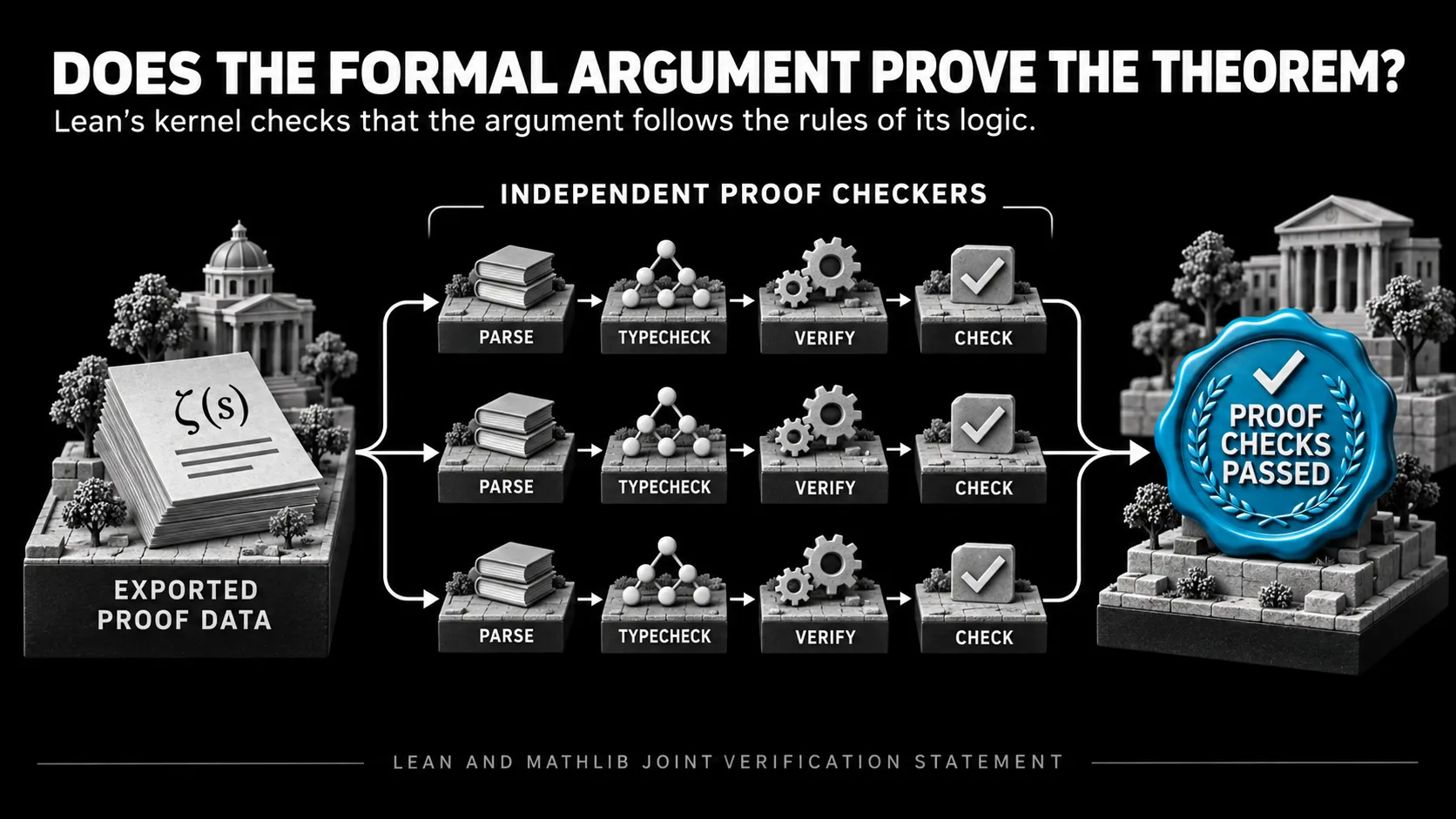
Lean is a proof assistant. Its kernel, the small core that checks proofs, verifies that a formal argument follows the rules of its logic. Andrew Sutherland reported that all 175,187 modules compiled and the five headline theorems relied on only Lean’s three standard axioms. Lean language reference · Sutherland’s verification logs
The independently written target matters because a theorem can be impeccable on paper and answer a weaker question. Reviewers isolated the standard statement from Alpöge’s library before comparing. There’s another job for mathematicians now. A working guide from Michael Rubinstein’s project distinguishes steps it explains in prose from steps it still takes from the Lean library. Waterloo working exposition
Masullo’s separate claim is still under review
On November 20, Ravi Vakil shared Alessandro Masullo’s separate human-written manuscript claiming a proof of the Generalized Riemann Hypothesis. Vakil said Brian Conrad had been giving feedback for months. In an update about eight hours later, he said people had reported problems they found with help from AI models. Vakil’s announcement and update
The same-day announcements make it easy to treat them as entries in a race. A reader deciding what to trust has more concrete evidence to compare. Alpöge released machine-checkable code and others ran independent checks. Masullo released a prose draft with a record of early feedback and issues that readers had flagged. Lean and Mathlib statement · Vakil’s update
I would judge each by what a reviewer can reproduce. For a concern raised about Masullo’s draft, that means pointing to the disputed step and showing exactly where the argument fails or where a missing justification belongs. The work of checking a report matters even when the report sounds convincing.
The $1 million prize has its own timeline
The Clay Mathematics Institute still lists the Riemann Hypothesis as unsolved. Its rules require publication in a qualifying outlet, at least two years from that publication, and general acceptance in the global mathematics community before it will consider a proposed solution. Clay’s status page · Millennium Prize rules
The institute allocates $1 million to each problem. Its rules typically call for a reputable refereed mathematics publication and give Clay discretion to approve an outlet under relaxed conditions. The public Lean archive gives reviewers something to check today. What starts the prize clock is publication in an outlet Clay considers qualifying. Clay’s full prize rules
I found the same distinction worth making when I wrote about the OpenAI math release. A headline can tell you a result exists. To find out what you can rely on, start with the exact statement and the record of who checked it. Here the independently written Mathlib target gives that record an unusually clear starting point.
How I would verify an AI workflow
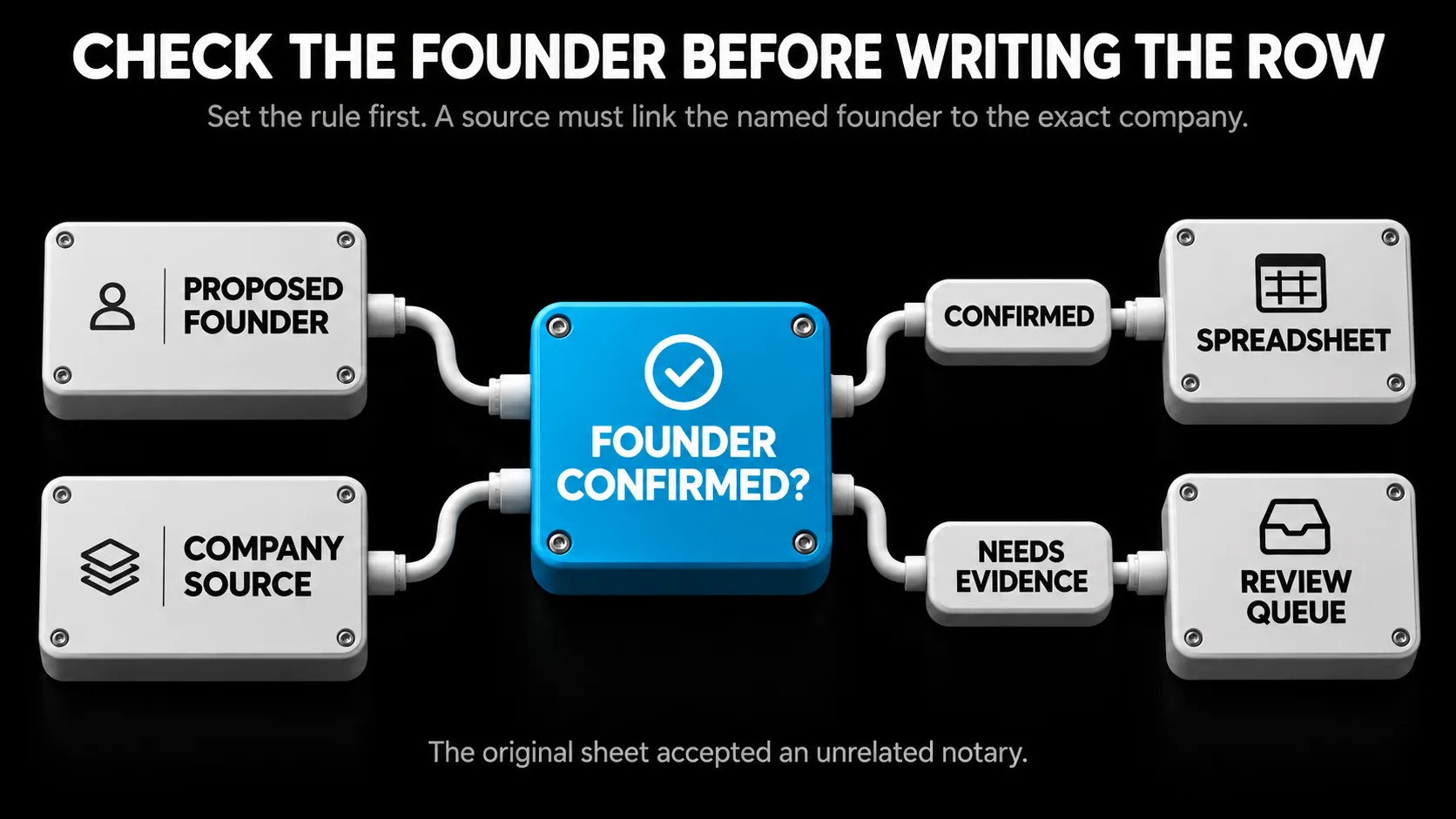
I would write the acceptance rule before handing an agent the job. Keep the rule outside the agent’s output and make the evidence easy to replay. In a lead-research workflow, that can be as concrete as requiring a source that ties the named founder to the exact company on the row.
I built a lead-research pipeline that initially wrote search results straight into a spreadsheet. One result attached an unrelated notary to a company. The sheet accepted the name because the workflow had no separate check that it belonged there. I routed search results to a review queue and let facts from the company’s own site go straight in. My pipeline teardown
In practice, a mandatory source field alone would have let the notary through. The reviewer needs evidence linking the person to the company. For your next agent workflow, pick one expensive wrong output. Write down the evidence the agent must provide before it can change anything. My guide to testing AI models
Frequently asked questions
Did Claude prove the Riemann Hypothesis on its own?
Levent Alpöge describes a collaboration. He says he was pursuing a way to combine two ideas and credits Claude with major progress near the end. The release documents a proposed proof and its formal verification. The checks verify the mathematics encoded in Lean and do not measure individual contributions.
Did Lean just test a large sample of zeros?
Lean checked a formal argument for the full statement in Mathlib, which covers every nontrivial zero of the Riemann zeta function. Independent reviewers also compared the theorem against a copy of the statement isolated from Alpöge’s code.
Is the Generalized Riemann Hypothesis a separate Millennium Prize problem?
Clay lists the classical Riemann Hypothesis, which concerns the Riemann zeta function. The generalized version discussed in the Alpöge and Masullo claims concerns a broader family of functions called Dirichlet L-functions and includes the classical case.
Does the two-year prize clock start when a proof is posted online?
Clay’s rules measure at least two years from publication in a qualifying outlet. The institute also requires general acceptance in the global mathematics community before it considers a proposed solution.
Frequently asked questions
01Did Claude prove the Riemann Hypothesis on its own?
Levent Alpöge describes a collaboration. He says he was pursuing a way to combine two ideas and credits Claude with major progress near the end. The release documents a proposed proof and its formal verification. The checks verify the mathematics encoded in Lean and do not measure individual contributions.
02Did Lean just test a large sample of zeros?
Lean checked a formal argument for the full statement in Mathlib, which covers every nontrivial zero of the Riemann zeta function. Independent reviewers also compared the theorem against a copy of the statement isolated from Alpöge's code.
03Is the Generalized Riemann Hypothesis a separate Millennium Prize problem?
Clay lists the classical Riemann Hypothesis, which concerns the Riemann zeta function. The generalized version discussed in the Alpöge and Masullo claims concerns a broader family of functions called Dirichlet L-functions and includes the classical case.
04Does the two-year prize clock start when a proof is posted online?
Clay's rules measure at least two years from publication in a qualifying outlet. The institute also requires general acceptance in the global mathematics community before it considers a proposed solution.