Gemini 4 Argon in real work: where Claude and GPT-6 still win
Gemini 4 Argon real-world performance vs Claude and GPT-6: coding results, agent costs, latency, long context and the launch-pricing catch.
My ticket-triage kit can reject a polished answer for one missing JSON field.
That is the standard I bring to Gemini 4 Argon. The published evidence makes it a credible candidate for coding agents and multimodal work, with a strong result on simulated business automation. Claude’s measured configurations still lead several coding and deliverable-quality tests. GPT-6.1 Sol remains a cheaper candidate for work it can complete acceptably.
The comparisons below use published evaluations, checked on October 22. My evaluation harness and scoring sheet provide the practical anchor: define the required result, keep failed attempts, and count the work needed to accept an output. The starter kit’s demo responses are simulated.
Where does Argon stand against Claude and GPT-6?
Gemini 4 Argon sits close to GPT-6 Astra on Artificial Analysis’s aggregate Intelligence Index, below the measured Claude Sonnet 5.5 and Opus 5.5 configurations. Its benchmark task cost is lower than those Claude runs and Astra, while GPT-6.1 Sol costs less again.
| Model and tested reasoning setting | Intelligence Index v4.3.2 | Cost per index task |
|---|---|---|
| Gemini 4 Argon, High | 53 | $1.99 |
| Claude Sonnet 5.5, Max with Default Fallback | 56 | $5.46 |
| Claude Opus 5.5, Max with Default Fallback | 58 | $5.98 |
| GPT-6.1 Sol, Max | 52 | $0.72 |
| GPT-6 Astra, Max | 53 | $3.26 |
Scores are rounded. Two displayed 53s do not establish identical performance or statistical equivalence. High and Max are provider settings, not matched compute budgets.
These are results from a defined evaluation mix. I would use them to choose candidates, then investigate the particular task I need delivered.
How well does Argon handle coding work?
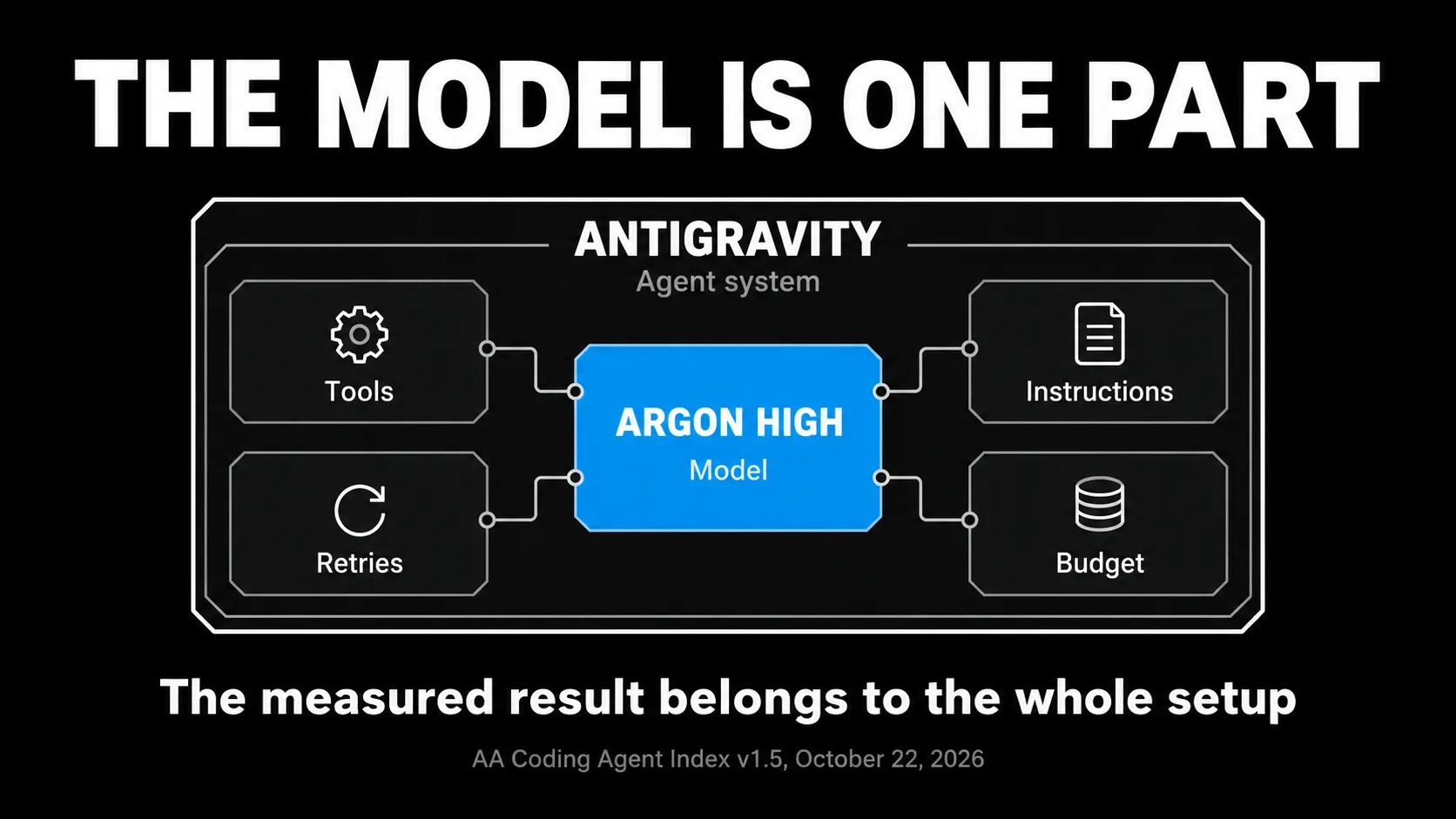
Antigravity CLI with Argon High lands between the measured Claude Code and Codex configurations on the Coding Agent Index. It offers a useful quality, cost and runtime tradeoff. That result belongs to the complete agent setup, including its tools and behavior around failures.
| Tested agent configuration | Index / 100 | API cost / task | Active minutes / task |
|---|---|---|---|
| Antigravity CLI + Argon High | 63.8 | $5.84 | 34.5 |
| Claude Code + Sonnet 5.5 Max | 68.4 | $14.19 | 87.4 |
| Claude Code + Opus 5.5 Max | 66.0 | $13.04 | 64.5 |
| Codex + GPT-6.1 Sol Max | 60.1 | $1.55 | 24.4 |
| Codex + GPT-6 Astra Max | 61.6 | $7.50 | 29.4 |
Source: AA Coding Agent Index v1.5. Claude Code runs include recorded fallback behavior. CLI versions and handling differ.
Active runtime excludes environment startup and verifier time. API costs exclude subscriptions, infrastructure and human supervision. A 34.5-minute measured run cannot promise a finished client feature in that time.
Where is Argon stronger in business workflows?
Argon’s business-work results split sharply by task. Artificial Analysis measures a stronger simulated SaaS automation score than these Claude and GPT configurations, while its knowledge-work deliverable score trails them. I would separate an agent updating application records from an agent producing a client-ready analysis.
On AutomationBench-AA, Argon High scores 77.5%, compared with Sonnet 5.5 Max at 71.8% and GPT-6.1 Sol Max at 64.9%.
That percentage measures the average share of objectives completed. A guardrail violation earns zero. It does not mean Argon fully completes 77.5% of arbitrary production jobs.
On AA-Briefcase 1.1, which evaluates analytical deliverables, Argon’s current Elo is about 1486. Sonnet reaches about 1817; Sol reaches about 1556.
The distinction matters in a paid workflow. Correctly changing a SaaS record and writing a defensible client recommendation require different evidence of completion. Argon’s automation result earns a focused trial. The deliverable gap gives me a reason to keep Claude in the comparison.
What does the million-token context actually buy?
Argon’s large context makes document, image, audio and video workloads worth investigating, but the budget is shared across input, thinking and output. A million-token specification does not establish that a model will reliably use every relevant fact in a large client folder.
Google documents a unified 1,048,576-token window for the stable API model, gemini-4-argon. It accepts multimodal input and produces text. Official model specifications.
Google’s model card reports strong long-context and video results. Its evaluation methodology also records different video-frame allowances across providers. I would retain those conditions alongside any comparison.
For my work, a useful candidate task would combine a requirements PDF, screenshots and a recorded user journey into one issue list. Each issue would need a source reference and a reproducible check. I would judge whether the evidence supports the finding before counting how much source material fitted into the request.
What will Argon cost after the launch discount?
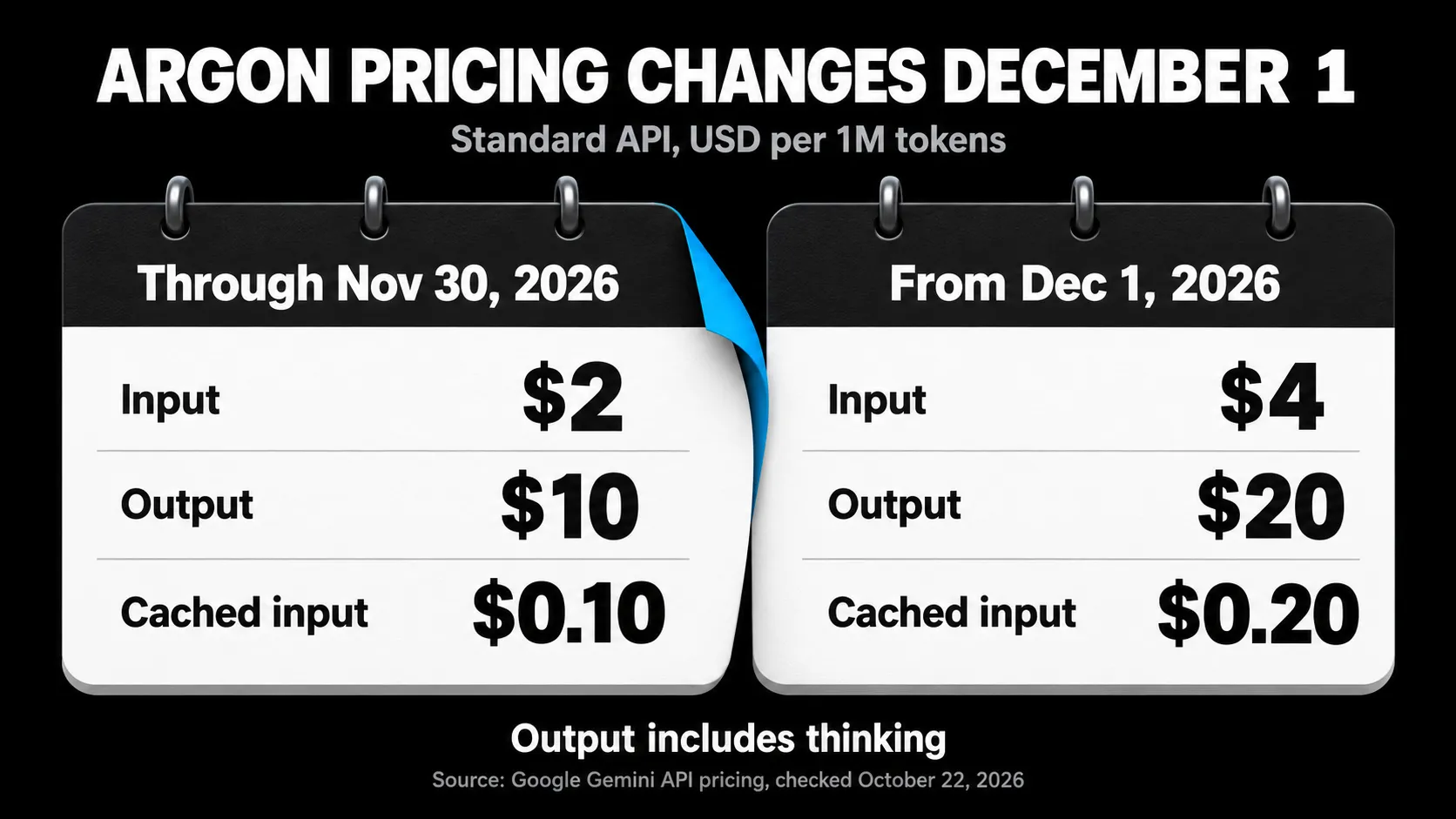
Argon’s current standard API rates are $2 per million input tokens and $10 per million output tokens through November 30, 2026. Google’s published rates rise to $4 and $20 on December 1. A buying decision made at launch should account for both price periods.
Cached input is listed at $0.10 per million tokens during the promotion, then $0.20. Output charges include thinking. Official pricing.
The $1.99 Intelligence Index task cost above reflects the current discounted rates. It is a measured cost for that benchmark workload, not a quote for my support-ticket workflow.
Long generation adds another consideration. Google’s long-decode documentation describes continuation hops that resend earlier context, creating additional input usage with caching discounts.
I would budget a pilot from its usage records and include retries. If the workflow will run into December, I would price the same recorded usage at the announced standard rates before committing to a migration.
Will Argon feel fast enough in an application?
Argon’s measured output speed is encouraging, but streaming speed alone cannot establish how quickly an application finishes a job. Reasoning before the answer, tool calls, retries and review all add time. An interactive triage step and an unattended repository change need different latency budgets.
AA’s Argon page reports roughly 81.6 output tokens per second for its High configuration. Its performance methodology uses defined prompt workloads and recent median measurements. That is narrower evidence than a promise about a user’s complete task.
There is also a settings mismatch to watch. Google’s default is Medium, while the AA Argon results used here are High. Google recommends Medium for most coding and agent tasks. I would measure Medium separately.
The output allowance covers thinking as well as visible text. A small allowance can run out before a usable answer appears. Thinking-budget guidance. Copying an old integration’s token limit could therefore undermine a comparison before the model reaches the task.
Which model would I choose for a paid workflow?
I would trial Argon on evidence-heavy multimodal work and bounded SaaS automation, compare Claude on demanding coding and analytical deliverables, and retain Sol as a cost-conscious candidate for repeatable tasks. The deciding result would be accepted work within the budget I can operate.
For ticket triage, my kit requires valid JSON and routing decisions that match a written policy. I would connect real adapters, freeze those checks and record rejected outputs alongside successful ones. Review time belongs beside the API bill.
For a repository task, I would compare the actual Antigravity, Claude Code or Codex setups I intend to use. Changing all three environments makes it a system comparison.
The broader frontier-model comparison explains that distinction; the Sol versus Astra guide covers the cheaper-model escalation decision.
Argon would earn a larger role if repeated runs reduced delivery effort after correcting failures and applying December’s pricing. Start with one recurring job and make that result inspectable.
Frequently asked questions
Is Gemini 4 Argon generally available?
Google announced broad availability on October 13, 2026, following restricted access in September. The stable Gemini API identifier is gemini-4-argon. Availability through the Gemini app, Antigravity and enterprise channels follows their respective access arrangements. Google’s release announcement.
Is Argon better than Claude for coding?
The measured Claude Code Sonnet 5.5 and Opus 5.5 configurations score above Antigravity with Argon High on AA’s Coding Agent Index v1.5. Argon’s measured API cost and active runtime are lower. That supports a tradeoff between tested systems, rather than a universal coding winner.
Does a lower hallucination rate mean more accurate answers?
Accuracy and conditional hallucination rate can move differently. On AA-Omniscience, Argon has 49.9% accuracy and a 15.1% conditional hallucination rate. The latter counts incorrect responses against non-correct responses, including abstentions. It is not a production error rate. Check both correctness and abstention behavior. Metric definitions.
Can I use High benchmark results to predict Medium performance?
The examined AA model and agent results identify Argon High. Google’s default Medium is a different configuration. Those measurements establish no Medium score or latency guarantee. Run the supported setting you intend to deploy and preserve its output limits, tools and timeout policy.
Is Argon the cheapest alternative to GPT-6?
In the published snapshots above, GPT-6.1 Sol Max costs less per Intelligence Index task and per coding-agent task than Argon High. Argon’s promotion also ends on November 30. Compare the model’s accepted-result rate, full usage and review effort before choosing it on price.
Newsletter
New notes, in your inbox.
Get each new article from the workbench by email. No spam, unsubscribe anytime.
Related reading
Continue through the system.
-
Genie 4 world model: a playable world from a sentence, two minutes at a time
The Genie 4 world model turns a prompt into a playable, steerable world for about two minutes. What it means for games, robotics and agents.
Read article → -
Meta Muse Wonder and Wonder Full: the comeback test
Meta Muse Wonder and Wonder Full bring stronger agent models. Compare access, memory, benchmarks, pricing, and the workflow test I would run.
Read article → -
Sprinting the Frontier: Reviewing and Comparing Opus 5.5, Sonnet 5.5, GPT-6.1 Sol, and GPT-6 Astra
Compare Opus 5.5, Sonnet 5.5, GPT-6.1 Sol, and GPT-6 Astra on real work, pricing, benchmark limits, and cost per accepted result.
Read article →