Genie 4 world model: a playable world from a sentence, two minutes at a time
The Genie 4 world model turns a prompt into a playable, steerable world for about two minutes. What it means for games, robotics and agents.

By Aleem Ul Hassan. Last updated November 2, 2026.
My first read of the Genie 4 demos was the same one most of my feed had: someone just typed a sentence and got a playable world, so game engines have a problem. Then I read what Google DeepMind actually published, and the more useful story turned out to be smaller and more practical.
Here is the short answer. The Genie 4 world model, announced on October 27, 2026, generates photorealistic scenes you can walk through in real time, steered with a keyboard and with typed prompts mid-simulation. It adds native audio, and Gemini 3.8 Flash acts as a director that plans steps and checks frames. Worlds stay consistent for up to about two minutes, according to TechCrunch’s launch report. It is a research preview for trusted testers only.
My take: Genie 4 is a drafting and practice tool, not a game engine. I would change my mind if a later version kept state for hours and exposed it to developers.
What is Genie 4, and what actually changed?
Genie 4 is Google DeepMind’s newest world model: an AI system that simulates an environment frame by frame and reacts to your actions, instead of playing back a fixed video. DeepMind’s Genie 4 announcement lists four headline changes: more realistic worlds, natural-language steering while the world runs, native audio, and tighter Gemini integration.
The audio is the part the clips undersell. Wind, waves and music match the scene, and characters hold dialogue that adapts to what you do. DeepMind calls it its first real-time world model to generate audio natively.
The lineage shows how fast the memory horizon is moving:
| Version | Released | Published specs | Memory or consistency |
|---|---|---|---|
| Genie 2 | December 2024 | 360p, 2D and 3D worlds | 10 to 20 seconds |
| Genie 3 | August 2025 | 720p, 24 fps, real-time | A few minutes, about one minute of visual memory |
| Genie 4 | October 2026 | Resolution and frame rate not stated | Up to about two minutes (TechCrunch) |
The Genie 3 figures come from DeepMind’s Genie 3 post, and the Genie 2 figures from the Wikipedia summary of the Genie models. Notice the empty cell. DeepMind did not publish resolution or frame rate for Genie 4, so any number you see quoted for those is not from the primary source.
How does a playable world from a sentence work?
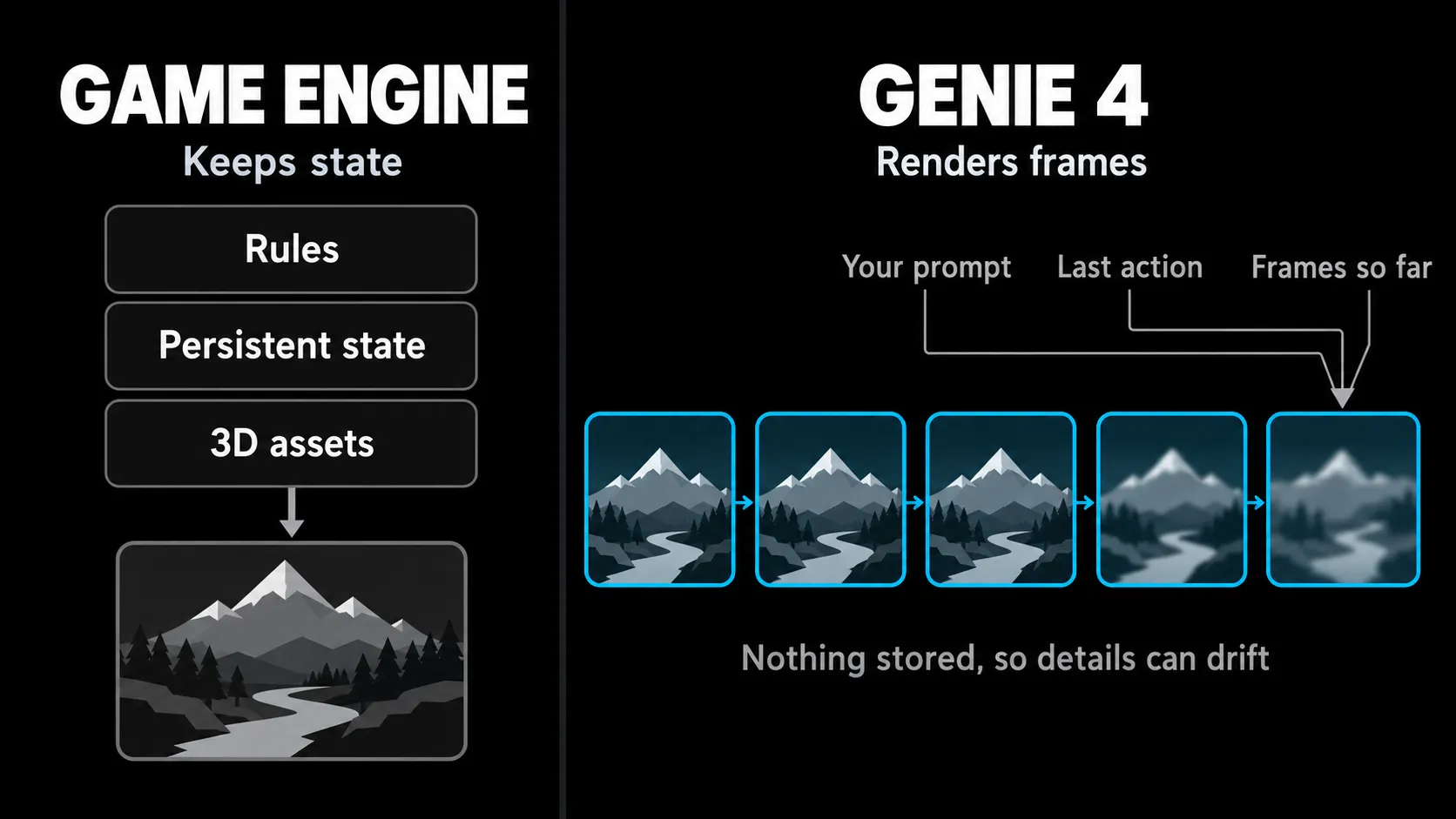
Genie generates the world one frame at a time. Each frame depends on your prompt, your last action and everything rendered so far. There is no 3D mesh, no level file and no physics engine underneath. Genie 3’s post describes consistency as an emergent capability rather than something stored in an explicit 3D representation.
That design explains both the magic and the drift. You can ask for rain or a crowd and the model just renders it. But nothing is stored, so an object you walked past can quietly change when you come back.
Genie 4’s answer to drift is a manager. Gemini 3.8 Flash watches the scene, breaks your goal into steps, checks frames and adjusts when you intervene. It is the pattern I described in the loop-based work behind Gemini 3.8: one model generates, another evaluates. DeepMind calls the destination “hybrid world models”, Gemini planning structure while Genie renders reality. That admits pixels alone do not hold a plan.
Will Genie 4 replace game engines?
No, not in any version DeepMind has described. A game is a set of rules and a persistent state: inventory, scores, saved positions, what happens when two players touch the same object. Genie 4 renders what that state might look like, but it does not hand you the state. Two minutes of coherence is also a demo length, not a session length.
Markets reacted anyway. Bloomberg’s coverage of the launch was headlined as an upgrade to the world model that rattled video game stocks, referring to share-price drops after Project Genie opened to subscribers in January 2026. I think that reaction prices the demo, not the product.
What DeepMind actually pitches for games is narrower: prototyping concepts and testing visual styles before anyone writes engine code. That is a real job. A designer who can walk through five moods of a level in an afternoon picks better.
When I looked at AI game modding between Minecraft and GTA V, the hard parts were collision, depth and state staying aligned. A frame generator guarantees none of those. Engines would be threatened by persistent, editable world state, not by better pictures.
Why do robotics and AI agent teams care most?
Because the bottleneck in training agents is practice, not ideas. A robot or a software agent needs thousands of varied situations to learn from, and collecting them in the real world is slow, expensive and sometimes dangerous. A world model can generate a warehouse, a kitchen or a flooded street on demand.
DeepMind has been building toward this for a while. With Genie 3 it generated worlds for its SIMA agent, which sent navigation actions while Genie simulated the results without knowing the goal. With Genie 4 it showed an experiment with Gemini Robotics in which a Gemini 4 Argon model split a task into steps that Genie 4 simulated in real time, plus an Apptronik Apollo humanoid playing checkers. I covered how Gemini 4 Argon behaves on real work separately, and its role here is planner, not renderer.
Can you trust what an agent learns in a generated world?
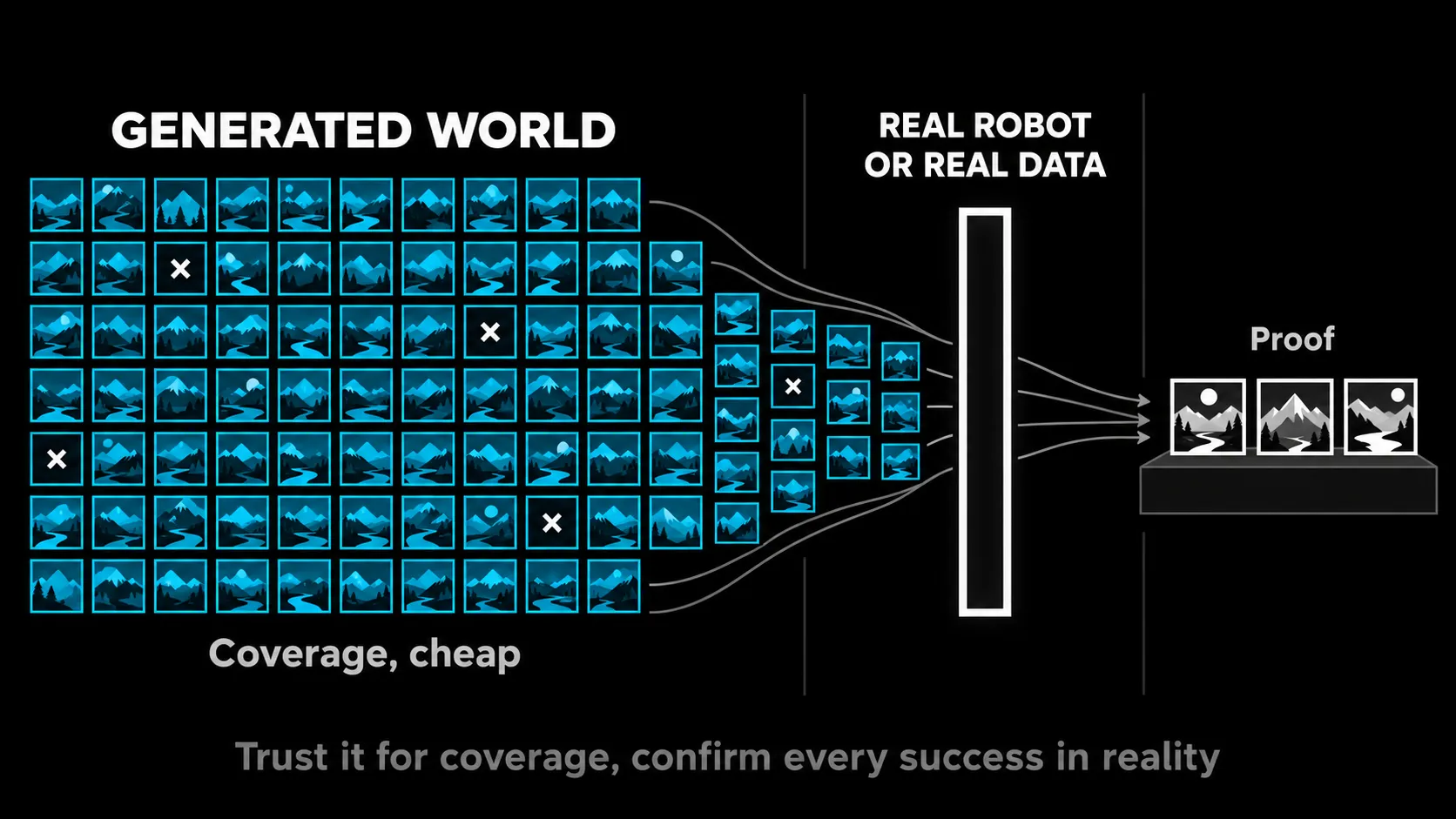
Only partly, and the gap is the whole risk. This is where my own work connects. When I build agent workflows, the expensive part is rarely the model call. It is building a test environment that fails the way production fails. A clean sandbox makes an agent look reliable, then the first real edge case breaks it. A generated world has the same trap at a larger scale: if the physics are slightly wrong, an agent can learn a skill that only works inside the simulation. The New Stack’s headline put it plainly: the physics still aren’t quite right.
So my rule for world-model training is the one I use for any test harness: trust the generated environment for coverage, never for proof. Use it to find failures cheaply, then confirm every success on a real robot or real data.
What are Genie 4’s limits right now?
DeepMind lists them itself, which I respect. Coherence holds over short sessions, but visual details and object permanence can drift over longer runs, after several prompt edits, or while you navigate. Complex physical interactions, real-time audio accuracy, legible text, spatial accuracy and long-term consistency are all named as open research problems. The post calls the whole thing “an early, evolving area of research.”
Access is the other limit. Genie 4 is a research preview for trusted testers. DeepMind says it is coming soon to Google AI Ultra subscribers in Project Genie and to early access partners in the Gemini API and Google AI Studio. TechCrunch reported “in the coming weeks.” There is a waitlist and no date. For reference, Genie 3 in Project Genie capped exploration at 60 seconds because the model is computationally expensive to run, so expect usage limits here too.
Every generated video and audio track carries SynthID watermarking, and the rollout is staged. That matters for anyone thinking about journalism or education uses, where synthetic footage of a historical event can easily be mistaken for the real thing.
What should builders do with Genie 4 today?
Plan, do not build. There is no public API yet, so anything you promise a client on top of Genie 4 depends on a date nobody has given. Here is how I would sort the use cases:
- Worth testing as soon as access opens. Previsualization and storyboarding, where a two-minute draft is the whole deliverable. DeepMind’s testers name this, and TechCrunch quotes DeepMind’s Diego Rivas saying the real-time aspect is most valuable there.
- Worth a small pilot. Game and experience concept prototyping, judged on whether it shortens the decision about which concept to build, not on whether the output ships.
- Worth watching, not betting on. Agent and robot training. The direction is clear, but no published evaluation yet shows agents trained in Genie 4 doing better in the real world.
What I would not do is pitch a “game from a sentence” product, or build any workflow where a generated world is the final source of truth. The drift is documented, and a demo that holds for two minutes will not hold for a paying user’s hour.
Who else is building world models?
Google is not alone, and the field is consolidating fast. TechCrunch’s report notes that Runway shipped GWM Worlds 2, a playable model with audio, a couple of months before Genie 4. World Labs, Fei-Fei Li’s company, is being acquired by AMD. Amazon is reportedly in talks to buy Decart, and Rivian acquired Third Dimension to bring self-driving simulation in-house.
The buyers tell you where the value is expected to land: chips, cloud and cars, not just entertainment. Simulation is becoming infrastructure for training physical systems, and the gaming demos are the shop window.
What does Genie 4 say about where AI is heading?
Every jump in generative media follows the same arc. The demo makes the finished product look one step away, and the real gain lands earlier in the pipeline, in drafting, testing and practice. Genie 4 fits that arc exactly. A world from a sentence is a remarkable draft. It is not yet a world you can rely on.
If you build with AI, the move this week is simple: write down the one task in your work where a cheap, disposable simulation would save you real time, and be ready to test that single task when access opens. If you want a method for judging it fairly, start with how I test AI models before trusting any demo.
Frequently asked questions about Genie 4
What is Genie 4?
Genie 4 is Google DeepMind’s world model for real-time interactive simulation, announced October 27, 2026. It generates photorealistic, explorable worlds from text and image prompts, lets you steer them with keyboard controls and typed prompts, and is DeepMind’s first real-time world model that generates audio natively.
Can I use Genie 4 right now?
Only if you are a trusted tester. DeepMind says Genie 4 is coming soon to Google AI Ultra subscribers in Project Genie and to early access partners of the Gemini API and Google AI Studio. A Project Genie waitlist is open, but no release date has been given.
How long does a Genie 4 world stay consistent?
TechCrunch reports up to two minutes, double Genie 3. DeepMind’s own post does not give a number and says visual details and object permanence can drift over longer runs, after multiple prompt edits, or during navigation.
Will Genie 4 replace game engines like Unity or Unreal?
Not on the evidence published so far. Genie 4 renders frames rather than keeping explicit game state, rules or 3D assets, and its worlds drift after minutes. DeepMind positions it for prototyping concepts and testing visual styles before engine coding, which is a different job.
Why does Genie 4 matter for robotics?
Robots and agents need many varied practice scenarios, and real-world data is expensive to collect. DeepMind showed Genie 4 working with Gemini Robotics and an Apptronik Apollo humanoid. The open question is how well skills learned in a generated world transfer to real physics.
Newsletter
New notes, in your inbox.
Get each new article from the workbench by email. No spam, unsubscribe anytime.
Related reading
Continue through the system.
-
Gemini 4 Argon in real work: where Claude and GPT-6 still win
Gemini 4 Argon real-world performance vs Claude and GPT-6: coding results, agent costs, latency, long context and the launch-pricing catch.
Read article → -
How to test AI models on your own tasks
Test AI models on your real tasks with a repeatable harness, clear acceptance gates, and a scoring sheet for quality, cost, and review time.
Read article → -
Meta Muse Wonder and Wonder Full: the comeback test
Meta Muse Wonder and Wonder Full bring stronger agent models. Compare access, memory, benchmarks, pricing, and the workflow test I would run.
Read article →