Meta Muse Wonder and Wonder Full: the comeback test
Meta Muse Wonder and Wonder Full bring stronger agent models. Compare access, memory, benchmarks, pricing, and the workflow test I would run.

I built a 19-document marketing system to carry decisions from intake into the work that ships.
Meta Muse Wonder and Wonder Full put Meta back on the frontier shortlist, with independent results showing a clear gain over Muse Spark 1.3. Standard Wonder is available through an API; Full requires an eligible Muse Code subscription. I would run a controlled workflow trial before changing the model behind production work.
Meta announced both models on October 12. The question I care about is whether their memory and sustained-work capabilities can reduce the effort of keeping a real project coherent. Meta’s announcement.
Is Meta really back at the frontier?
There is independent evidence for taking the release seriously. Artificial Analysis measured Muse Wonder at 52 and Wonder Full at 56 on its Intelligence Index v4.3, both at max reasoning effort. Its October 12 analysis compares those with 48 for Muse Spark 1.3 at max. Independent evaluation.
That supports putting Meta back into a model comparison. It does not settle which system will handle a particular client’s work best.
Meta’s model card also makes the comparison conditions worth reading. Some coding evaluations use a shared harness; externally reported results retain their original setups. The SWE-Marathon row mixes agent products and is explicitly not a controlled common-harness comparison. Evaluation methodology.
My interpretation: the comeback is credible enough to earn a trial. A benchmark lead still needs to survive the tools, inputs, and review process surrounding my actual work.
How do Muse Wonder and Wonder Full differ?
Muse Wonder is the API-accessible model. Wonder Full is a separate, higher-capability variant available through qualifying Muse Code subscriptions. Increasing Wonder’s reasoning effort to max does not turn it into Full. That distinction matters when comparing a headline benchmark with the model your application can call. Meta’s model catalogue.
| Question | Muse Wonder | Muse Wonder Full |
|---|---|---|
| Direct Model API access | Available as muse-wonder-1.0 | Not available |
| Muse Code access | Pay-as-you-go and subscription plans | Power Usage and Maximum Usage plans |
| Context window | 1M tokens | 1M tokens |
| Inputs / output | Text, image, audio and video / text | Text, image, audio and video / text |
The context and modality specifications come from Meta’s model card. This is multimodal understanding with text output, so I would keep image-generation needs separate when designing a workflow.
For an existing application, I would begin by evaluating the route I can integrate and operate.
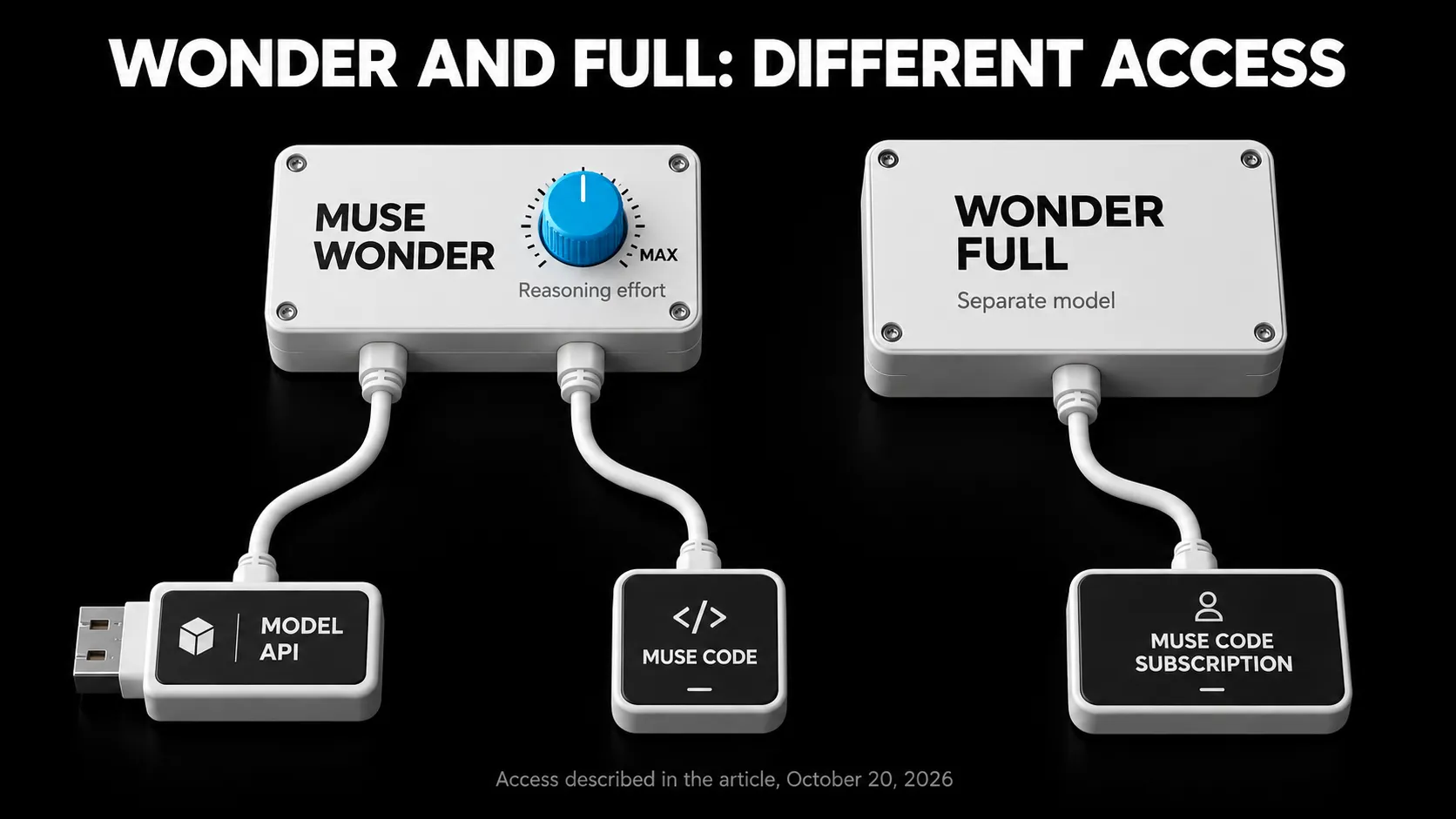
Concept illustration of the access routes described above, checked October 20, 2026.
Will Active Memory fix the context problem?
Meta describes Active Memory as carrying important information across conversations and retrieving relevant details when they matter. That is a useful capability to investigate. For my work, success would mean applying the current client decision in the next deliverable, including when an older instruction conflicts with a newer one. Meta’s research explanation.
I have seen a brand document specify a restrained voice while an SEO plan pursues unrelated keywords and a writer receives neither input. Each artifact can look competent. Their decisions fail to travel together.
My 19-document marketing system addresses that with explicit dependencies: the next stage reads the relevant upstream files.
A model with better memory could make those handoffs easier. I would still keep an authoritative source for positioning, evidence, and approved changes. If a client changes the offer, the system needs to know which decision replaced the old one.
Remembering both versions is only the beginning of that job.
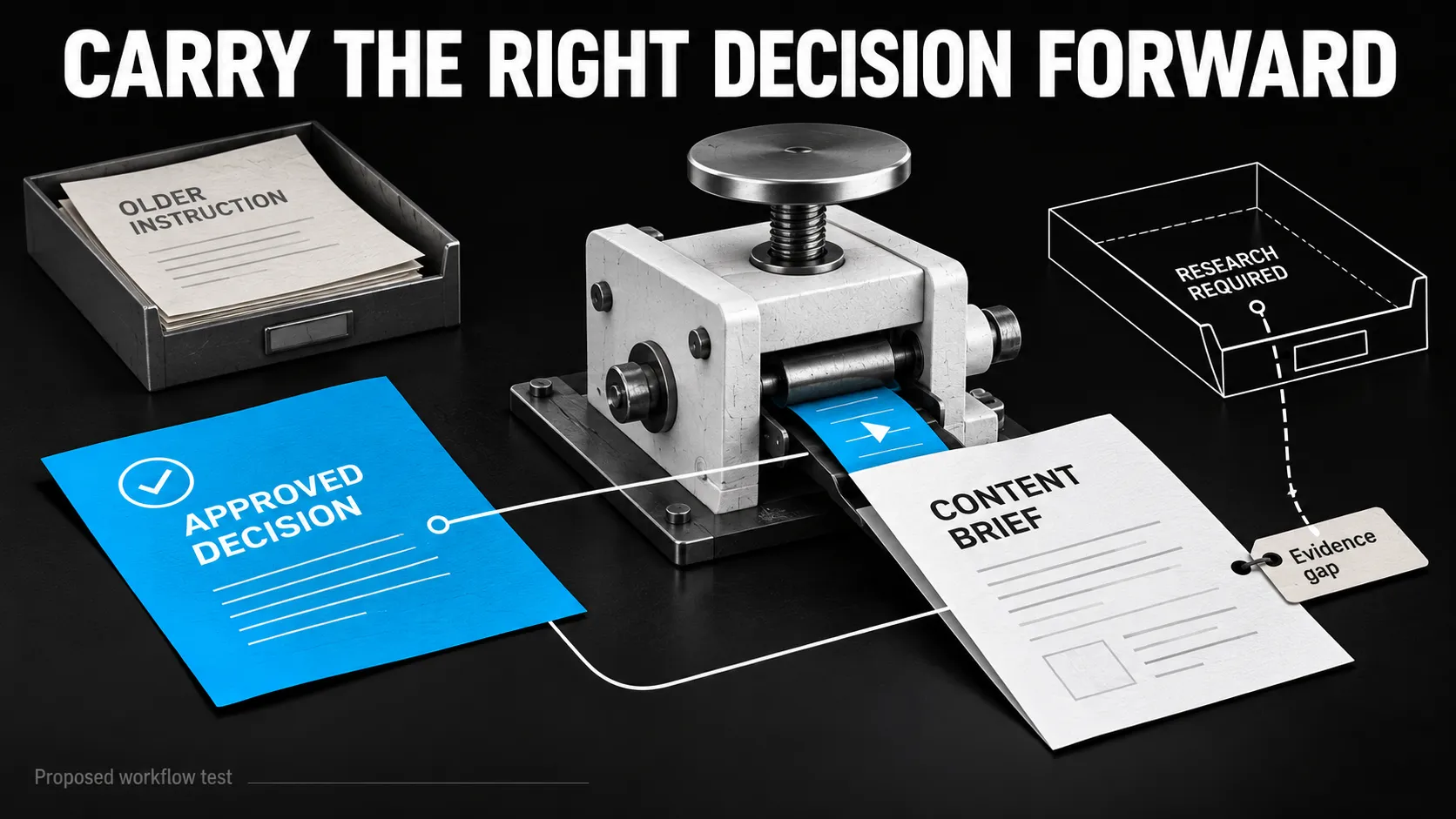
Proposed workflow test: carry the approved decision forward and keep missing evidence visible.
Does Active Focus make longer runs useful?
Active Focus is Meta’s term for sustained work toward a difficult goal: trying alternatives, recovering from blockers, and adapting to new information. Meta evaluates it with FocusBench and examines longer software work through SWE-Marathon. Those are capability signals; I would judge a run by the useful artifact it leaves behind. Active Focus description.
In my marketing chain, missing research must remain visible. The brand manual refuses to assemble without its required inputs. Content work flags a missing voice source.
A persistent agent should preserve those boundaries. If the persona evidence is missing, generating a convincing substitute would push uncertainty into every later document.
My always-on agent pilot criteria apply here too: accepted outputs, correction time, and the work left for a human.
I would welcome an agent that resolves a recoverable tool failure. I would also expect it to report when further progress requires a decision or unavailable evidence.
What does Muse Wonder cost to try?
As checked on October 20, Meta Model API lists standard Wonder at $4 per million input tokens, $20 per million output tokens, and $0.20 per million cached-input tokens. Web search grounding has a separate charge. These are usage rates, not a prediction of the cost of completing a task. Current API pricing.
For a pilot, I would record billed usage alongside retries, elapsed time, and correction time. A cheaper response can become expensive if I must reconstruct the research behind it.
The data mode also affects the choice. Meta says Standard mode content is not used to train its models. Muse Code subscriptions default to Contributor mode, which permits training use and can be disabled in settings. Wonder has no Contributor mode on the pay-as-you-go API. Mode and availability details.
That is a concrete setup choice to resolve before putting client work through a trial.
How would I test it on real work?
I would test one handoff from the marketing system, using the same inputs and acceptance criteria as the current workflow. The task would require the candidate to carry a changed decision into a downstream draft, identify the evidence it used, and leave missing information unresolved. This is a proposed test.
I would use three cases:
- Change an approved positioning decision, then check whether the content brief reflects the new version.
- Supply an older, conflicting voice instruction and check which source the model follows.
- Omit a required research input and check whether the model names the gap.
I would assess the saved deliverable against the source documents, then record corrections, completion time, and cost. The result needs enough traceability that reviewing it does not require rebuilding it.
I use the same principle in my frontier-model comparison: choose the model against the work you need accepted.
Should founders switch after this release?
My recommendation is to add Meta Muse Wonder to the shortlist and run a narrow comparison. Wonder Full merits a separate evaluation if its Muse Code access fits the work. I would change a production workflow after repeated accepted results show that the new setup reduces the total effort of delivery.
That call could change quickly if the trial shows reliable context updates, useful recovery, and lower correction time. I do not need Meta to win every benchmark. I need the chosen system to carry the right decisions through my work.
The useful consequence of Meta’s return is another credible option. Its value becomes concrete when a handoff improves.
Start with one that currently needs your attention. Give the candidate the sources, the changed decision, and the required output. Judge what survives into the final artifact.
Frequently asked questions
Is Muse Wonder Full the same as Muse Wonder at max reasoning?
No. Meta documents Wonder Full as a separate, higher-capability variant. Setting Muse Wonder’s reasoning effort to max does not select Full. Full is available through eligible Muse Code subscriptions, while the standard Wonder model is available through Meta Model API. Variant documentation.
Can I use Muse Wonder Full through an API?
As of October 20, 2026, Meta lists Muse Wonder Full as unavailable on Model API. Its documented access route is Muse Code on the Power Usage and Maximum Usage subscription plans. Standard Muse Wonder is available through the API as muse-wonder-1.0. Current availability.
Are Muse Wonder and Wonder Full open-weight models?
The Wonder family is proprietary; do not assume Meta’s open-weight releases include it. Meta separately documents Muse Spark Open and Muse Glimmer as open-weight options. Check the model family and its license before planning a local deployment. Wonder Full specifications, Meta’s model families.
Have you tested Muse Wonder on your own production workflows?
No. The workflow described here is the trial I would run, based on the 19-document marketing system I built. Benchmark results come from their named evaluators. A production recommendation would require comparing accepted outputs, correction time, task duration, and cost.
Newsletter
New notes, in your inbox.
Get each new article from the workbench by email. No spam, unsubscribe anytime.
Related reading
Continue through the system.
-
Sprinting the Frontier: Reviewing and Comparing Opus 5.5, Sonnet 5.5, GPT-6.1 Sol, and GPT-6 Astra
Compare Opus 5.5, Sonnet 5.5, GPT-6.1 Sol, and GPT-6 Astra on real work, pricing, benchmark limits, and cost per accepted result.
Read article → -
Personal AI agents compared: Claude Duet, Dots, Muse and Grok Bot
Personal AI agents now share one design. Compare Claude Duet, OpenAI Dots, Meta Muse and Grok Bot by approval rules, memory and privacy, not by the model.
Read article → -
Gemini 4 Argon in real work: where Claude and GPT-6 still win
Gemini 4 Argon real-world performance vs Claude and GPT-6: coding results, agent costs, latency, long context and the launch-pricing catch.
Read article →