AI Automation7 min read
OpenAI's 722 math papers: what survives the checks?
OpenAI's math release began with 722 papers. See what changed, what Lean verifies, and why checking matters more than counting AI-generated results.
[ Key takeaways ]
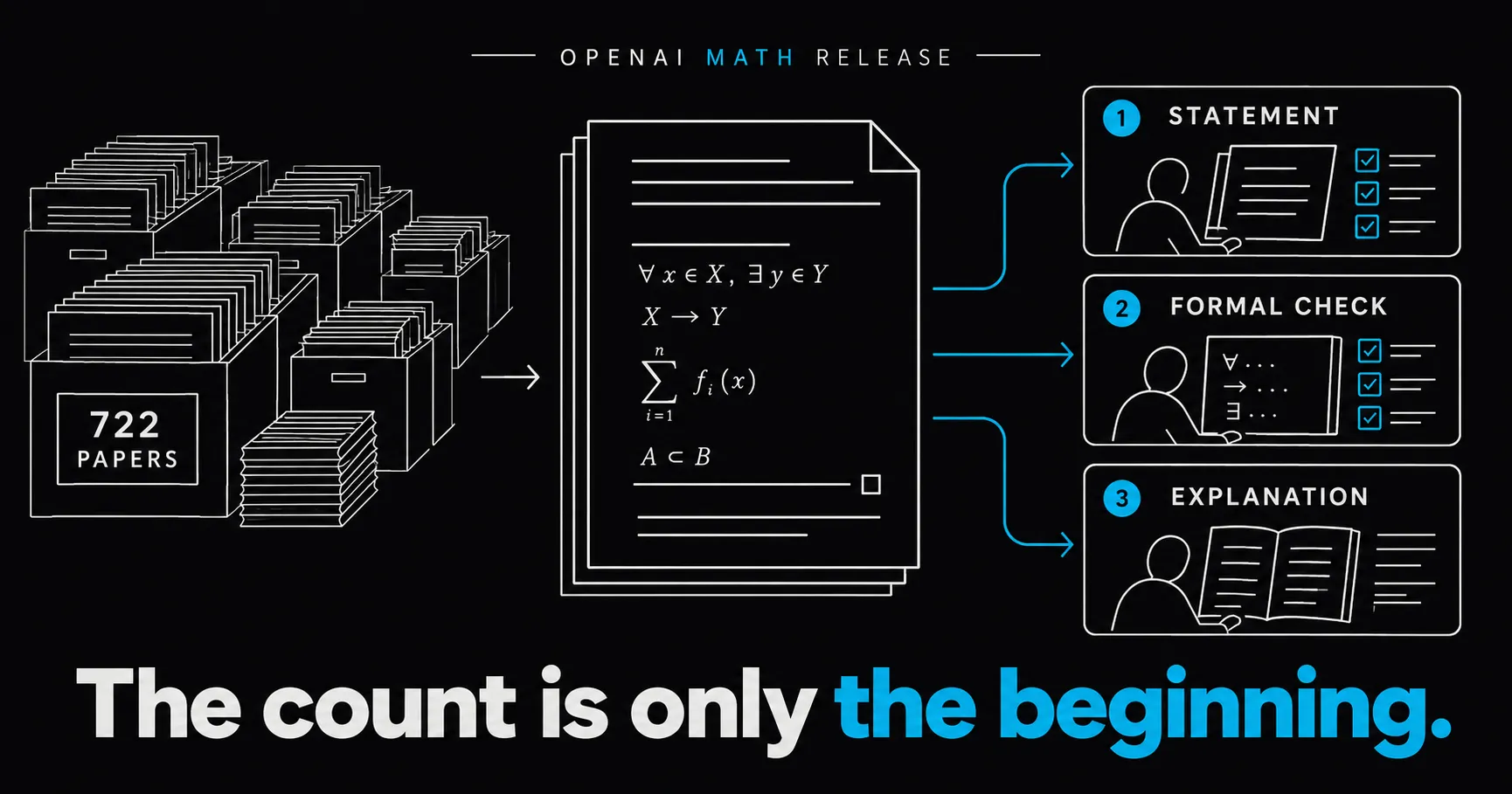
- The initial release grouped 722 manuscripts into 372 families; the current catalogue lists 719 manuscripts after withdrawals.
- Formal checks establish precise statements under stated assumptions. Check whether they cover a paper’s main theorem or supporting results.
- Corrections can affect dependent papers. Read the revision history alongside the result.
- Give verification, explanation, and independent review enough capacity to keep up with generation.
In my lead-routing build, two email addresses could hide one person.
The OpenAI math release published 722 mathematical manuscripts across 372 related result families on October 6. Its current catalogue lists 719 after withdrawals. The collection contains work at different stages of verification, so the paper count needs to travel with its qualifications. Original catalogue, current catalogue.
My view: this is a consequential research release. Its lasting value will come from the mathematics people can check, understand, and build on. I have not independently verified these proofs. I build automation systems, and that work has made me careful about the gap between an output and the claim attached to it.
What did OpenAI actually release?
OpenAI released manuscripts and supporting proof artifacts from an unreleased internal model. A family can contain a main result, companion arguments, consequences, or alternative proofs. That makes 372 families a useful organizing count, but neither count establishes how many independently accepted breakthroughs the collection contains. Repository documentation.
The numbers also need dates:
| Measure | What the source reports |
|---|---|
| Initial release, October 6 | 722 manuscripts, 372 families |
| Catalogue checked October 11 | 719 manuscripts, 372 families |
| Formalization update recorded under October 7 | 300 of 719 top-line results, approximately 42% |
| Problems posed during the evaluation | Approximately 4,000 |
Sources: initial README, current README, revision history.
I would resist turning that table into a success rate. Attempted problems, result families, and manuscripts are different units. Selection and significance filtering also sit between an attempt and a released paper. Dividing one headline number by another would conceal those differences.
Why did the count fall from 722 to 719?
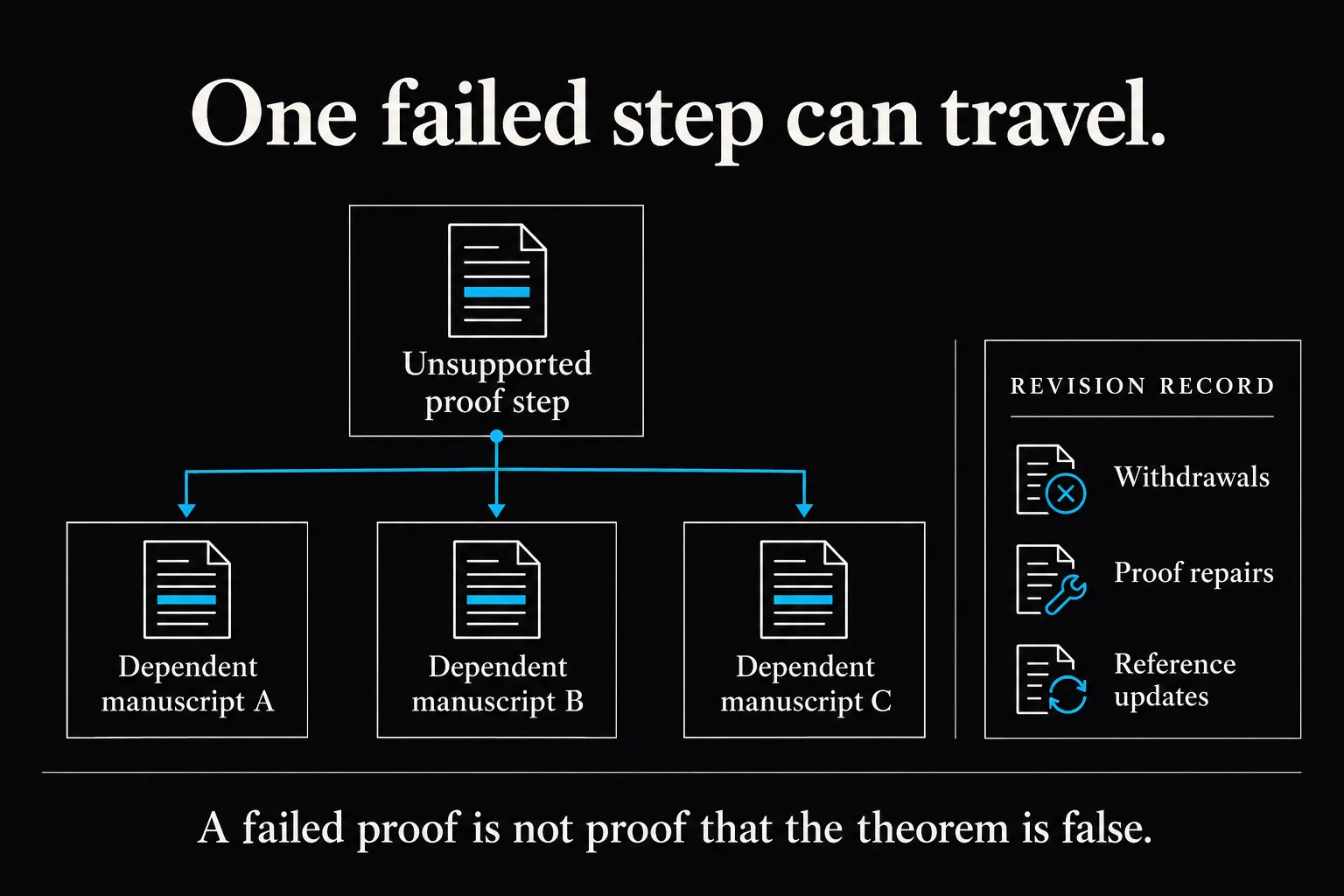
OpenAI’s revision history records three withdrawals linked to a sign error in one argument. It also records proof repairs and other corrections to 14 manuscripts, plus reference updates to 13 more. These are changes to a research collection that readers need to track. Release history.
The withdrawal notice for Algebraicity of Weil classes on split abelian eightfolds explains the problem. A cancellation step required a signed count of zero; the corrected calculation did not produce zero. The construction relying on that step was therefore unsupported. The notice explicitly distinguishes a failed proof from showing the theorem itself is false. Withdrawal explanation.
That dependency matters to me. One unsupported step can affect several downstream claims. Counting each output separately hides the shared point of failure. Reading the correction history reveals where confidence needs to change, and which conclusions must be reconsidered together.
What does a Lean formalization actually establish?
A formal proof can give unusually strong evidence for a precise mathematical statement. The checking setup matters. Comparator, the tool linked by this release, checks that a submitted proof matches the trusted challenge statement, stays within permitted axioms, and is accepted by the Lean kernel, under its documented assumptions. Comparator documentation.
That is a serious advantage over judging an argument by how convincing its prose sounds.
Coverage still requires care. OpenAI’s instructions identify five comparison setups that verify supporting results rather than the corresponding papers’ main theorems. A formal artifact beside a manuscript therefore needs a scope check before anyone attaches a blanket “verified” label. Supporting-result comparisons.
My question would be: which exact claim was checked, using which definitions and assumptions? A passed check earns confidence in its stated scope. The remaining work includes connecting that statement to the paper’s claim and explaining why the result is useful. Those tasks deserve their own attention.
Did the release solve the Riemann hypothesis?
The Riemann-related result in OpenAI’s overview claims a zero-free region with real part greater than 7/8, with a companion argument for greater than 11/12. The full Riemann hypothesis concerns all nontrivial zeta zeros lying on the line with real part 1/2. These are different claims. OpenAI’s result overview, Clay Mathematics Institute’s definition.
A result can be a major advance while leaving a stronger conjecture open. Reading the actual boundary is how you preserve the achievement without exaggerating it.
I see a familiar version of this problem in software: a system completes a defined task, and its description quietly expands into “handles the whole process.” The expansion can happen in a sales conversation or in your own thinking. Either way, the evidence still covers the narrower task.
For this collection, the theorem statement is the place to start. A famous problem’s name in a title gives you a subject to investigate. It does not tell you which version of the problem has been resolved.
Why are mathematicians asking for more than the papers?
The independent Advisory Group on Mathematics and Artificial Intelligence, or AGMAI, says its advisory role should not be taken as an endorsement of how OpenAI obtained the results or a judgment of their impact. It stresses that public release begins the work of human understanding and assessment. AGMAI’s October 6 statement.
Its recommendations explain the concern: clear theorem statements, attribution to prior work, recorded revisions, evidence about the research process, and support for mathematicians to understand the output. It also calls for broad, equitable access to powerful tools and recommends scholarly repositories outside AI-lab control. Responsible-release guidelines.
The group’s point about research freedom is sharper than a request for better documentation: “Mathematicians must be able to formulate their own questions.” AGMAI.
I agree. A community needs room to choose what matters and develop its own approaches. If the institution producing results also controls the strongest instrument, access becomes part of the scientific question. Understanding determines whether others can extend the work on their own terms.
What should founders and developers take from this?
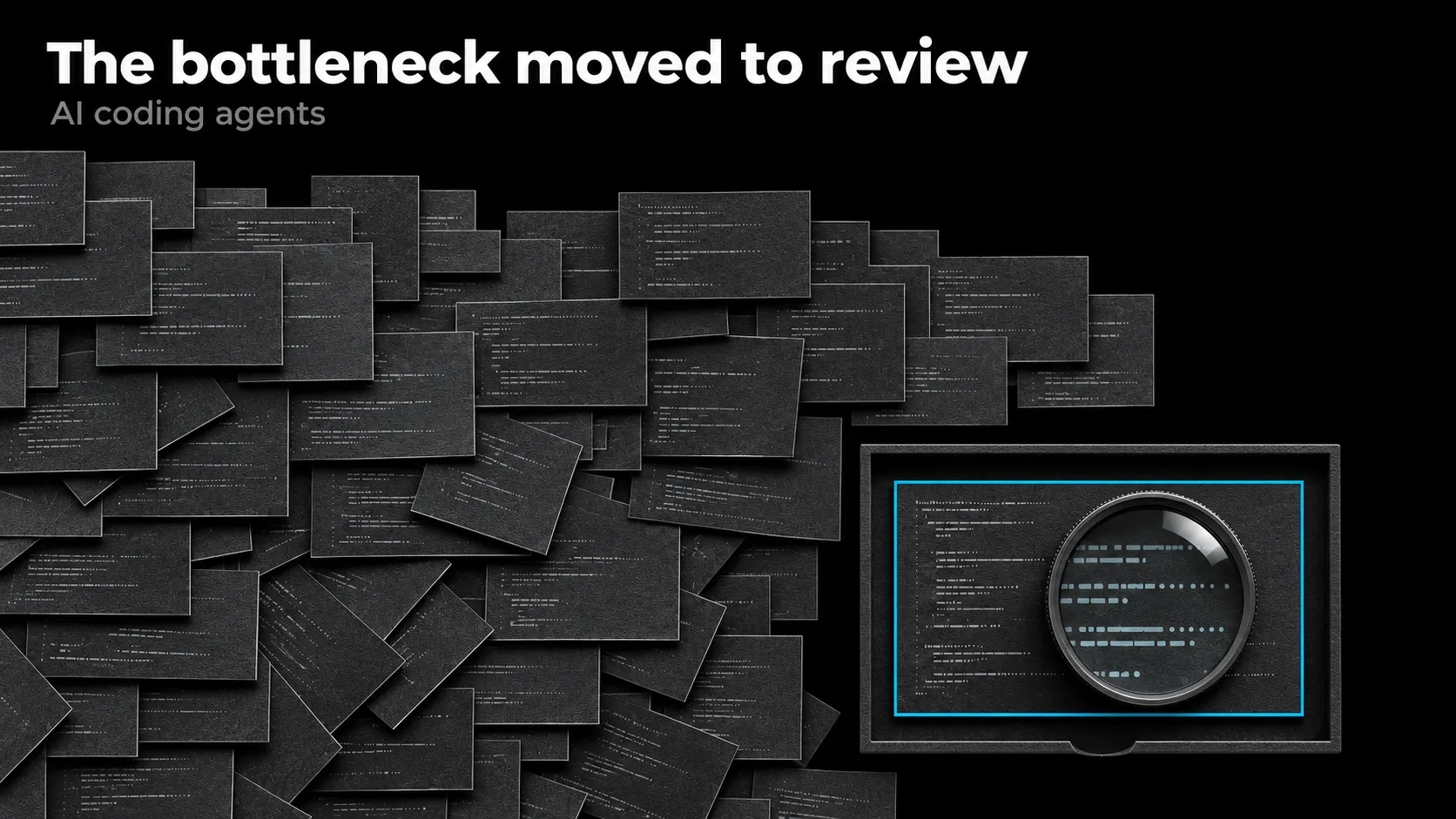
The useful engineering lesson is to give checking and interpretation enough capacity to keep up with generation. More output can save time when someone can establish what is correct, relevant, and worth using. If that work stays manual and unclear, faster generation can simply move the bottleneck to the reviewer.
When I’m the reviewer as well as the builder, every extra output competes with delivery time.
In my lead-routing build, changing the identity rule required judgment about the business data. Email equality was easy to implement. Recognizing one person across different records needed a hierarchy of signals and attention to conflicting matches. That experience made me more careful about defining identity before automating the match.
A workflow test and a mathematical proof provide different levels of assurance. The shared lesson is to define the claim before choosing the check.
For an AI-built system, I would require:
- A precise description of the behavior the output is meant to establish.
- Checks that address that behavior and expose their assumptions.
- A record of corrections, including which outputs depend on the changed part.
How would I judge whether this release delivers lasting value?
I would look for independently checked arguments, clear explanations, useful follow-on work, and accessible tools that let researchers pursue their own questions. Those signals would tell me more about the collection’s impact than the volume of its first announcement. Progress should become easier for other people to use.
OpenAI says it is releasing ten reasoning summaries, reporting compute information, planning support for workshops and related programs, and working toward releasing the model. Those are commitments and materials to assess over time. Its estimate of roughly three hours of ChatGPT Pro thinking compute per average result is not a quoted dollar cost or a promise about elapsed time. OpenAI’s announcement.
My bottleneck argument would weaken if reliable checking, explanation, and reuse accelerated alongside generation. That would be an excellent outcome. The practical question is how much of the new output becomes dependable input for somebody else’s work.
Frequently asked questions
Are the 722 papers all separate discoveries?
No. The initial release grouped 722 manuscripts into 372 families. Families can include companion papers, consequences, and alternative arguments. Manuscript count, family count, novelty, and mathematical importance are different measures. Treat the catalogue as a map to investigate, rather than a count of equally significant discoveries. Original README.
Are all the results formally verified?
No. OpenAI’s update reports 300 of 719 top-line results formalized, approximately 42%. Some supplied comparison setups cover supporting results only. Inspect the exact theorem, assumptions, and coverage for the paper you care about. A collection-wide percentage cannot establish the status of an individual result. History, comparison scope.
Can I use the model that produced the papers?
As of October 11, OpenAI describes the producing model as an unreleased internal model and says it is working toward releasing it. Public access to manuscripts and proof artifacts does not provide access to that model. Use the published materials to examine specific claims while watching for an actual model-release announcement. OpenAI.
Does this mean mathematicians are obsolete?
That conclusion goes beyond the evidence. This collection does not establish that choosing research questions, understanding arguments, teaching ideas, or assessing significance can be dispensed with. AGMAI emphasizes researchers’ freedom to pursue their own directions. My expectation is that those responsibilities become more consequential as the supply of candidate results grows. AGMAI.
Give the checks a budget
The promising future here is a growing body of mathematics that people can trust and use. Getting there takes corrections, precise statements, explanation, and independent scrutiny.
I use the same standard for always-on AI agents: useful progress has to survive inspection.
Pick one result you care about. Read its statement, verification scope, dependencies, and revision history. That is where a large release becomes something you can actually judge.
Frequently asked questions
01Are the 722 papers all separate discoveries?
No. The initial release grouped 722 manuscripts into 372 families. Families can include companion papers, consequences, and alternative arguments. Manuscript count, family count, novelty, and mathematical importance are different measures. Treat the catalogue as a map to investigate, rather than a count of equally significant discoveries.
02Are all the results formally verified?
No. OpenAI's update reports 300 of 719 top-line results formalized, approximately 42%. Some supplied comparison setups cover supporting results only. Inspect the exact theorem, assumptions, and coverage for the paper you care about. A collection-wide percentage cannot establish the status of an individual result.
03Can I use the model that produced the papers?
As of October 11, OpenAI describes the producing model as an unreleased internal model and says it is working toward releasing it. Public access to manuscripts and proof artifacts does not provide access to that model. Use the published materials to examine specific claims while watching for an actual model-release announcement.
04Does this mean mathematicians are obsolete?
That conclusion goes beyond the evidence. This collection does not establish that choosing research questions, understanding arguments, teaching ideas, or assessing significance can be dispensed with. AGMAI emphasizes researchers' freedom to pursue their own directions. My expectation is that those responsibilities become more consequential as the supply of candidate results grows.